The value of a Louisiana car accident case comes down to your medical bills, your lost income, the lasting effect of your injuries, your share of fault, and the insurance available to pay. We walk you through all five before you decide anything.
Combined experience
Trial Lost in Over 20 Years
Every search for a settlement number returns a range so wide it tells you nothing. That is because the number depends on facts nobody has gathered yet, and the adjuster calling you already knows it.
A real valuation is not a guess pulled from an average. It is built from records, wage documentation, medical opinions, and Louisiana law applied to your specific crash.
Valuing a car accident claim starts with what has already happened to you and ends with what your injury will still cost you years from now. We collect the medical records, the billing, the employment history, and the crash evidence, then work with your treating physicians to understand where your recovery is likely to plateau. Only then does a settlement figure mean anything. Melancon, Rimes & Daquanno has handled these claims in Baton Rouge since 2005.
We prepare every case for trial rather than for a quick resolution, because a claim built to withstand a jury is the same claim an insurer takes seriously in negotiation. That preparation is what separates a number the adjuster suggests from a number that reflects what you actually lost.
Louisiana Civil Code Article 2315 allows an injured person to recover the damages caused by another’s fault. In practice, that breaks into distinct categories, and a claim is only worth what has been documented across all of them.
Emergency treatment, imaging, surgery, therapy, and every bill generated from the crash forward, including amounts already paid by health insurance.
Projected cost of continuing treatment, injections, revision surgery, or long-term therapy your physicians expect you to need.
Income you did not earn while you were unable to work, documented through pay records and employer verification.
The gap between what you could earn before the crash and what you can realistically earn now, which often outweighs every other category.
Compensation for the pain caused by the injury itself, the treatment required, and any pain expected to continue.
Anxiety, depression, sleep disruption, and driving-related fear that follow a serious collision and are documented through treatment.
Activities, work, hobbies, and daily functions the injury took away, measured against how you lived before.
Permanent visible injury, which is valued separately from the medical cost of treating it.
Repair or replacement value of your vehicle, plus personal property destroyed in the collision.
Categories overlap and interact. A shoulder injury that ends a career is worth far more in lost earning capacity than in medical bills, and that distinction is easy to miss without someone building the file.
We are a locally owned firm serving the greater Baton Rouge area, and much of our work comes from former clients and other attorneys who send us cases. That only continues if the results hold up.
Each of our partners directly manages the cases they take from the first call through resolution. You are not passed to a junior associate after signing.
We prepare each case for full litigation and never assume it will settle, which changes what an insurer is willing to put on the table.
Car accident cases are the core of our practice, so we know how these claims are valued, disputed, and defended in this area.
Court filing fees, expert witnesses, accident reconstruction, and medical records are advanced by our firm, not billed to you along the way.
Knowing the sequence removes most of the uncertainty about what comes next. Here is how a car accident claim moves through our office, from the day you call us to the day it resolves.
You are kept informed at every stage, and no settlement is ever accepted without your approval. The decision to settle or go to trial is always yours to make, not ours.

We listen to your account of the crash, document the details, ask the questions that matter to valuation, and explain your options.

We gather the crash report, photographs, witness statements, and vehicle data, and retain experts where the fault picture is contested.

We track your treatment and gather records and physician opinions until your doctors can speak to your long-term prognosis.
We assemble the full damages picture into a demand and negotiate directly with the insurer for the maximum available recovery.
If the offer does not reflect what you lost, we file suit and try the case. Read about our prior successful cases.
Your claim is supported by records, bills, wage evidence, and medical opinion rather than an adjuster's internal formula.
You communicate with the attorney working your file, including by phone and text, without going through a call screen.
We handle insurer contact so you are not negotiating against a professional adjuster while you are still in treatment.
There is nothing to pay upfront and nothing owed unless we recover money for you.
Past results depend entirely on the facts of each individual case, but they show how a fully prepared file tends to perform when an insurance company disputes who caused the crash or how serious the injuries really were.
Prior results do not guarantee or predict a similar outcome in any future case. Every claim turns on its own facts and evidence.
Your first consultation is free and carries no obligation. We will review the crash, your injuries, and your insurance situation, give you an honest read on whether the claim is worth pursuing, and tell you what we think it will take. You are free to walk out and do nothing with that information.
Car accident cases are handled on contingency. You pay nothing upfront and nothing out of pocket while the case is pending. Our fee is one third of the recovery if the case resolves without a lawsuit, and 40% if a lawsuit is filed. We advance the case expenses, and our general practice is to structure the resolution so the client takes home more than the firm does.
"Great experience. They were very professional and were there whenever I called or needed them. My settlement was well worth the wait. I recommend them to anyone needing legal services. They will fight for you and get you what you deserve for your injuries. I didn't just gain good legal representation I also gained friends and a law firm that cared."
"I couldn't be more pleased with choosing Jason and all of the associates at Melancon & Rimes. I was told by several people throughout the duration of my litigation that I was in good hands with one of the best attorneys in Louisiana, and the results did not disappoint. A very efficient group that worked diligently to win my case and keep me well informed along the way."
"I was referred to Melancon Rimes by a friend and I am beyond pleased with the outstanding professionalism and astounding work ethic that Lee Daquanno and his staff put into my case. Lee was prompt and kept me informed at every step. I would recommend him to anyone seeking legal help."
Clients consistently point to the same two things: being kept informed throughout, and a result that justified the time the case took.
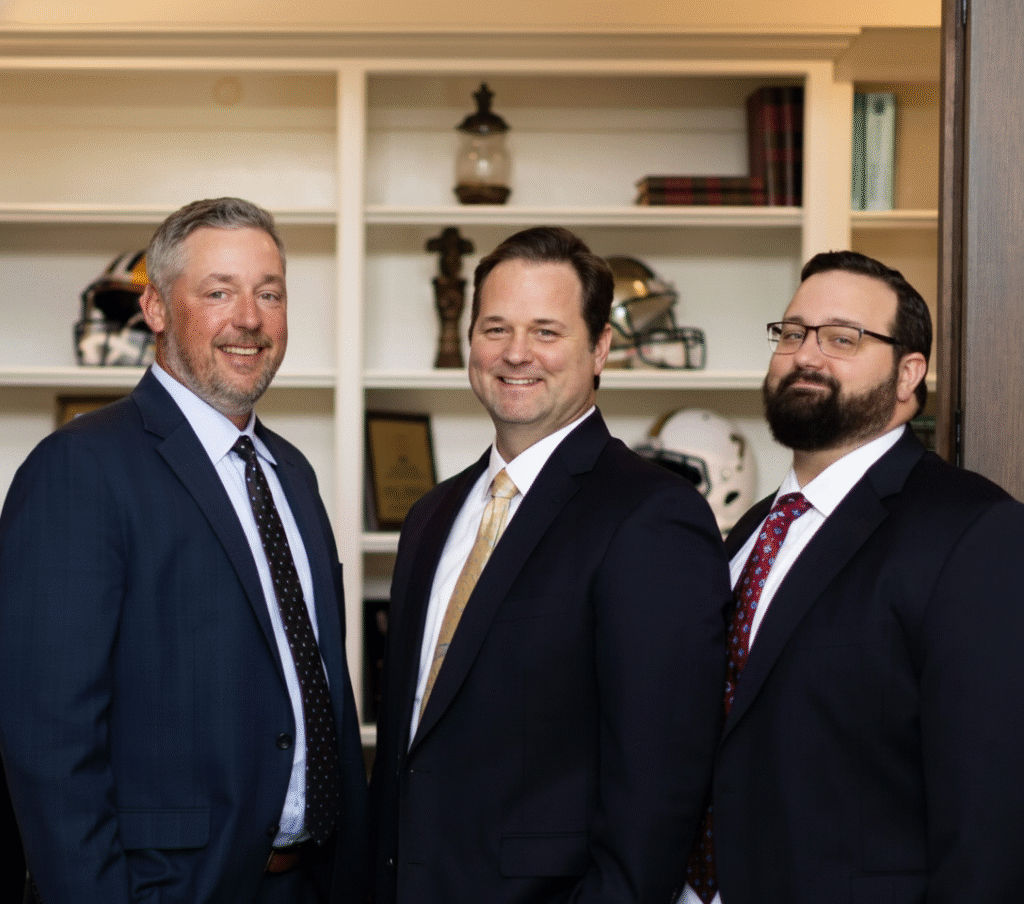
Our three partners bring more than 50 years of combined experience to the cases they take. Jason L. Melancon leads our litigation work and earned his law degree from LSU, where he served as a Senior Associate with the Louisiana Law Review. Robert C. Rimes leads the personal injury section and holds his law degree from Loyola University School of Law in New Orleans. R. Lee Daquanno, Jr. graduated magna cum laude from Southern University Law Center.

Jason Melancon was named Rising Star (2013-2015) and Super Lawyer (2018-2021)

Leads the firm’s personal injury section, handling car accident, premises liability, and product liability claims across the Baton Rouge area.

Lee Daquanno graduated magna cum laude from Southern University Law Center
When you hire one attorney at our firm, the collective experience of the entire team goes to work on your case, and the partner who signs it is the one who sees it through.
No, and any figure presented as an average should be treated with suspicion. Settlement amounts published online usually blend minor soft-tissue claims with catastrophic injury cases, which produces a number that describes nobody’s actual situation. What determines your claim’s value is specific: the total of your past and projected medical treatment, the income you lost and will lose, the permanence of the injury, the strength of the evidence on fault, and the insurance coverage available to pay a judgment. Two people in the same collision can have claims worth vastly different amounts because one returned to work in three weeks and the other never returned to the same job. We can give you an informed range once we have seen the records, and we will not give you a number before that.
Louisiana applies comparative fault under Civil Code Article 2323. As of January 1, 2026, the state uses a 51% bar rule. If you are found 51% or more at fault for the crash, you recover nothing. If your share of fault is less than 51%, you can still recover, but your damages are reduced by your percentage. A claim valued at $200,000 with 20% fault assigned to you pays $160,000. This is why insurers work so hard to shift blame, and why the accident report, the physical evidence, and what you said at the scene matter so much to the final number. Fault is argued, not simply recorded, and a few percentage points can move a recovery substantially.
For crashes occurring on or after July 1, 2024, Louisiana allows two years from the date the injury was sustained under Civil Code Article 3493.1. For injuries sustained before that date, the older one-year deadline applies, because the change was not made retroactive. Missing the deadline extinguishes the claim entirely, regardless of how strong it was or how badly you were hurt. Waiting also damages value in quieter ways: witnesses become harder to locate, vehicle data is overwritten, surveillance footage is deleted on a rolling schedule, and gaps in medical treatment give the insurer an argument that your injuries were not serious. If your crash was near the July 2024 changeover, confirm the applicable deadline with an attorney rather than assuming.
Louisiana’s No Pay, No Play statute, La. R.S. 32:866, bars an uninsured owner or operator from recovering the first $100,000 in bodily injury damages and the first $100,000 in property damage, even when the other driver caused the crash. That threshold rose sharply from the previous $15,000 and $25,000 figures, so older articles on this topic are out of date. Exceptions exist, including crashes where the other driver was cited for intoxicated driving, fled the scene, acted intentionally, or was committing a felony, and for passengers who do not own the uninsured vehicle. If you were uninsured at the time of the crash, tell us at the consultation so we can evaluate whether an exception applies before anything else is decided.
Louisiana requires only $15,000 per person and $30,000 per accident in bodily injury coverage, plus $25,000 for property damage, under La. R.S. 32:900. A single surgery can exhaust that in an afternoon. When the at-fault policy cannot cover your losses, we look elsewhere: your own uninsured and underinsured motorist coverage, coverage held by a resident relative, an umbrella policy, and the employer of the at-fault driver if the crash happened on the job. Commercial policies carry far higher limits than personal auto policies, which is why identifying every responsible party early can change the ceiling on your recovery. Available coverage is often the practical limit on what a claim is worth, no matter how severe the injuries are.
Not before you know what your treatment will ultimately cost. The first offer typically arrives while you are still being treated, which means it cannot account for a surgery your doctor has not yet recommended or for work you have not yet missed. Once you sign a release, the claim is closed permanently, even if your condition worsens the following month. Adjusters are trained negotiators evaluating hundreds of files, and a fast, friendly offer is often a reflection of how little information you have rather than how strong your case is. Before you respond to any offer, read our guidance on what not to say after a car accident.
Most cases run anywhere from two months to three years, and the range reflects real differences rather than firm efficiency. A claim with clear fault, modest injuries, and full recovery inside a few months can resolve quickly. A disputed-fault case involving surgery, permanent impairment, and a lawsuit will take considerably longer, and pushing it faster usually means accepting less. The single biggest factor is your medical treatment, because a claim should not be valued until your physicians can speak to whether your condition is permanent. We give you a realistic timeline for your specific circumstances at the consultation and update it as the case develops.
We handle car accident claims throughout the greater Baton Rouge area and the surrounding parishes. If your crash happened anywhere in the region below, we can evaluate it, and if you are unsure whether we cover your area, call and ask.
East Baton Rouge | West Baton Rouge | Ascension | Livingston | Iberville | Pointe Coupee | West Feliciana | East Feliciana | St. Helena
Our office is at 6700 Jefferson Hwy, Building 6, in Baton Rouge, and you can contact us here to set up a time.
Hours:
Wed 8:30am – 4:30pm
