When another business fails to do what it agreed to do, Louisiana law lets you recover the money you lost and the profit you were denied. You can also ask a court to order the other side to perform, or to cancel the contract altogether. How much you recover usually comes down to whether the other party breached in good faith or in bad faith. A business that breaches in good faith owes only the damages both sides could reasonably have expected when they signed. A business that breaches in bad faith owes every dollar of direct loss, foreseeable or not.
Louisiana is the only state whose contract law comes from the civil law tradition rather than English common law. That means the rules here are set by the Louisiana Civil Code, and general contract principles you may have picked up doing business in other states will not always apply.
At Melancon, Rimes & Daquanno, our partners handle commercial litigation matters directly, from the first meeting through trial. Our results include a $16 million judgment in a consumer fraud class action brought on behalf of roughly 67,000 Louisiana citizens, and in twenty years of practice we have lost one trial.
Two things trip up more Louisiana contract claims than anything else, and both come up early. The first is default, because in many cases damages for delay do not start running until you formally put the other side in default. The second is your filing deadline. Most contract claims carry a ten-year deadline in Louisiana, but unpaid invoices, the most common business dispute of all, carry only three.
What counts as a breach of contract under Louisiana law
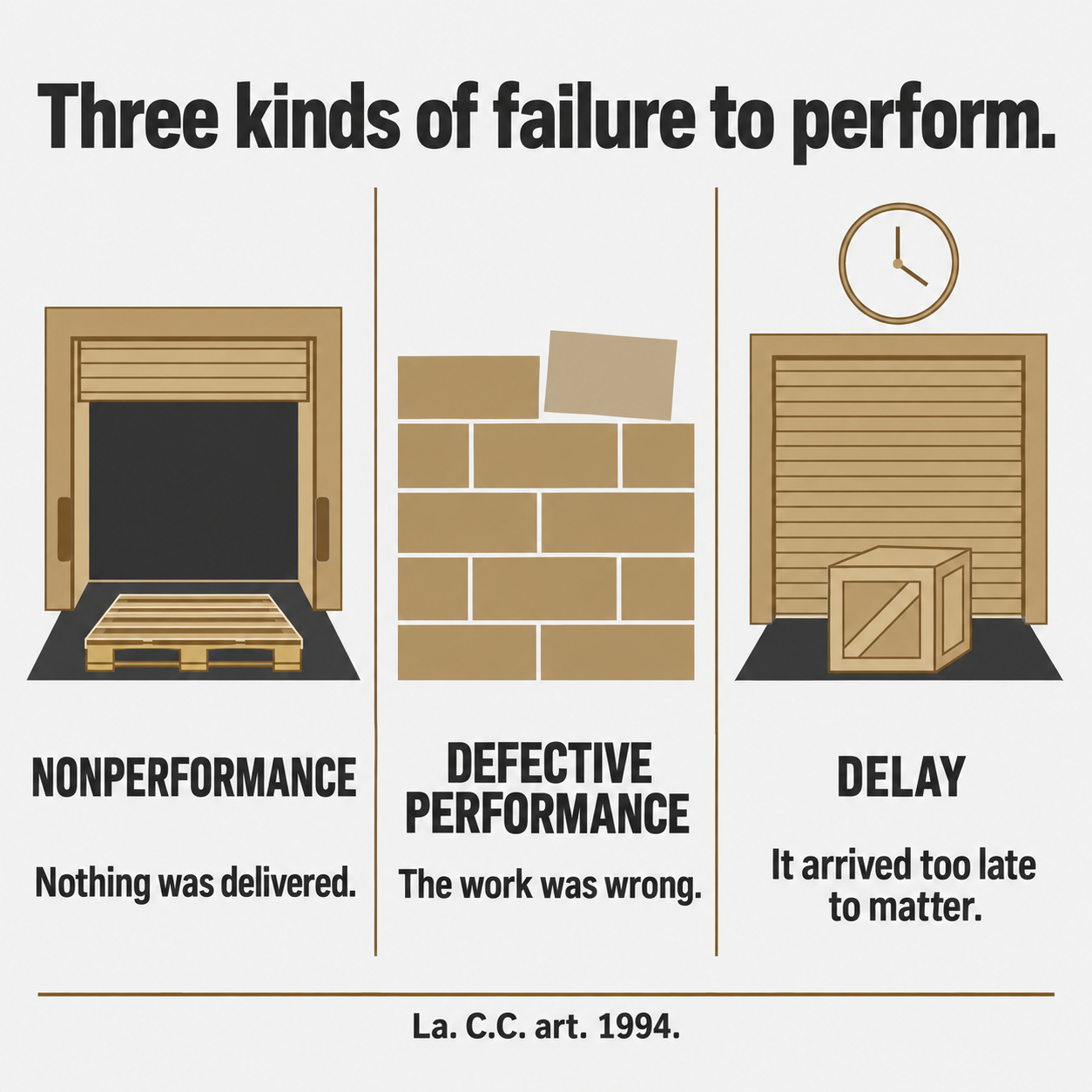
Louisiana law calls a breach a failure to perform, and it covers more than walking away from a deal. Under La. C.C. art. 1994, a party is liable for the damages caused by three different kinds of failure:
- Nonperformance, where the other side never did what it promised. A supplier never shipped, a contractor never started, a customer never paid.
- Defective performance, where the work got done but not the way the contract required. The building went up with the wrong materials, or the software arrived without the functions you paid for.
- Delay in performance, where the work eventually got done but too late to do you any good. A shipment that arrives after your selling season has ended is a breach even though the goods showed up.
That third category surprises a lot of business owners, because the other side will usually insist that it performed. Delay is its own breach under Louisiana law, and the damages the delay caused are recoverable on their own.
Two terms come up constantly in the Civil Code and in anything a lawyer sends you, so they are useful to learn now. The Code calls the party who owes performance the obligor, and the party who is owed performance the obligee. If your business is the one that was harmed, you are the obligee.
The three elements of a Louisiana breach of contract claim
To win, your business has to prove three things: that a contract existed, that the other side failed to perform under it, and that the failure caused you a loss you can measure in dollars.
The first two are usually the easier part when you have a signed agreement and a paper trail. The third element is where most contract claims are won or lost. If you cannot document a loss, a court will not award it, so the quality of your records often matters as much as the strength of your legal position.
Are oral contracts enforceable in Louisiana?
Yes, but proving one is harder, and how much harder depends on the dollar value. Under La. C.C. art. 1846, an oral agreement worth $500 or less can be proved with any competent evidence. Above $500, the contract must be proved by at least one witness plus other corroborating circumstances.
Louisiana courts have allowed a party’s own testimony to satisfy that one-witness requirement, as long as other evidence generally backs up the claim. You do not need independent proof of every detail. The corroboration is usually the ordinary business record you already have: emails confirming terms, invoices, a partial payment, text messages, or a pattern of dealing between the two companies over time.
What damages can you recover for a breach of contract?
Louisiana measures contract damages in two parts, both set out in La. C.C. art. 1995: the loss you sustained, and the gain you were deprived of. The first is money you actually spent. The second is money that never came in. The purpose of both is to put your business in the financial position it would have been in if the contract had been performed properly.
Loss sustained covers the costs the breach forced on you:
- What you paid a replacement vendor above the original price
- Expedited shipping to cover a missed delivery
- Crews you paid while there was no work for them to do
- Deposits that got you nothing
- The cost of redoing defective work
Gain deprived covers the profit the deal would have produced.
Lost profits and the reasonable certainty standard
Lost profits are recoverable in Louisiana, but only when you prove them to a reasonable certainty. An estimate, a rough projection, or your own testimony about what the deal would have been worth is not enough, and Louisiana appellate courts regularly reverse lost profit awards that rest on that kind of evidence.
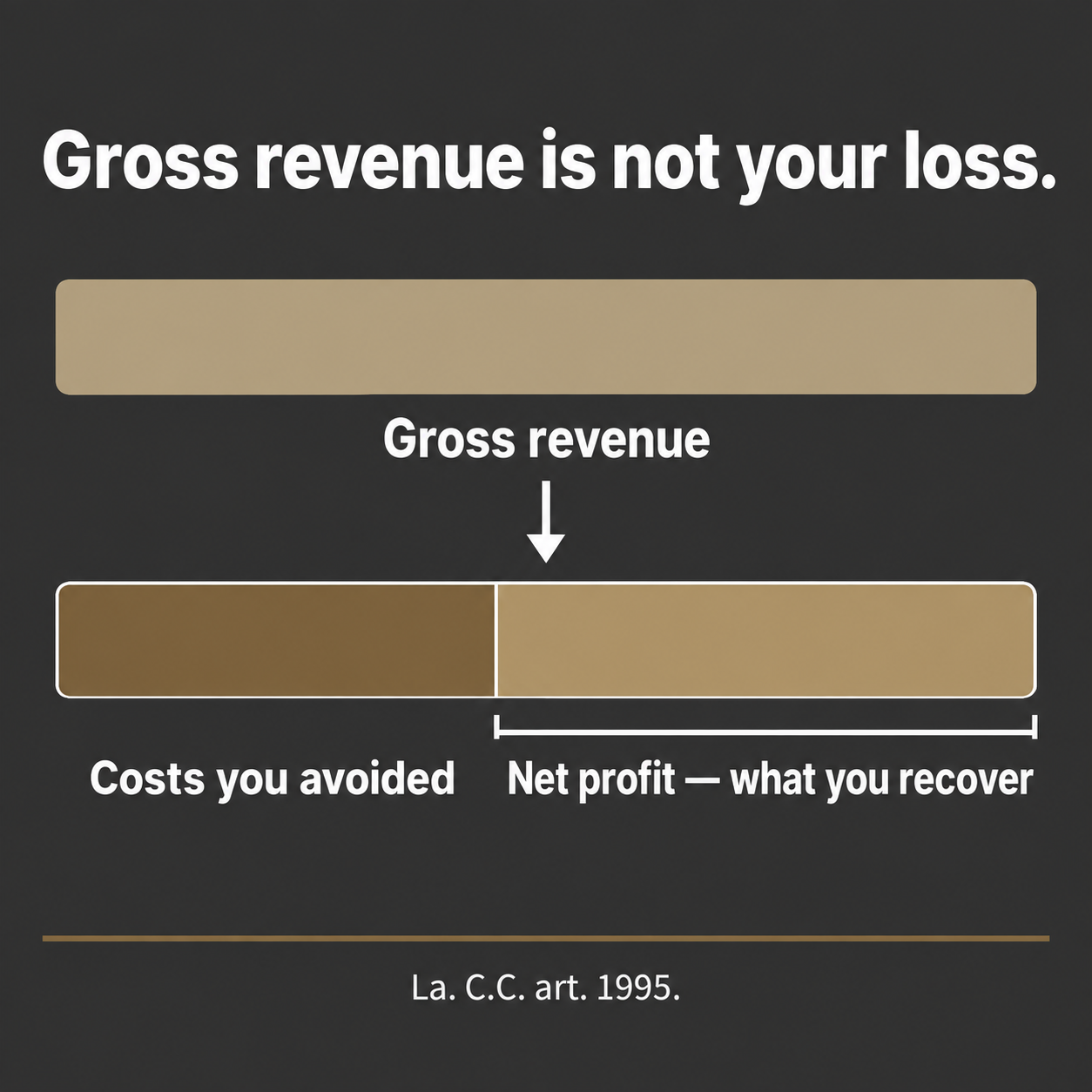
Proving lost profits generally takes three things. The first is several years of historical operating statements, which establish what your profit margins actually are. The second is the specific commercial agreements or third-party subcontracts you lost as a direct result of the breach. The third is a forensic economic expert who can isolate net profit, meaning gross revenue minus the overhead and variable costs you avoided by not performing.
That last calculation is the most common reason these claims fail. A business that presents gross revenue without deducting the expenses it never had to pay is claiming more than it actually lost, and Louisiana courts reject those awards. Newer companies have the hardest time here, because a business with no operating history gives a court nothing to measure the projection against.
Can a business recover for frustration or mental anguish?
No. La. C.C. art. 1998 allows nonpecuniary damages, meaning distress, frustration, and mental anguish, in only two situations: when the contract was made to satisfy a nonpecuniary interest, or when the obligor deliberately set out to hurt the other party’s feelings. Business contracts are made for economic gain, so Louisiana courts consistently bar this category of recovery in commercial disputes. A corporation, partnership, or limited liability company cannot claim nonpecuniary damage at all, as a matter of law.
Good faith vs. bad faith breach
This distinction decides the size of most Louisiana contract claims, so it is the first thing to work out about your own case.
Under La. C.C. art. 1996, an obligor in good faith is liable only for the damages that were foreseeable at the time the contract was made. When a company fails to perform because of an ordinary business interruption, an administrative error, or overhead it miscalculated, its exposure is limited to what both sides had in mind when they signed. Downstream losses that were never communicated and were not foreseeable at signing cannot be recovered from a good faith obligor.
La. C.C. art. 1997 takes the opposite approach. An obligor in bad faith is liable for all the damages, foreseeable or not, that are a direct consequence of the failure to perform. The foreseeability defense disappears, and the breaching business becomes liable for consequences it never considered: penalties you owed to third parties, related contracts that collapsed when this one did, and the value the breach cost your business as a whole. You still have to prove that the breach directly caused each of those losses.
Bad faith is a demanding standard, and it helps to be realistic about it. The revision comments to La. C.C. art. 1997 and Louisiana appellate decisions define bad faith as an intentional and malicious failure to perform. Bad judgment does not meet that standard, and neither does ordinary negligence. Even a calculated decision to breach because performing stopped being profitable is generally not enough on its own. What the standard asks for is a deliberate decision to breach, with a fraudulent or malicious motive behind it.
| Good faith breach (La. C.C. art. 1996) | Bad faith breach (La. C.C. art. 1997) | |
| What you can recover | Only damages that were foreseeable when the contract was signed | All damages that directly resulted, foreseeable or not |
| What you have to show | A failure to perform, without fraud or malice | An intentional and malicious failure to perform |
| Common situations | Missed deadlines, administrative errors, miscalculated costs, ordinary business interruptions | Fraud, deceit, or a deliberate plan to cause economic harm |
| Downstream losses | Excluded if they were not communicated or foreseeable at signing | Third-party penalties, collapsed related contracts, and lost business value are recoverable if you prove direct causation |
Louisiana courts are not perfectly uniform on where this line falls. Some appellate panels have treated a calculated, deliberate breach, such as abandoning a supply contract to chase a higher market price, as bad faith without separate proof of personal malice. The prevailing view in the First and Fourth Circuits still requires evidence of fraud, deceit, or an affirmative intent to cause economic injury.
The good faith rule carries a practical lesson for the contracts you have not signed yet. Because foreseeability is measured as of the day you sign, what you tell the other side in writing about your downstream exposure can decide whether that loss is recoverable later. If a late delivery would cost you a specific contract or trigger a specific penalty, the contract is the place to say so.
Three remedies when the other side fails to perform
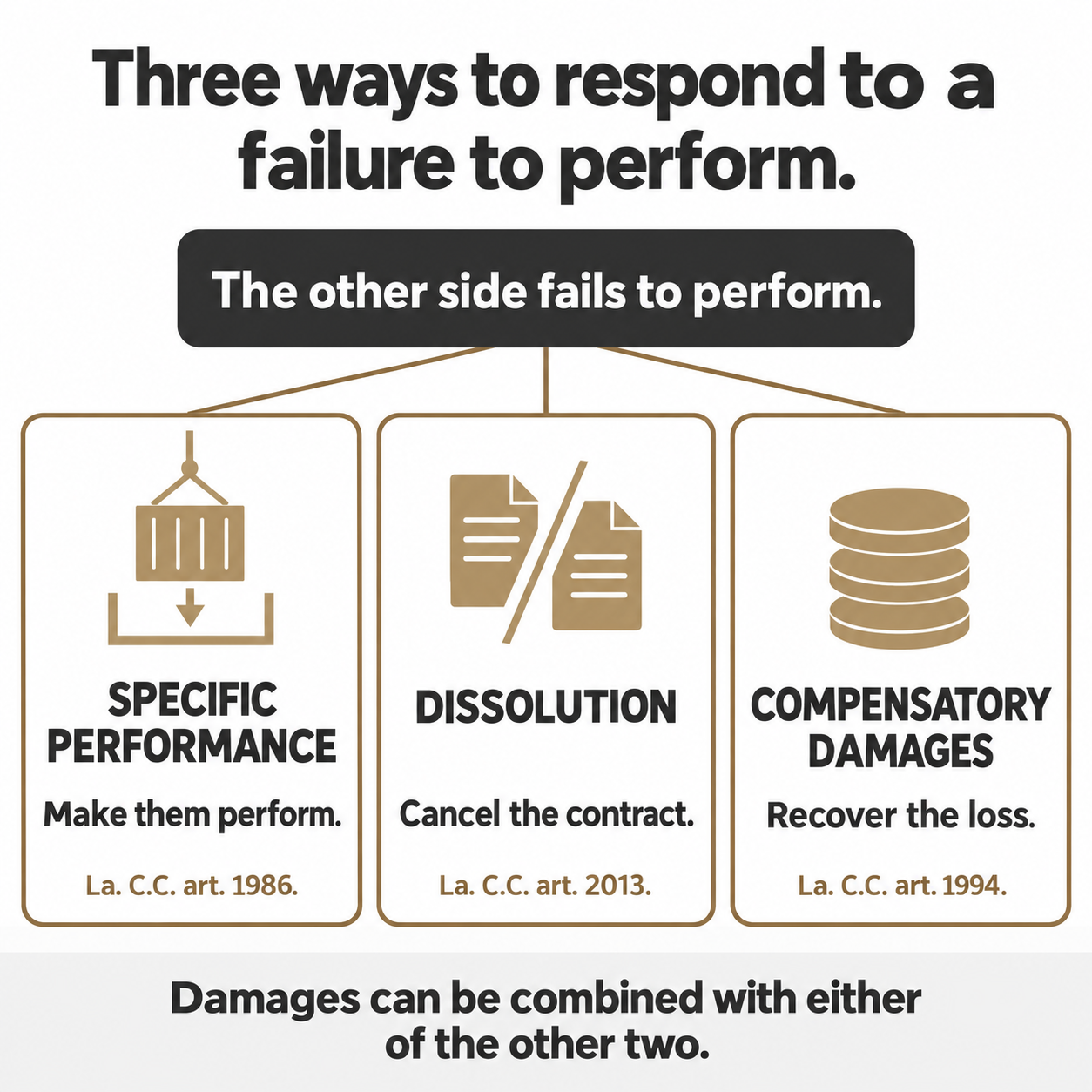
The Civil Code gives a business three ways to respond to an unexcused failure to perform. They are not mutually exclusive, and choosing among them is one of the earliest strategic decisions in a contract case.
Specific performance
Specific performance means asking the court to order the other side to actually do what it promised. In common law states, this is an extraordinary remedy courts grant only when money will not fix the problem. Louisiana treats it as a primary remedy, which is a real advantage when what you need is the performance itself rather than money.
La. C.C. art. 1986 sets availability by the type of obligation. When the obligation is to deliver a thing, to refrain from doing something, or to execute an instrument, the court shall grant specific performance plus damages for the delay if you demand it. That makes it a statutory right in purchase agreements for immovable property, in leases, and in transfers of specialized corporate instruments. When the obligation is an obligation to do, such as commercial construction, software development, or professional services, granting specific performance is left to the judge’s discretion.
The limit is impracticability. The Louisiana Supreme Court has held that specific performance becomes impracticable when performance is physically or legally impossible, when the cost of compliance is out of proportion to any real benefit to you, or when enforcement would require the court to supervise complex commercial operations on an ongoing basis. That last situation is why courts decline to order a retailer to keep a store open or to oversee an ongoing construction job.
Before a court reaches the question of performance, it has to be satisfied the contract was validly formed, and authority to sign is a frequent fight in these cases. Our article on who can sign a real estate contract for an LLC in Louisiana walks through a Louisiana appellate case where a $1.44 million Baton Rouge commercial purchase agreement was challenged because the person who signed for the seller was not the LLC’s designated manager.
Dissolution of the contract
Dissolution means canceling the contract and unwinding the deal. La. C.C. art. 2013 lets you seek it when the other side fails to perform, and there are three routes.
The first is judicial dissolution under La. C.C. art. 2013, where you petition the court and establish a substantial failure to perform. The second is dissolution by notice under La. C.C. art. 2015, which applies when your contract has no termination clause. You serve a written demand requiring performance within a reasonable time, and the notice has to state plainly that you will treat the contract as dissolved if performance does not happen in that window. The third is an express dissolution clause under La. C.C. art. 2017, where the parties agreed in advance that the contract dissolves automatically if a specific obligation goes unmet. Notice under a clause like that takes effect when the defaulting party receives it.
One defense will end a dissolution claim. Under La. C.C. art. 2014, a contract cannot be dissolved if the obligor has rendered a substantial part of the performance and the part it did not render does not substantially impair your interest. In that situation you have to accept the work and pursue damages or a reduction in price for the deficiencies instead.
Compensatory damages
Compensatory damages under La. C.C. art. 1994 are the most common remedy, and they can stand alone or pair with either of the others. Combined with specific performance, they cover the loss the delay caused you while you waited. Combined with dissolution, they cover what you spent and what you lost in reliance on the contract before you terminated it.
When your contract already set the damages
Before calculating anything, read your contract for a stipulated damages clause. Louisiana calls it stipulated damages; other states call the same thing liquidated damages. Under La. C.C. art. 2005, the parties may fix in advance what will be owed for nonperformance, defective performance, or delay.
A clause like that helps you in one way and limits you in another. The benefit is that La. C.C. art. 2009 relieves you of proving actual damages at all, which removes the hardest part of a contract case. The cost is that the stipulated figure becomes the exclusive measure of recovery. If your real losses turn out to be larger than the number in the contract, you generally cannot set the clause aside and pursue the higher amount. La. C.C. art. 2007 also makes it an either-or choice: you may demand the stipulated damages or performance of the obligation itself, but not both, unless the damages were stipulated for mere delay.
Louisiana also makes these clauses hard to attack, which matters when one is being enforced against you. Courts start from a presumption that the clause is enforceable. La. C.C. art. 2012 provides that stipulated damages may not be modified by a court unless they are so manifestly unreasonable as to be contrary to public policy. Getting a clause reduced or thrown out means showing that the agreed amount was punitive, coercive, and unconnected to any plausible estimate of the loss at the time of signing.
One question in this area remains unsettled. When a party breaches in bad faith, the breaching side argues that La. C.C. art. 2005 caps its liability at the stipulated figure, while the harmed side argues that the public policy behind La. C.C. art. 1997 should override a contractual cap. Louisiana courts have not resolved that tension cleanly, so raise it with your attorney if a bad faith breach has occurred under a contract with a stipulated damages clause.
Your duty to mitigate damages after a breach
Louisiana requires you to take reasonable steps to keep your losses from growing after a breach. Under La. C.C. art. 2002, the obligee must make reasonable efforts to mitigate the damages caused by the other side’s failure to perform. If you skip steps a business would reasonably take to keep the loss from growing, the court reduces your award by the amount you could have avoided.
That usually means finding a replacement supplier, re-letting the space, reassigning the crew, or getting the defective work fixed rather than letting a project sit. Keep records of what you did and what it cost. Failure to mitigate is one of the first arguments the defense will make, and records you created at the time are the strongest answer to it.
How to put the other party in default
In many Louisiana contract cases, damages for delay do not begin to accrue until you formally put the other side in default. La. C.C. art. 1989 sets that rule, and La. C.C. arts. 1990 and 1991 set out how default happens.
- Arrival of a term. If your contract fixes a definite date for performance, or the date is clearly determinable from the circumstances, La. C.C. art. 1990 puts the other side in default automatically when that date arrives. No demand is required.
- Written demand. When the contract has no fixed date for performance, La. C.C. art. 1991 allows you to put the other side in default with a written request for performance.
- Judicial demand. Filing suit for performance is itself a manner of putting the obligor in default under La. C.C. art. 1991.
- Oral demand. La. C.C. art. 1991 also allows an oral request for performance made before two witnesses.
- A provision in your own contract. La. C.C. art. 1991 recognizes a specific provision of the contract as a manner of putting the obligor in default, so your agreement may already define how and when default happens.
What happens if you are also behind on your own obligations
Check this before you send anything, because it stops more claims than any other rule in this area. Two Civil Code articles work together.
La. C.C. art. 1993 is the one that decides the question: where the obligations are reciprocal, you cannot put the other side in default unless you have performed, or are ready to perform, your own obligation. La. C.C. art. 2022 is the companion rule and gives the other side an affirmative defense: either party to a commutative contract may refuse to perform if the other has failed to perform or does not offer to perform at the same time, when the performances are due simultaneously.
The consequence is direct. A business that is delinquent on its own side of the deal cannot put the counterparty in default. An owner who fell behind on progress payments cannot claim default against the contractor who stopped work. A company that never supplied the specifications the project needed cannot claim default against the vendor waiting on them. Confirm your own performance is current before you send a demand letter, because the other side will check.
Who pays attorney fees in a Louisiana contract case?
The default rule is that each side pays its own attorney fees. In Louisiana, a prevailing party recovers fees only when a contract provision says so or a statute authorizes it. Read your contract’s fee provision early, because who pays the legal fees often decides whether a smaller claim makes sense to pursue at all.
Unpaid invoices and the open account statute
The main statutory route to attorney fees in a business payment dispute is Louisiana’s open account statute, La. R.S. 9:2781. If someone fails to pay an open account within thirty days after you send a written demand that correctly sets forth the amount owed, that person becomes liable for reasonable attorney fees for prosecuting and collecting the claim. Recoverable fees include the work done before judgment and the collection work after it, including garnishments, judgment debtor examinations, and writs of fieri facias.
The statute reaches further than most business owners expect. Louisiana courts once limited open accounts to revolving credit relationships with rolling, successive transactions. In Frey Plumbing Co., Inc. v. Foster, decided in 2008, the Louisiana Supreme Court held that an open account includes any account where all or part of the balance is past due, whether the account reflects one transaction or many and whether or not the parties expected future business. Single-job commercial contracts, standalone vendor invoices, construction subcontractor billings, and one-off professional engagements can all qualify.
One requirement regularly costs businesses their fee claim, and it comes up before a lawyer is ever involved. Because the statute departs from the default rule against fee shifting, courts construe it strictly, and the written demand has to correctly set forth the amount owed. If your thirty-day demand overstates the debt by including inaccurate finance charges, unsupported penalties, or balances the customer legitimately disputes, you forfeit the statutory fees. If the court later finds the actual sum due was less than the figure in your demand letter, the fee claim fails even though you won the underlying debt. Reconcile the balance against your invoices before the letter goes out.
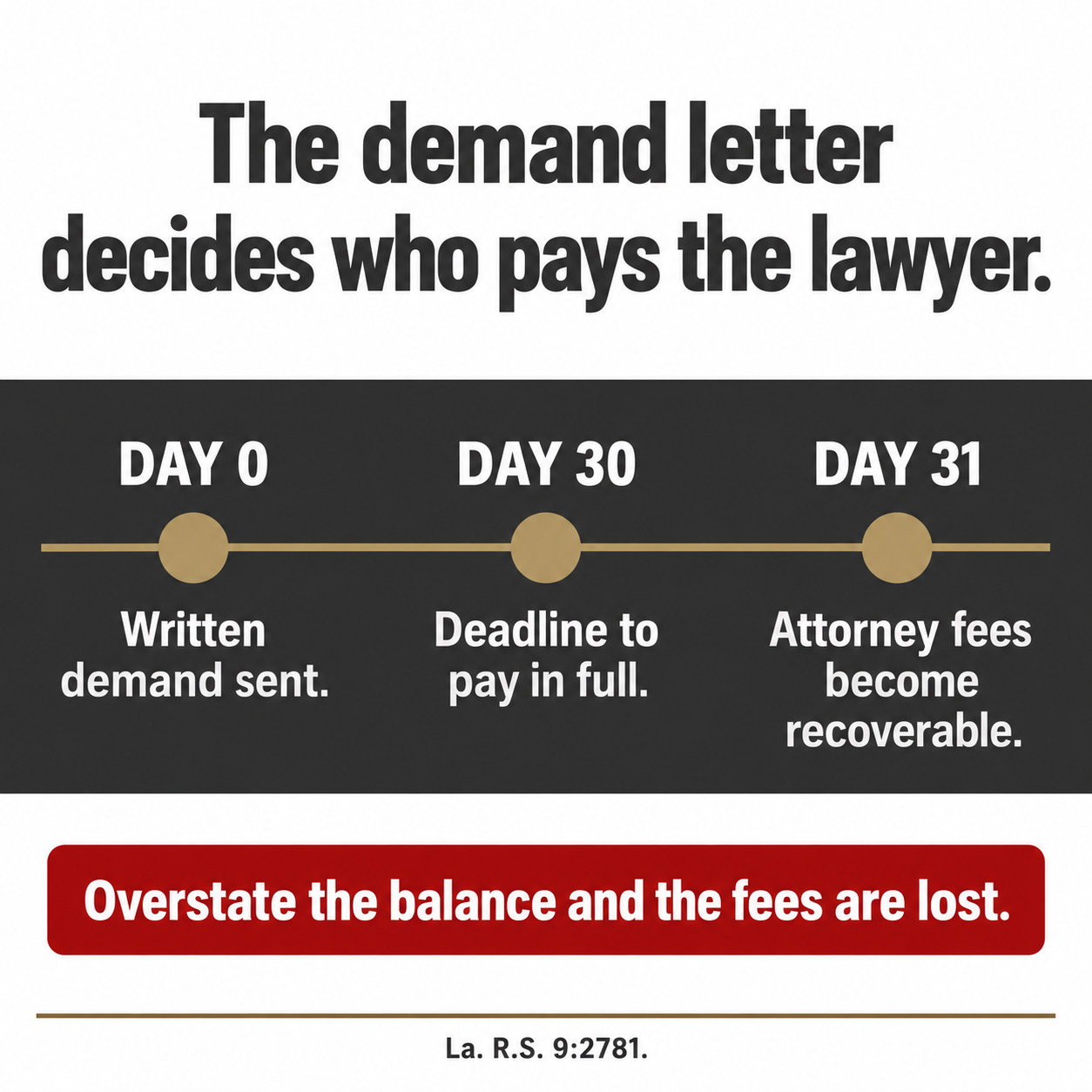
If you file suit without sending a demand first, service of the petition serves as the formal demand. The debtor then gets a statutory window to avoid fees by paying the entire balance: ten days from service in city courts, fifteen days from service in all other courts.
Interest on money you are owed
When the breach is simply a failure to pay money, La. C.C. art. 2000 governs what you recover for the delay. Damages are measured by interest on that sum from the date the payment was due, at the rate your contract specifies or, if the contract is silent, at the legal rate. La. R.S. 9:3500 sets that legal rate, for sums that are the object of a judicial demand, at the judicial interest rate fixed under La. R.S. 13:4202. You do not have to prove any actual loss or economic harm to collect this interest on a liquidated money obligation.
Louisiana’s Office of Financial Institutions publishes the judicial interest rate each year. Under the formula in La. R.S. 13:4202, the Commissioner of Financial Institutions sets it on the first business day of October at 3.25 percentage points above the Federal Reserve discount rate, and that figure applies for the following calendar year.
| Calendar year | Judicial interest rate |
| 2024 | 8.75% |
| 2025 | 8.25% |
| 2026 | 7.50% |
Because the interest runs from the date the debt became due rather than from the date you filed, a balance that has been outstanding for two or three years can add a substantial amount to the final judgment.
How long do you have to sue in Louisiana?
You usually have ten years to file a breach of contract claim in Louisiana. Several exceptions run much shorter, though, and one of them covers unpaid invoices.
Louisiana calls these deadlines prescription rather than statutes of limitations, and it distinguishes between two kinds. Liberative prescription extinguishes your remedy but can be interrupted, which starts the full period over. Peremption extinguishes the underlying right itself, and it cannot be interrupted, suspended, or waived by anyone, including by the other side’s acknowledgment of the debt.
| Type of claim | Deadline | How it works |
| Breach of contract as a general personal action (La. C.C. art. 3499) | 10 years | The default rule, covering asset purchase agreements, operating agreements, licensing deals, and nondisclosure agreements |
| Open accounts, compensation for services, money lent, rent arrearages (La. C.C. art. 3494) | 3 years | Covers unpaid invoices, professional fees, wages, commissions, and freight |
| Construction and building deficiencies (La. R.S. 9:2772) | 5 years, peremption | Runs from the recorded acceptance of the work, or from the date the owner took possession if no acceptance is recorded within six months of occupancy |
| Claims against engineers, architects, and surveyors (La. R.S. 9:5607) | 5 years, peremption | Runs from registry of acceptance, from the owner taking possession if no acceptance is recorded, or from completion of the services if the professional never inspected the work |
| Tort claims, for comparison (La. C.C. art. 3493.1) | 2 years | Applies to negligence and property damage claims, not to contract claims |
If you have heard that Louisiana gives you one year, or two, you are thinking of tort claims. Act 423 of the 2024 Regular Session moved the deadline for tort and property damage actions from one year to two, effective July 1, 2024. It did not touch the ten-year contract period or the three-year open account period. When a case involves both a contract claim and a related business tort such as intentional interference, the two claims run on separate clocks.
Two mistakes account for most claims lost to prescription. The first is assuming that calling a suit a breach of contract gives you the full ten years. In Starns v. Emmons, the Louisiana Supreme Court held that La. C.C. art. 3494 operates as an explicit legislative limitation on La. C.C. art. 3499, so a suit for unpaid invoices, professional fees, or rent stays on the three-year clock no matter how it is styled. Courts will separate out individual billing entries and dismiss the ones older than three years even when they are pled inside a broader contract claim.
The second mistake is assuming a demand letter stops the clock. It does not. Prescription is interrupted when suit is filed in a court of competent jurisdiction and venue, or when the debtor acknowledges the debt. Demand letters, notices of default, settlement discussions, and months of good-faith negotiation do not interrupt anything. If the petition is not filed before the deadline passes, the claim is gone regardless of how strong it was.
When a breach becomes an unfair trade practice
Businesses often want to add a claim under the Louisiana Unfair Trade Practices and Consumer Protection Law, La. R.S. 51:1401 and following, because it allows treble damages and attorney fees. The standard is high, and an ordinary breach of contract does not meet it.
The statute makes unfair methods of competition and unfair or deceptive acts in trade or commerce unlawful under La. R.S. 51:1405(A), and La. R.S. 51:1409(A) gives an injured party a private action for actual damages and attorney fees. That same provision requires the court to award three times the actual damages when it finds the unfair or deceptive practice was knowingly used after the defendant was put on notice by the Attorney General.
Louisiana courts keep contract claims and this statute firmly separate. In Turner v. Purina Mills, Inc., decided in 1993, the U.S. Fifth Circuit held that the act is not an alternate remedy for simple breaches of contract, and that a wide gap separates a contract claim from the conduct the statute actually targets. The Louisiana Supreme Court took the same approach in Cheramie Services, Inc. v. Shell Deepwater Production, Inc., describing the range of prohibited practices as extremely narrow and limited to egregious conduct involving fraud, misrepresentation, deception, or other unethical behavior. Showing that the other side breached intentionally, willfully, or stubbornly is not enough.
One deadline here is far shorter than the contract periods above, and it is easy to miss. Under La. R.S. 51:1409(E), a private action under the statute is subject to a liberative prescription of one year running from the transaction or act that gave rise to it. A claim that would otherwise qualify can expire well before the underlying contract claim does.
The conduct that supports one of these claims looks very different from a missed deadline. Our commercial work includes a vertical antitrust suit over a coal ash price-fixing scheme that settled for $1.5 million after we retained an antitrust expert and defeated the defendants’ motions for summary judgment and exceptions in both the state and appellate courts, and a trade secrets case in which public officials overseeing a project conspired with private competitors to take our client’s technical designs.
Can you recover punitive damages in a Louisiana contract case?
No. Punitive and exemplary damages are unavailable in Louisiana breach of contract disputes. Louisiana courts have long held that punitive or other penalty damages are not allowable unless a statute expressly authorizes them, a rule the Louisiana Supreme Court restated in International Harvester Credit Corp. v. Seale, and no Louisiana statute authorizes them for the breach of a conventional obligation.
This holds even when the breach was in bad faith. La. C.C. art. 1997 expands what you can recover to include unforeseeable damages, but everything it allows is still compensatory. The narrow statutory exceptions that do permit punitive damages in Louisiana apply to specific tort claims, including injuries caused by drunk driving under La. C.C. art. 2315.4 and childhood sexual abuse under La. C.C. art. 2315.7. None of them apply to a commercial dispute. The treble damages provision in the unfair trade practices statute is the only multiplier realistically available to a business, and it requires the notice finding described above.
What to do first if a contract has been breached
The work you do in the first few weeks tends to determine what the claim is worth later.
- Pull the contract first and read the provisions that will decide your claim. Termination clauses, stipulated damages, attorney fee provisions, notice requirements, interest rates, and arbitration or venue clauses frequently settle the size and the forum of a dispute before the Civil Code has anything to say about it.
- Confirm your own performance is current. If you owe the other side something that was due at the same time as their obligation, La. C.C. art. 1993 may prevent you from putting them in default at all.
- Preserve documents and communications now, including emails, text messages, change orders, invoices, delivery records, and internal accounting. Disputes over electronic discovery of corporate email and financial files are one of the biggest drivers of cost and delay in commercial cases.
- Reconcile the balance before sending any demand letter. An overstated demand can cost you statutory attorney fees under La. R.S. 9:2781 even if you win the debt itself.
- Document every step you take to reduce the loss, along with what it cost. That record is your answer to the mitigation defense.
- Start assembling the financial proof for lost profits: historical operating statements, the specific contracts or subcontracts the breach cost you, and the cost figures an expert will need to isolate net profit.
- Identify your deadline. Work out whether your claim is a ten-year contract action, a three-year open account, or a five-year peremptive claim over construction or design work, and remember that nothing short of filing suit extends it.
How long a commercial contract case takes in Louisiana
In Louisiana state district courts, including the 19th Judicial District Court serving East Baton Rouge Parish, a commercial contract action generally runs 18 to 36 months from the filing of the petition to a trial on the merits. Four things shape that timeline:
- Discovery disputes over corporate email and financial records
- Pre-trial exception practice on prescription and no cause of action
- Challenges to damages calculations and to forensic accounting experts
- How the court coordinates its civil docket
Cases that settle can move considerably faster, and cases with heavy document volume can run longer.
Expect the possibility of a jury. Under La. C.C.P. art. 1732, the amount in dispute required to request a jury trial is $10,000, excluding interest and court costs, lowered from $50,000 effective January 1, 2021. Nearly every significant commercial breach case filed in state district court now qualifies, and either side can make the demand. We prepare commercial cases for trial from the beginning rather than assuming they will settle, and we try them when a fair settlement cannot be reached.
Talk to us before you send the demand letter
We are selective about the commercial matters we take, because a contract case takes real time and resources to handle properly. That works in your favor at the first meeting. We would rather give you an honest assessment of what your claim is worth and where it is vulnerable than take on a case we cannot give the attention it needs. Jason Melancon leads our commercial litigation work, and our partners handle these matters directly rather than passing them to an associate.
If another party has failed to perform on a contract with your business anywhere in East Baton Rouge, West Baton Rouge, Ascension, Livingston, or the surrounding parishes, call us at (225) 303-0455 or contact our office to set up a free consultation. Bring the contract, the correspondence, and whatever you have on the numbers, and we will tell you plainly what your options are under Louisiana law.