Choosing a medical malpractice attorney in Baton Rouge comes down to three things you can check at a free consultation. Ask whether the attorney has taken claims through Louisiana’s medical review panel, which nearly every malpractice claim in this state has to clear before a lawsuit can be filed. Ask who advances the cost of the medical experts and records, because a claim cannot be proven without both. And ask whether the attorney you meet with will be the one reading your records and handling your file, and whether they will tell you early if you do not have a claim. Most advice about hiring a malpractice lawyer skips all three, because it was not written for Louisiana.
Louisiana handles medical negligence under its own set of rules, and those rules decide what you should be asking. You have one year to file, not the two years that applies to a car accident claim. Almost every claim has to go to a medical review panel before a lawsuit can be filed, and the panel process commonly takes a year or two on its own. Total damages are capped at $500,000, and future medical care is handled separately and paid over your lifetime.
At Melancon, Rimes & Daquanno, we have practiced injury law in Baton Rouge since 2005, and our three partners have more than 50 years of combined experience between them. A partner manages every case we take, from the first meeting to the end. We take malpractice cases where negligence can be clearly shown, and we tell people early when we do not think it can be.
Has the attorney taken claims through Louisiana’s medical review panel?
Ask about panel experience at the first meeting, and ask for specifics. A claim against a Louisiana doctor, dentist, hospital, or nursing home that is enrolled with the state’s Patient’s Compensation Fund cannot go straight to court. It has to be submitted to a medical review panel first, and how an attorney handles that process decides how fast your claim moves and what happens if the panel’s opinion goes against you.
What is a medical review panel?
A medical review panel is four people who read the records in your case and issue a written opinion on whether your provider met the standard of care, and whether any failure caused your injury. Three of them are licensed Louisiana healthcare providers, and those three are the ones who vote. When a single physician is named as the defendant, all three have to practice in the same specialty. You choose one, the defense chooses one, and those two agree on the third. The fourth member is an attorney who chairs the panel and advises on procedure, and who does not vote. The rules are in La. R.S. 40:1231.8.
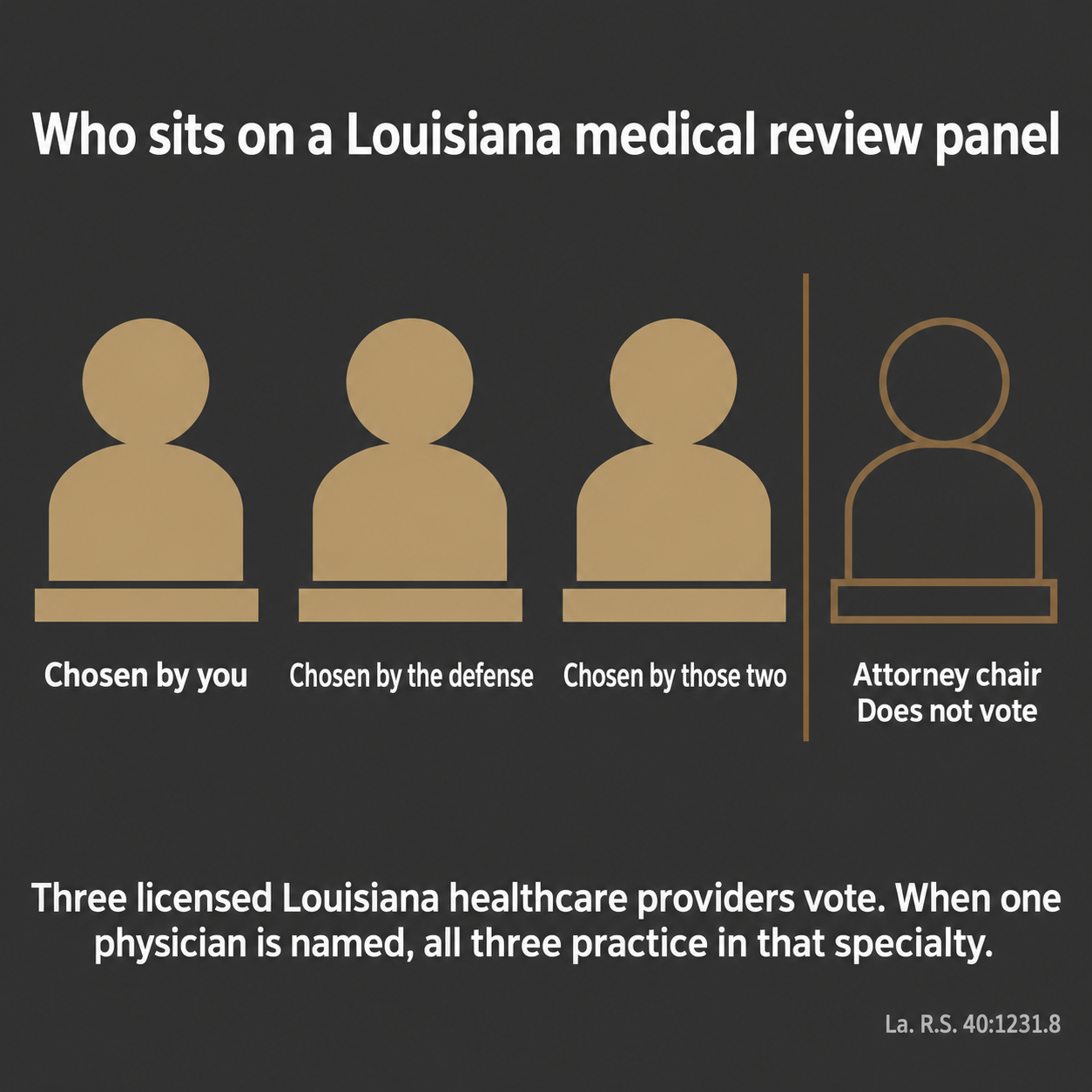
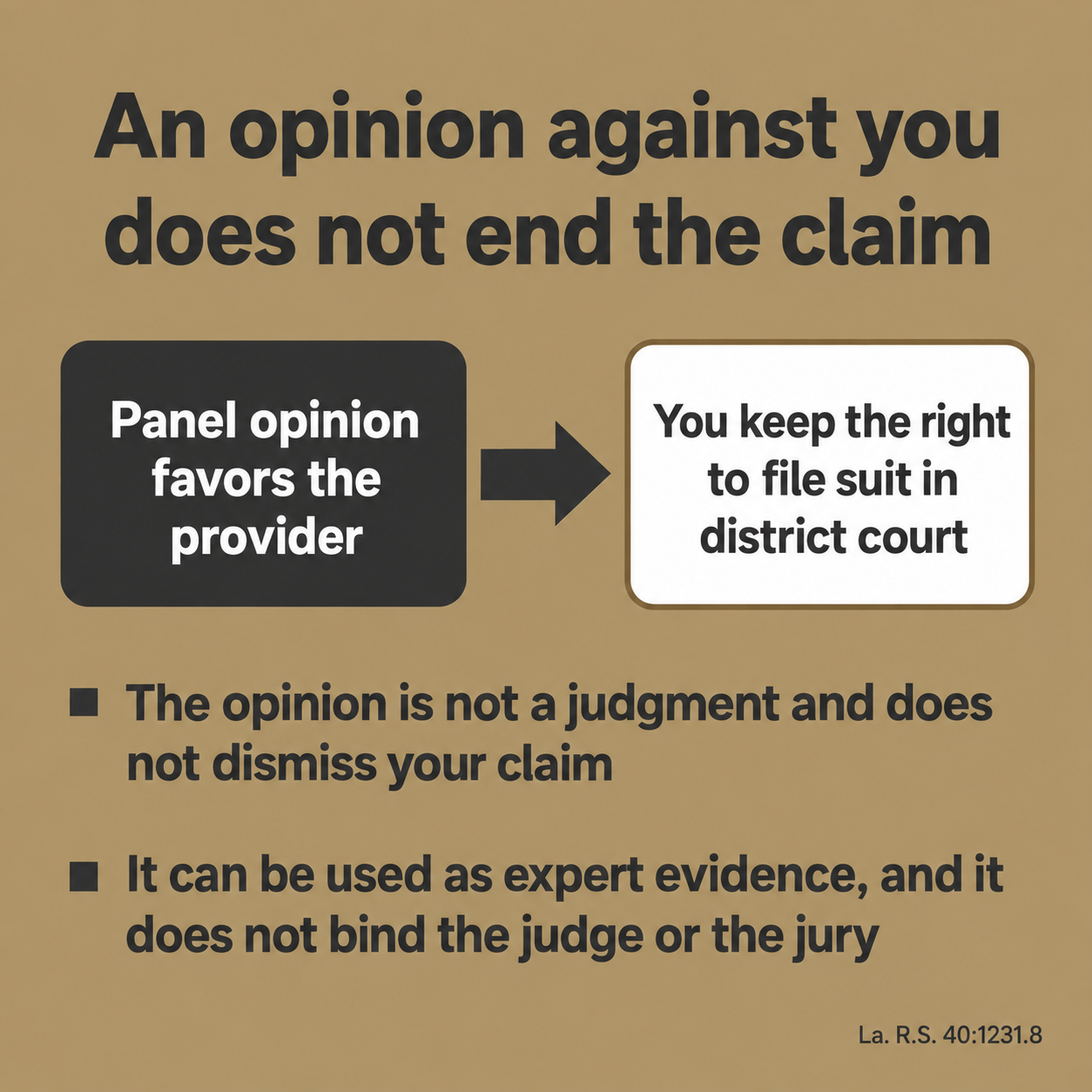
The panel does not decide your case. Its opinion is not a judgment, and an opinion in the provider’s favor does not dismiss your claim. The opinion can be used as expert evidence later, but it does not bind the judge or the jury, and you keep the right to file suit in district court once it comes back.
Where the request gets filed depends on who treated you. Claims against private providers go to the Louisiana Patient’s Compensation Fund Oversight Board. Claims against a state hospital or a state employee go through the Division of Administration. Either way, there is a $100 filing fee for each provider you name, due within 45 days of the board’s confirmation.
Filing the request also stops your one-year filing clock, and the clock stays stopped through the panel process. It starts running again 90 days after you or your attorney receive certified notice that the panel has issued its opinion.
How long does the medical review panel take?
Plan on one to two years for the panel alone. The statute sets a target of 12 months from the day the attorney chair is appointed, but the Patient’s Compensation Fund’s own report to the Legislature says it generally takes one to two years for a claim to complete the panel process, and another two to three years after that to conclude the claim. The delays come from fights over who chairs the panel, scheduling around three working clinicians, and waiting on records from hospitals and clinics that are slow to send them.
The panel timeline is part of the hiring decision, because you are choosing someone you will be working with for years. Most of our cases resolve in two months to three years depending on how severe the injury is and whether a suit gets filed. A malpractice claim sits well beyond that range, since the panel alone can take as long as an entire car accident case.
So ask how many panel claims the attorney has filed, what the opinions said, and what the firm did in the cases where the opinion came back against the patient.
How long do you have to file a medical malpractice claim in Louisiana?
One year. Louisiana gives you one year from the date of the malpractice, or one year from the date you discovered it, and never more than three years from the date it happened. The deadline is in La. R.S. 9:5628, and it applies whether the claim is framed as negligence or as a breach of contract.
Louisiana calls this deadline prescription rather than a statute of limitations, and it works the same way as one. Once the year runs out, the claim is gone, and the court will dismiss it without ever looking at what the provider did.
The two-year deadline you may have read about does not apply to medical malpractice. In 2024, Act 423 gave general injury claims two years to file instead of one, under Civil Code article 3493.11. It left La. R.S. 9:5628 alone, so malpractice kept its one-year deadline. A 2025 law, Act 176, spelled out that survival and wrongful death claims based on malpractice also stay under the malpractice rules. A medical malpractice claim is a type of injury claim, but it does not share the deadline that applies to the rest of our personal injury work.
| Type of claim | Deadline to file | Outer limit |
| Medical malpractice injury | 1 year from the act, or 1 year from the date you discovered it | 3 years from the date of the act, even if you discovered it later |
| Medical malpractice wrongful death | 1 year from the date the patient died | 3 years from the date of the act |
| Other injury claims, such as a car accident, on or after July 1, 2024 | 2 years from the date of the injury | Varies with the underlying claim |
| Wrongful death not involving malpractice | 1 year from the death, or 2 years from the injury, whichever is longer | Not subject to the 3-year malpractice limit |
The one-year deadline applies to everyone, including children and people under interdiction. Nothing pauses it for a minor’s age, so a claim brought on behalf of a child injured at birth runs on the same one-year schedule as an adult’s.
Any malpractice attorney you meet with should be able to tell you your deadline and which date it runs from. If you have already talked to another firm and months have passed, say so at the first meeting. The request for a review panel is the only thing that stops the clock, and it has to be filed before your year is up.
What does Louisiana’s $500,000 malpractice cap mean for your claim?
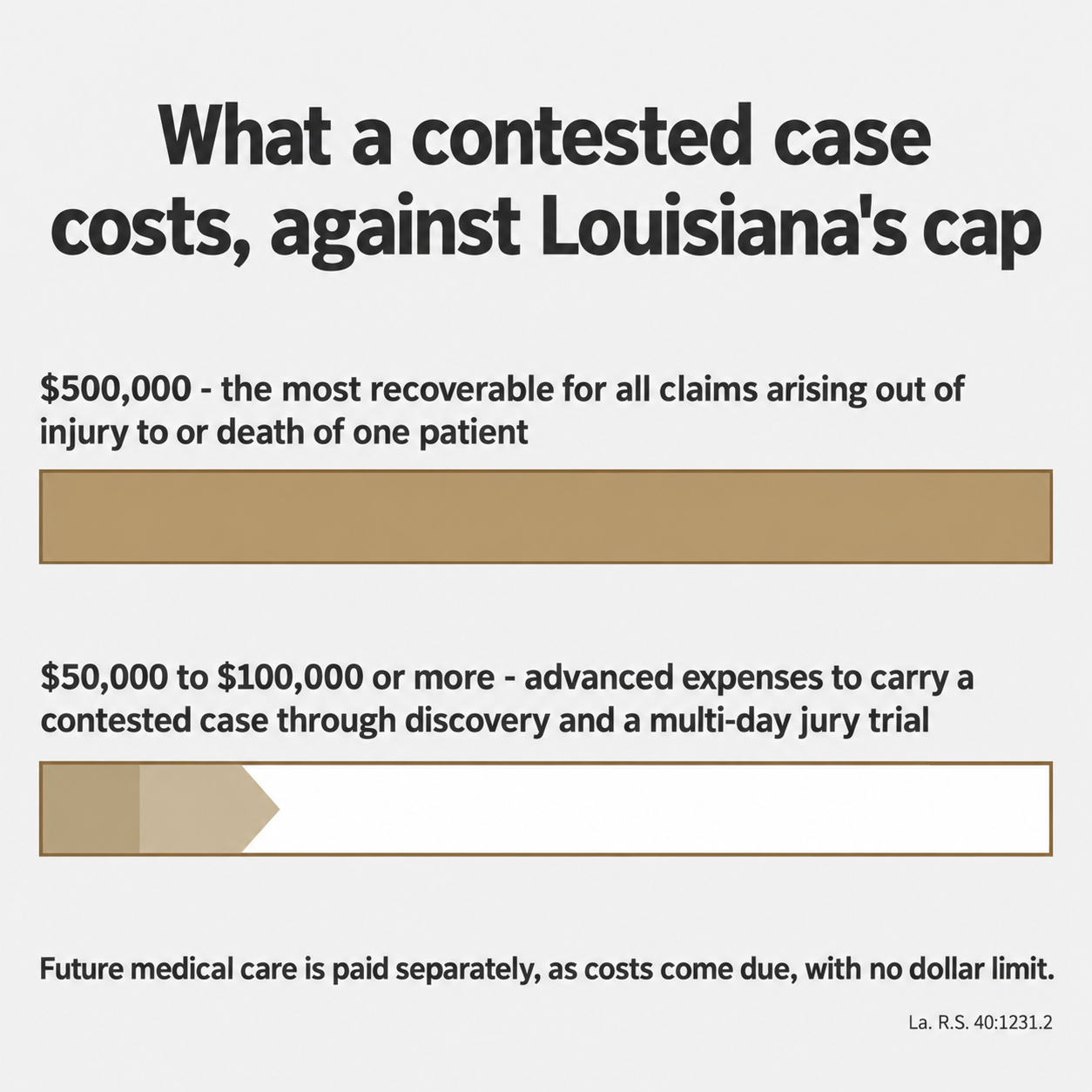
Louisiana limits total damages in a medical malpractice claim to $500,000, plus legal interest and court costs, for all claims arising out of injury to or the death of one patient. Future medical care is handled separately and does not count against that $500,000. The cap is in La. R.S. 40:1231.2, and it is still $500,000 in 2026. The Louisiana Supreme Court has upheld it, and bills to raise it to $750,000 or $1 million, or to tie it to inflation, have not passed.
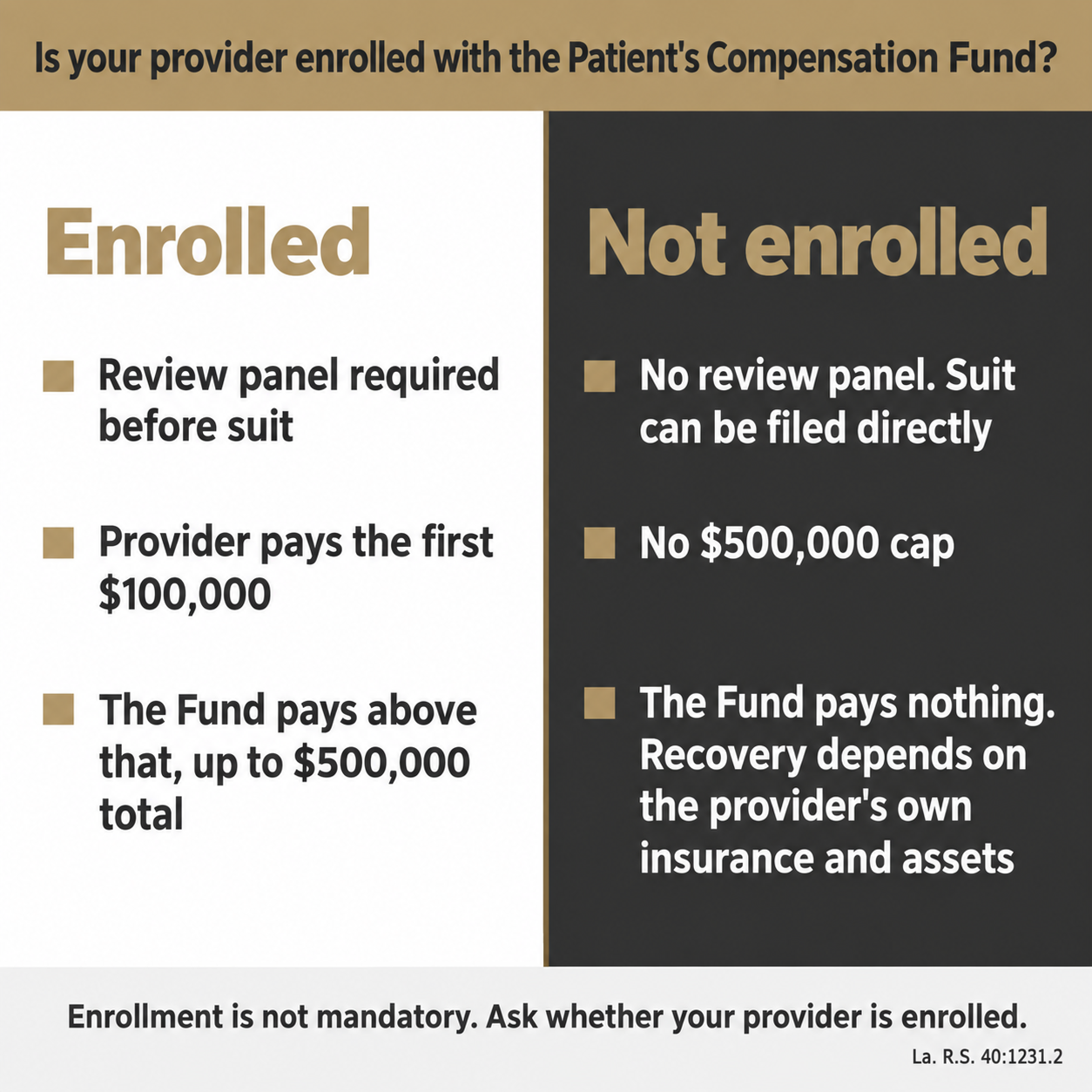
A provider enrolled with the Patient’s Compensation Fund is personally liable for the first $100,000 of a claim, which their malpractice insurance ordinarily covers. The Patient’s Compensation Fund pays everything above that, up to the cap.
Future medical care is the part most people miss, and in a serious case it is worth more than the cap itself. If the judge or jury finds that you need ongoing care because of the malpractice, those costs are not converted into a lump sum. The Patient’s Compensation Fund pays them as they come due over the rest of your life: surgeries, therapy, prescriptions, attendant care, adaptive equipment. There is no dollar ceiling on that part of a claim. Future medical care is also what drives the value of a birth injury or a brain injury claim, which we handle as catastrophic injury cases.
| What is being paid | Limit | Who pays it |
| The enrolled provider’s share of a claim | $100,000, plus legal interest and court costs | The provider or their malpractice insurer |
| The rest of the damages, up to the cap | Up to $400,000 more | Louisiana Patient’s Compensation Fund |
| All claims tied to injury to or death of one patient | $500,000 total, plus interest and costs | The provider and the Fund combined |
| Future medical care and related benefits | No dollar limit, paid as the costs come due | Louisiana Patient’s Compensation Fund |
The cap is per patient, not per family member. If a parent dies because of malpractice and a spouse and three adult children each bring a claim, all four share one $500,000 ceiling.
Not every provider is covered by the Medical Malpractice Act, and the rules change when yours is not. Enrollment takes proof of at least $100,000 in financial responsibility plus an annual surcharge paid to the Patient’s Compensation Fund Oversight Board, and participation is not mandatory. When a provider never enrolled, you can file suit directly without a review panel, and the $500,000 cap does not apply to them. What you can collect from an unenrolled provider depends on their own insurance policy and assets, because the Fund pays nothing on behalf of a provider who is not enrolled. Ask whether your provider is enrolled at the first meeting.
The cap has not moved in decades, and it changes the math for the firm as much as it does for you. Trying a contested claim can take $60,000 to $90,000 in experts and depositions. Against a ceiling of $500,000, with little future medical care to pursue, a claim can cost more to prove than it can return, and attorneys turn down valid claims for that reason. That is why two questions matter more in a malpractice case than in any other injury claim: who pays for the experts, and whether the attorney will give you a straight answer early.
Who pays for the medical experts and records?
In most contingency arrangements, the firm advances the cost of the records and the experts and takes it out of a recovery at the end. What you need in writing is what happens if there is no recovery, because Louisiana permits a fee agreement that leaves you owing those expenses either way.
Proving medical negligence costs more than proving a car wreck, because you cannot do it without other doctors. Louisiana requires expert medical testimony to establish the standard of care, the failure to meet it, and the cause of the injury, except in a narrow set of cases where the mistake is obvious without an expert to explain it. In a Louisiana malpractice case, those costs typically run:
- Certified records, chart audit trails, and imaging from every hospital and clinic involved: $1,000 to $3,000
- A board-certified specialist to review those records and give an opinion before the panel request goes in: $2,500 to $5,000 per specialist
- Expert time once the case is in suit, at $500 to $1,500 an hour for record review and depositions
- Total expert fees of $30,000 to $75,000 when a case involves more than one medical specialty plus a life care planner
- $50,000 to $100,000 or more in advanced expenses to carry a contested case through discovery and a multi-day jury trial
Louisiana’s Rules of Professional Conduct govern what your fee agreement has to say. Rule 1.5(c) requires it in writing and signed by you. It has to state the percentage the firm receives at each stage of the case, whether expenses come off the recovery before or after the fee is calculated, and any expenses you owe no matter how the case ends. Rule 1.8(e) allows a firm to advance court costs and litigation expenses and to make repayment depend on the outcome. Those rules permit that arrangement, and they do not require it, so read what your own agreement says. If the agreement does not state that advanced expenses are forgiven when the claim fails, a dismissal can leave you owing tens of thousands of dollars in expert fees.
On the cases we take, we advance all case expenses: medical records, expert witness fees, court filing fees. Nothing comes out of your pocket up front, and you owe us nothing unless we recover for you. Ask every firm you talk to for those terms in writing, along with the percentages, before you sign anything.
Will the attorney you meet be the one handling your case?
Ask who will handle your file day to day, and ask specifically who will read your medical records. Malpractice cases are decided by what is in those records, and reading them takes an experienced lawyer.
A malpractice file is built from electronic health records with audit trails showing who opened a chart and when, medication administration records, hospital bylaws and internal protocols, imaging, and published medical literature on what a reasonable provider should have done in the same situation. Someone with judgment and experience has to read all of it and recognize which pieces matter. At a firm carrying a high volume of files, that reading gets spread across support staff, and the one detail that would have proven causation is easy to miss.
At Melancon, Rimes & Daquanno, a partner manages every case from the first meeting through the end, and you have direct access to that partner by phone, text, and email. The person who sits with you at the consultation is the person doing the work on your file. You can read how we handle cases and who our three partners are before you call.
Is the firm prepared to try the case, or only to settle it?
Ask what the firm does when a review panel opinion comes back in the provider’s favor. That outcome is common enough that you should know the answer before you hire anyone, because a firm counting on a favorable opinion to force a settlement may hand your file back at that point.
The three voting members of a panel are working Louisiana clinicians reviewing a peer, sometimes one who practices a few miles away. An opinion against the patient is a normal step in one of these claims, and it does not end the claim. Getting past it means filing suit and trying the case in district court, where the jury is free to disagree with the panel. That takes experts who have already been paid and a firm that has been preparing for trial since the day it took the case.
We prepare every case for litigation the day we take it, and in twenty years we have lost one trial. The closest work we can point to on medical proof comes from our personal injury cases. In a spinal injury case, the insurance company’s attorneys argued our client’s low back pain was pre-existing and unrelated to the collision. We gathered his full medical history and his MRI films, proved the accident caused the herniated disc that led to his fusion surgery, and settled for $1.25 million. In a dog bite case, we worked directly with a child’s plastic surgeons and social workers to document the full extent of her facial injuries and the emotional harm she was left with, turned down an offer of less than $100,000, and a jury returned $360,000. Neither of those was a medical malpractice claim. Both show how we build medical proof and answer a causation defense.
What kind of experience should you look for?
Look for experience with Louisiana malpractice claims specifically, rather than years in practice alone. You want an attorney who has taken malpractice claims through the Louisiana panel process, understands the medicine in a case like yours, has tried cases to a verdict, and can name the specialty experts they would bring in.
A firm does not have to practice medical malpractice exclusively to handle your claim well. What matters is whether the people who will work on your case have done this kind of work, and whether they can explain in the first meeting how they would go about proving it.
Ask about the kind of error in your case, too. Missed, delayed, and wrong diagnoses make up the largest category of malpractice claims and the hardest to prove, because they usually turn on whether a vague symptom, a subtle finding on a scan, or an inconclusive lab result should have prompted more testing. Cases like that come down to competing expert opinions, first in front of the panel and then in front of a jury, so the experts your attorney can call matter as much as the facts do.
We handle medical malpractice claims involving misdiagnosis, surgical errors, medication errors, birth injuries, and nursing home negligence, and we evaluate each one carefully before taking it. Jason Melancon holds a biological engineering degree from LSU alongside his law degree from LSU, where he was a senior associate with the Louisiana Law Review, and that science background helps in a case built on medical records and expert opinion. He has been recognized as a Super Lawyers Rising Star from 2013 through 2015 and a Super Lawyer from 2018 through 2021. Our partners are licensed in all Louisiana state courts and admitted to the U.S. District Courts for the Middle, Eastern, and Western Districts of Louisiana, and Jason Melancon is also admitted to the Fifth Circuit Court of Appeals and the U.S. Supreme Court. We are members of the Louisiana Association for Justice and the Baton Rouge Bar Association.
How do you check a Louisiana attorney’s license and disciplinary record?
Search the Louisiana State Bar Association member directory and the Louisiana Attorney Disciplinary Board. Both are free and take about a minute. Check every attorney you were told would work on your case, not only the one you met with.
Start with the Louisiana State Bar Association member directory. Searching an attorney’s name returns their bar roll number, the date they were admitted to practice, the law school they attended, their office address, and their current status. Eligible means licensed and in good standing. Any other status, including Inactive, Resigned, Ineligible MCLE, Ineligible Dues, and Ineligible TAD, is worth asking about directly. The directory will not show you complaints, malpractice suits against the attorney, trial records, or areas of practice.
Then search the Louisiana Attorney Disciplinary Board. The LADB publishes formal public discipline: Louisiana Supreme Court disciplinary opinions, findings of misconduct, public reprimands, suspensions, and disbarments. Under Louisiana Supreme Court Rule XIX, client grievances and open investigations are confidential, so a clean LADB search tells you there is no public discipline on record. It does not tell you that no complaint has ever been filed.
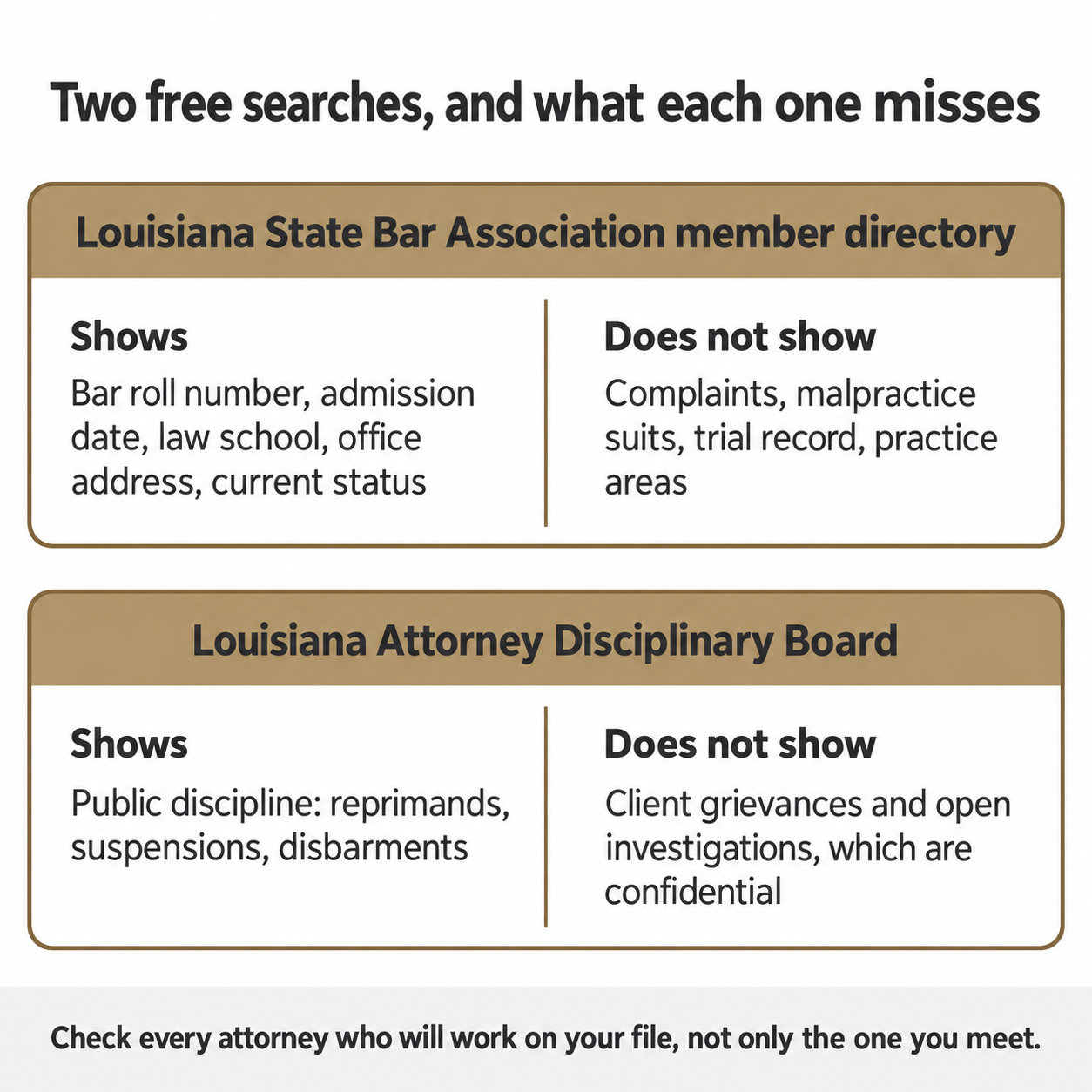
The credentials and bar admissions for each of our attorneys are on our site, so you can check what we have told you against the state’s records.
What should you expect at a first meeting with a malpractice attorney?
You should leave a first consultation knowing your deadline, what proving your claim would involve, and whether the attorney believes you have a claim at all. An attorney who tells you at that first meeting that you do not have a claim is doing you a service, because it leaves you time to ask someone else.
Not every bad medical outcome is malpractice. In a national review of closed malpractice claims, about a third involved no identifiable medical error or no injury caused by one, and most of those claims were denied compensation. Where reviewers did find an error that harmed the patient, most of those claims were paid, though roughly one in four still recovered nothing. Sorting a bad outcome from actual negligence is what the first meeting and the expert record review are for.
If you are told no, ask why, ask what your deadline is, and ask how close it is. Then talk to another firm promptly. Prescription keeps running while you look, and the request for a review panel is the only thing that stops it.
Talk to more than one attorney even when the first meeting goes well. Consultations are free, nothing obligates you to hire anyone, and a second conversation tells you whether the first attorney’s answers were specific to your case or the same answers anyone would get.
We tell people early when we do not think a malpractice claim can be proven. That is not what anyone wants to hear, and hearing it early leaves time to get another opinion before the year runs out.
What to bring to a free consultation, and what to ask
Bring whatever you already have. You do not need a complete medical file, and no attorney expects you to gather records yourself, but the more you bring, the more useful the first meeting will be:
- The name of every provider and facility involved, with the dates you were treated
- Records already in your possession: discharge papers, test results, imaging discs, after-visit summaries
- Bills and insurance statements, including anything showing what has already been paid
- A written timeline of what happened, what you were told, and when you first learned something had gone wrong. That last date can decide your deadline
- The death certificate and any autopsy report, if the patient died
- Names and phone numbers for family members who were in the room for conversations with providers
Questions worth asking before you leave:
- Have you taken claims through Louisiana’s medical review panel, and how did they turn out?
- What is my deadline, and what date does it run from?
- Who handles my file day to day, and who reads the medical records?
- Is the provider who treated me enrolled with the Patient’s Compensation Fund?
- What will the records and experts cost, who advances that money, and what do I owe if we lose?
- Which specialty experts would you use in a case like mine?
- If the panel opinion goes against us, will you file suit?
- Can I read the fee agreement before I sign it?
Talk to a Baton Rouge medical malpractice attorney
If you believe a doctor, a hospital, or a nursing home harmed you or someone in your family, call us at (225) 303-0455 and we will sit down with you at no cost and no obligation. You will meet a partner. You will leave knowing what your deadline is and what we think of your claim. On the cases we take, we advance the cost of the records and the experts, and you owe us nothing unless we recover for you. If you call after hours, we will call you back the next day.
Our office is at 6700 Jefferson Hwy, Building 6, in Baton Rouge. We practice only in Louisiana, and we serve East Baton Rouge, West Baton Rouge, Ascension, Livingston, Iberville, Pointe Coupee, West Feliciana, East Feliciana, and St. Helena parishes.