Yes, you can still recover money after a Louisiana car accident that was partly your fault, as long as your share of the blame stays below 51 percent. Under Louisiana Civil Code Article 2323, your recovery is reduced by whatever percentage of fault gets assigned to you. If your damages come to $100,000 and you are found 30 percent at fault, you collect $70,000. At 51 percent or more, you collect nothing.
The date of your crash decides which version of that rule applies to you. Louisiana only began cutting off recovery at 51 percent on January 1, 2026. For wrecks that happened before that date, the older rule still controls, and even a mostly at-fault driver could recover a reduced amount.
At Melancon, Rimes & Daquanno, we have represented injured drivers in car accident cases across Baton Rouge since 2005, and we have taken arguments about fault all the way to a jury. In one East Baton Rouge case, the insurance company’s lawyers claimed our clients had caused their own wreck by speeding. The judge threw that argument out for lack of evidence, and the jury came back with over $1 million.
Nobody assigned you a fault percentage at the scene. That number is an argument the other side builds over the following weeks, and what you do during those weeks affects how it turns out.
Louisiana’s 51 percent comparative fault rule
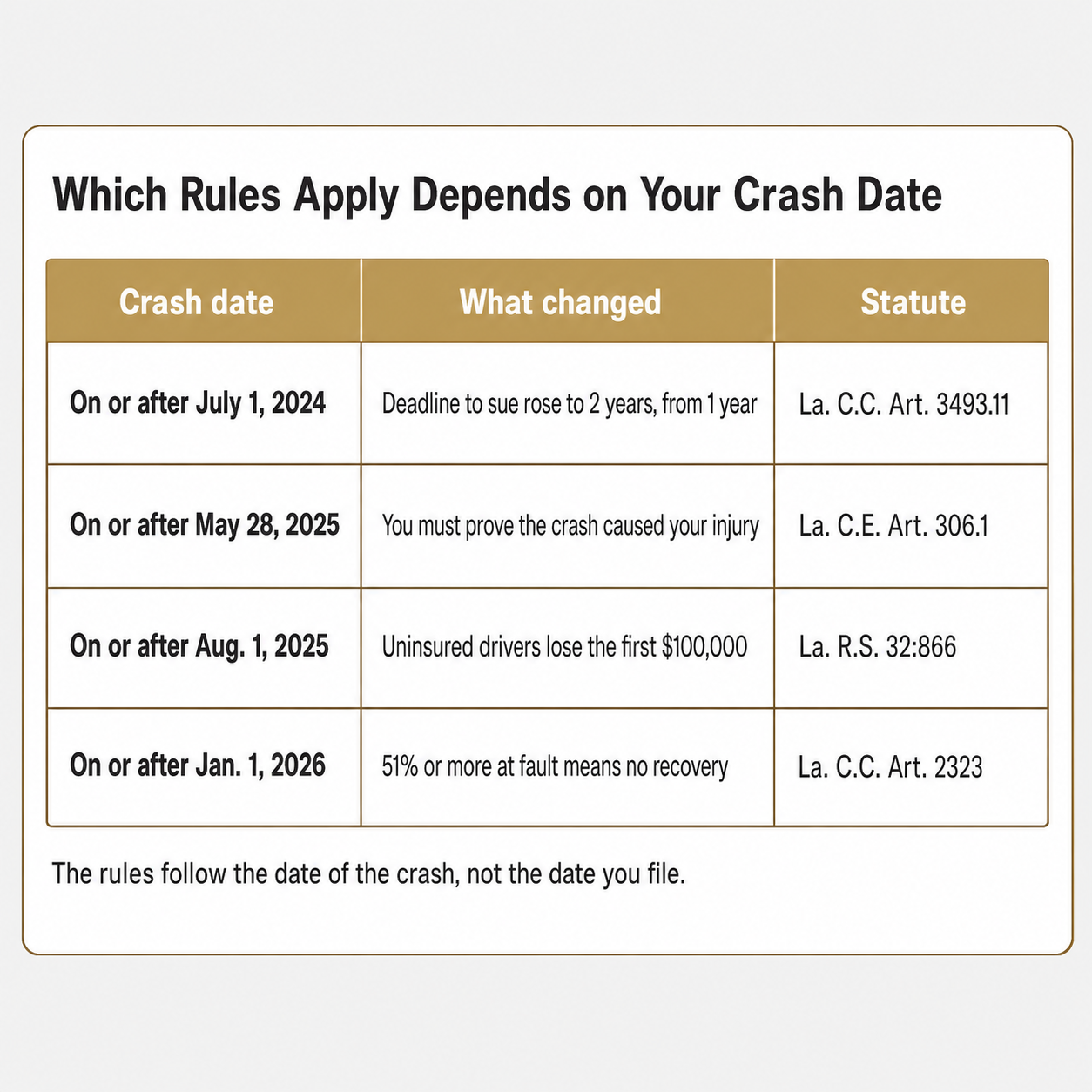
Louisiana now blocks recovery entirely for an injured driver found 51 percent or more at fault. The change came from Act 15 of the 2025 regular session, which amended Civil Code Article 2323. Governor Landry signed it on May 28, 2025, and it took effect on January 1, 2026.
Before that, Louisiana followed what lawyers call pure comparative fault. Your percentage decided how much you collected, not whether you collected anything at all. A driver who was 90 percent responsible for a wreck could still recover 10 percent of their damages. That is no longer the case.
If your share comes in below 51 percent, you still recover, reduced in proportion to that share. A driver found exactly 50 percent at fault takes home half of their damages. One point higher and the recovery is zero.
| Fault assigned to you | Crash before January 1, 2026 | Crash on or after January 1, 2026 |
| 25 percent | 75 percent of your damages | 75 percent of your damages |
| 50 percent | 50 percent of your damages | 50 percent of your damages |
| 51 percent | 49 percent of your damages | Nothing |
| 75 percent | 25 percent of your damages | Nothing |
The jump from 50 to 51 percent is what makes this topic matter so much more than it used to. If an adjuster can push your number from 49 to 51, the company closes the file and pays nothing at all. Expect the other side to argue over small details of your driving that nobody would have bothered with two years ago.
Does the new rule apply to your crash or to your lawsuit?
The rule follows the date of the crash, not the date you file suit. Louisiana Civil Code Article 6 says that a law taking away a right someone already holds applies going forward only. So if your wreck happened on December 15, 2025, you are still under the old pure comparative fault rule, even if the case is filed and tried in 2026 or later.
There is one caveat here, and we would rather you hear it from us. The law is new enough that no Louisiana appellate court has ruled on the question yet. Some insurers have argued that the 51 percent bar should apply to any suit filed on or after January 1, 2026. That argument runs against the way Louisiana normally handles changes of this kind, but it is being made. If your crash falls anywhere near the end of 2025, have a lawyer look at it.
What the jury gets told about your fault percentage
Act 15 also requires the judge to spell out the consequences for the jury. When comparative fault goes to a jury now, the court has to tell jurors that assigning 51 percent or more to the injured person means that person takes nothing home.
That instruction tends to work in an injured person’s favor. Juries have long split fault down the middle as a compromise, without knowing what an even split would cost the person who brought the case. Jurors now hear where the line falls before they answer the question, so a jury that believes the other driver was mostly responsible can see exactly what a 51 percent finding would do.
How your fault percentage actually gets decided
No one at the scene has the authority to set your fault percentage. Not the responding officer, not the other driver, and not the adjuster who calls you three days later with a number. In Louisiana, comparative fault is decided by a judge or a jury, and the defense has to prove your share of it.
The police report causes the most confusion here. Louisiana treats the officer’s crash report as hearsay, which means it generally cannot be handed to a jury to prove how the wreck happened. An officer who did not see the collision can testify about what they personally observed at the scene, things like skid marks, where the vehicles came to rest, gouges in the pavement, and what people said to them. The officer’s opinion about who was to blame does not come in unless that officer is qualified as an accident reconstruction expert.
A traffic ticket does not settle it either. A citation on its own is not proof of negligence in a civil case. How you resolve it is a different matter. Pleading guilty, which is what paying a ticket by mail usually amounts to, can be used against you in the injury claim, so talk to a lawyer before you pay one.
The adjuster’s first number is only an opening position. Adjusters build fault arguments by looking for any violation of Louisiana’s traffic laws they can pin on you, then using your own recorded statement to lock in an admission about your speed, your braking, or where your eyes were. We go through more of that process on our page covering how insurance companies determine fault in a car accident.
The Watson factors Louisiana courts use
When a court divides up fault, it follows a framework the Louisiana Supreme Court laid out in Watson v. State Farm Fire and Casualty Insurance Co. in 1985. The court weighs the nature of what each person did against five factors, then considers how closely that conduct caused the damages:
- Whether the conduct was simple inadvertence or an awareness of the danger. Misjudging how fast an oncoming car was closing is treated differently from pulling out when you already saw it coming.
- How much risk the conduct created. Rolling a stop sign at 5 miles an hour and running a red light in a loaded dump truck are not weighed the same way.
- What the person was trying to accomplish. A driver swerving to avoid a child is judged differently from a driver swerving to make an exit.
- The capacities of each driver. Commercial drivers and professional operators are held to a higher standard than an ordinary motorist.
- Any circumstances that forced someone to act in a hurry. A sudden hazard created by a third party can reduce your share.
- Then, how directly the conduct caused the damages. A minor infraction that had little to do with the collision should not carry the same weight as the act that caused it.
These factors are why a percentage is arguable. Two people can look at the same wreck and come out 20 points apart, and the side that shows up with actual evidence usually wins that argument.
The evidence that changes a fault percentage
Physical and electronic evidence beats competing driver stories almost every time, because it is the only proof in the file with no stake in the outcome. The evidence that tends to decide these disputes includes:
- Event data recorders, the black box in most modern vehicles, which records pre-crash speed, throttle position, braking, and steering input.
- Dashcam footage, business security cameras, and traffic cameras along the route.
- Cell phone records, which can match the timestamp of a text or call to the moment of impact for either driver.
- Physical evidence at the scene, including skid marks, gouges, debris fields, and where each vehicle ended up.
- Independent witnesses who have no relationship to either driver.
- Accident reconstruction by a qualified expert.
We have seen how fast that kind of proof can end a fault argument. In a wrongful death case involving a dump truck that ran a red light on Airline Highway, the defense insisted the crash was unavoidable because of the truck’s weight. We retained experts immediately to pull and analyze the truck’s onboard electronic data, and it showed the driver had accelerated rather than braked. Once that data came out, the insurance company tendered its full policy limits.
What to do if you think you were partly at fault
Report the crash to police
Louisiana law requires you to notify law enforcement of any crash involving injury, death, or property damage over $500. Under Louisiana Revised Statutes 32:398, that report goes to the local police department if the wreck happened inside city limits, or to the sheriff’s office or State Police if it happened outside one. You also have to give the other driver and the investigating officer your name, address, and vehicle registration number, and show your license on request.
Reporting the crash protects you even when you are worried about being blamed. A documented scene, with an officer measuring and photographing, preserves facts that otherwise disappear. Skipping the report will not make a fault argument go away, and it leaves you with less evidence to answer one.
Get medical care right away
See a doctor as soon as you can, and follow through on the treatment you are given. Louisiana changed the rules on proving medical causation in May 2025. Under the old approach, someone who was healthy before a crash and hurting right after it got the benefit of a legal presumption that the crash caused the injury. That presumption is gone. Under Louisiana Code of Evidence Article 306.1, the absence of a prior medical history no longer connects your injury to the collision on its own, and you have to prove that link with affirmative medical testimony.
Gaps in treatment give the other side something to work with. If you wait three weeks to see anyone, expect an argument that whatever is wrong with you came from somewhere else.
We have handled that argument before. In a rear-end case where our client needed low-back fusion surgery, the insurance company’s attorneys claimed the back pain was pre-existing and had nothing to do with the wreck. We ran an exhaustive search of the medical records and proved the accident caused the injury. That case settled for $1.25 million.
Preserve the evidence before it disappears
The proof that keeps your fault percentage down does not last long, and most of it is gone inside a month. Start working on all of it in the first days after the crash:
- Security camera footage from gas stations, shopping centers, and businesses along corridors like Airline Highway, Florida Boulevard, and Siegen Lane is usually recorded within 7 to 30 days unless someone sends a written preservation letter first.
- The event data recorder in a vehicle can be lost for good once the car is dismantled, scrapped, or sold off by a salvage yard. Do not let an insurance company total and dispose of a vehicle before the data has been pulled.
- Tire scuffs, skid marks, gouges, and fluid patterns on the roadway wear away in a matter of days in Baton Rouge weather.
Take photographs of everything while you are still at the scene if you are able to, including both vehicles from several angles, the position of the cars, the traffic controls, and the road conditions. Get names and phone numbers for any witness who stopped.
Be careful what you say to the other driver’s insurance company
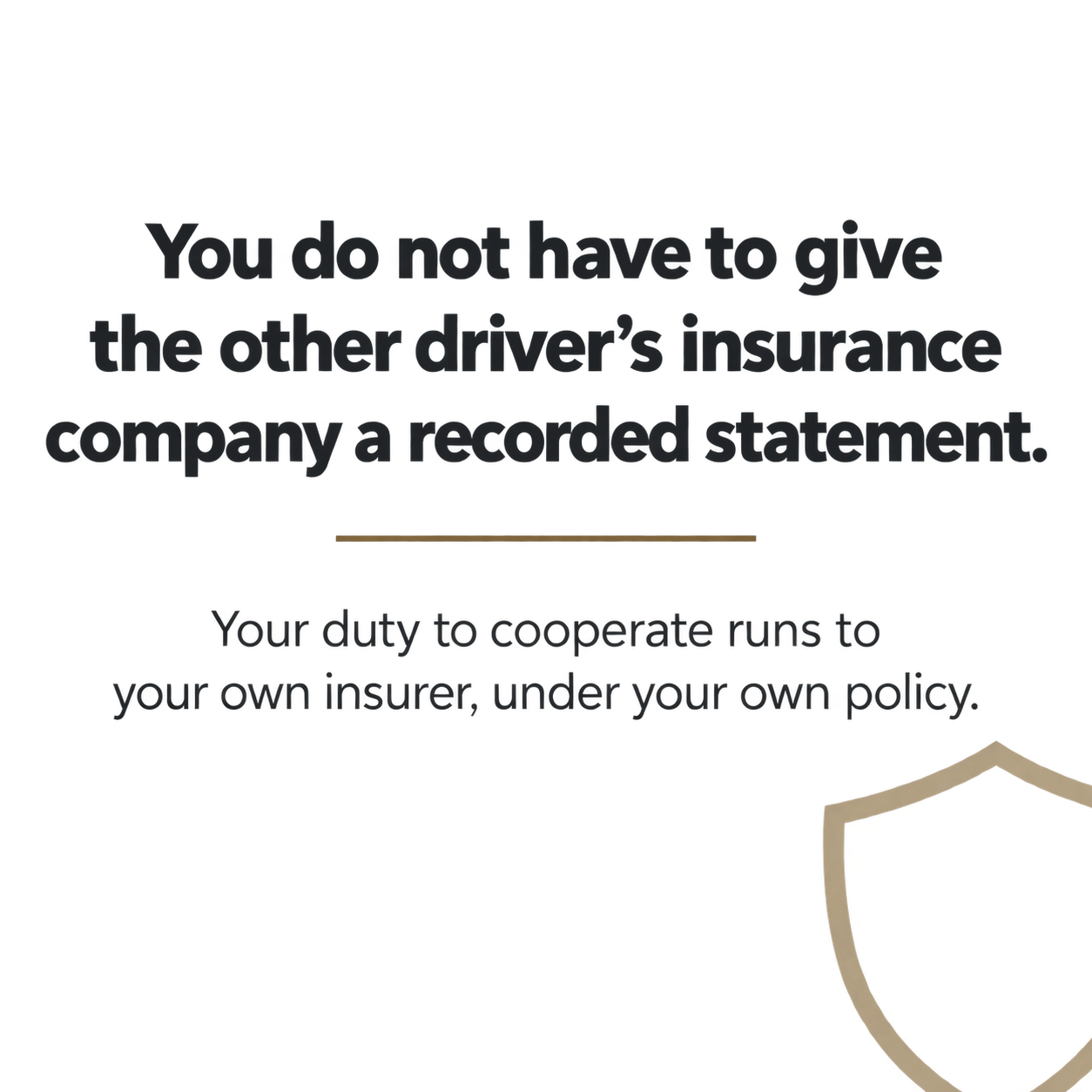
You have no legal obligation to give the other driver’s insurer a recorded statement, and you should not give one before you have talked to a lawyer. Adjusters use recorded statements to lock you into specific numbers about your speed and distances, and to get you saying things that can be read later as admissions of fault. Guessing at “maybe 40, 45” during a phone call becomes a fact in their file.
Your own insurance company is a different matter. Your policy includes a duty to cooperate with your own carrier in investigating the claim, and that obligation is real. You still have the right to have your attorney involved in those communications, particularly on an uninsured or underinsured motorist claim, where your own insurer is the one who will end up paying.
Stay off social media while your claim is open
Do not post about the wreck, your injuries, or your activities while a claim is pending, and ask your family to do the same. Insurers look at public profiles. A photo of you at a crawfish boil two weekends after the crash tells them nothing about how your back actually feels, but it will still show up in a deposition. Adjust your privacy settings and leave it alone until the case is resolved.
Don’t take the first offer
Early offers usually arrive before anyone knows what your injuries are worth. If you have not finished treatment, no one, including your own doctor, can say yet whether you need surgery or how much of your pain is permanent. An offer that shows up two weeks after a wreck is built on that uncertainty, and it is priced low because of it. Once you sign the release, the claim is closed for good, no matter what your doctor finds later.
In a shared-fault case, the offer already has a fault percentage baked into it, and nobody tells you what that percentage is. If the adjuster has decided you were 40 percent responsible, the offer has already been cut by 40 percent, and taking it means agreeing to that number.
What if you already apologized or gave a recorded statement?
Louisiana does not have a law protecting apologies made after a car accident. There is a statute that keeps expressions of sympathy from being used as evidence, but it applies only to healthcare providers in medical malpractice cases. Nothing like it covers drivers. Saying “I’m so sorry, I didn’t see you” at the scene is treated as a statement against your own interest, and the other side can use it.
An apology is still not a finding of fault, and it does not end your claim. People apologize reflexively after a wreck, often before they know what actually happened, and often when the other driver did something they could not have seen. An apology is one piece of evidence. Black box data, video, and physical evidence from the scene can flatly contradict it, and a judge or jury weighs all of it together under the Watson factors.
If you have already apologized or given a recorded statement, here is what to do next. Stop giving statements to the other driver’s insurer. Write down everything you remember about the crash now, while it is fresh, including the parts that support you. Then get a lawyer looking for the physical evidence, because that is what answers the statement.
Seat belts and comparative fault in Louisiana
If you were not wearing a seat belt, expect the other side to raise it. Louisiana used to prohibit defense attorneys from bringing up seat belt use at all, but the Legislature repealed that protection in the Civil Justice Reform Act of 2020, effective January 1, 2021. Since then, an adult driver’s or passenger’s failure to buckle up is admissible both to argue comparative fault and to argue that you failed to limit your own injuries.
That matters more now than it did before 2026. If a defense biomechanical expert testifies that a seat belt would have prevented or reduced specific injuries, the jury can assign you fault for that, and under the current rule, those points can be what pushes your total past 50 percent.
Child passengers are treated differently. Louisiana’s child restraint requirements sit in a separate statute, and a driver’s failure to properly secure a child cannot be charged against the child to reduce that child’s own recovery.
Louisiana’s No Pay, No Play law if you were uninsured
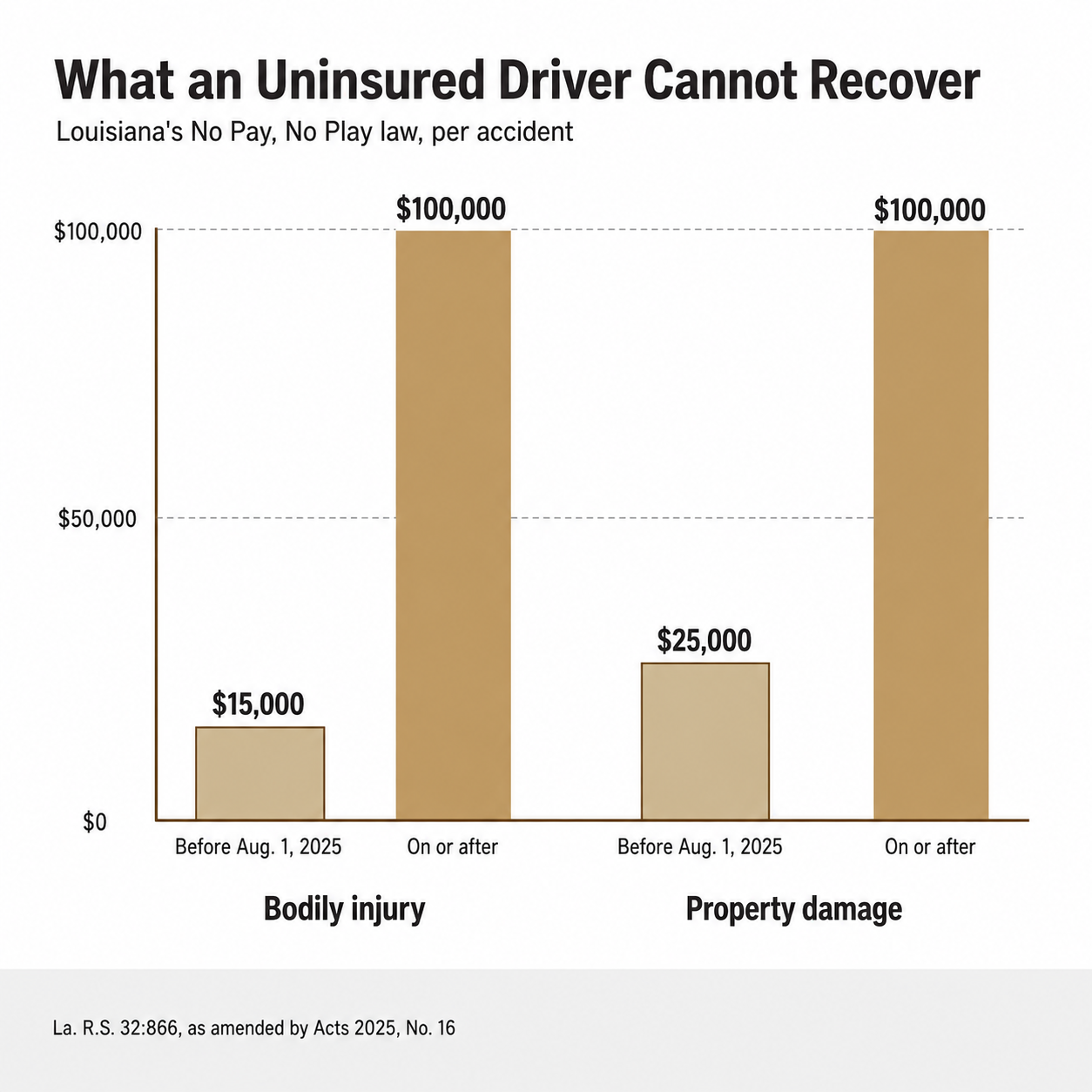
Driving without insurance creates a second problem that has nothing to do with your fault percentage. Under Louisiana’s No Pay, No Play statute, an uninsured driver cannot recover the first portion of their damages even when the other driver caused the wreck. Act 16 of the 2025 session raised those amounts sharply, effective August 1, 2025.
For crashes on or after that date, an uninsured driver cannot recover the first $100,000 of bodily injury damages or the first $100,000 of property damage. The old thresholds were $15,000 and $25,000. The statute bars recovery for that first $100,000 without carving out any category of damages, so medical bills and lost wages count against the threshold too, not just pain and suffering. There is also a cost provision: an uninsured driver who files suit and is awarded $100,000 or less has to pay the court costs of the litigation, whether or not they were at fault.
The bar does not apply if the at-fault driver was cited for DWI and convicted or pled no contest, intentionally caused the collision, fled the scene, or was committing a felony at the time.
If you were both uninsured and partly at fault, you are facing two separate obstacles stacked on top of each other. That is a hard spot to be in, and plenty of people in it still have a claim worth pursuing, particularly where one of those exceptions applies. Please have someone look at the facts before you decide there is nothing there.
How long you have to file a car accident claim in Louisiana
For crashes on or after July 1, 2024, you have two years from the date of injury to file suit. For crashes before that date, the old one-year deadline still applies. The Legislature made that change in 2024, and it did not revive any claim that had already expired under the one-year rule.
Two years sounds like plenty of time, and for the paperwork it is. The problem is that the evidence deciding your fault percentage disappears in the first weeks. Security footage gets recorded over, damaged vehicles get scrapped with the black box still in them, and skid marks wash off the road. Waiting a year to call a lawyer usually means the proof you needed is already gone.
Common questions about shared fault in Louisiana
What happens if we were each 50 percent at fault?
You each recover half of your damages. Fifty percent is on the recoverable side of the line, and the bar only kicks in at 51 percent. That is why the difference between a 50 and a 51 percent allocation is worth fighting over in a way that a 30 versus 35 percent dispute never was.
Does the police report decide who was at fault?
No. The officer’s crash report is hearsay under Louisiana’s evidence rules and generally cannot be used at trial to prove how the collision happened. Adjusters lean on it heavily during negotiations, and it carries real weight in that setting, but it does not bind a court and it is not the last word on your percentage.
Do I have to give the other driver’s insurance company a recorded statement?
Louisiana law does not require it, and there is rarely a good reason to give one. Your duty to cooperate runs to your own insurance company under your policy, not to the other driver’s.
Will my insurance rates go up if I was partly at fault?
Possibly, but that is a separate question from your injury claim. Your premium is set by your own carrier under its underwriting rules, and it is not decided by the fault percentage a court eventually assigns in your case. Worrying about a rate increase is not a good reason to skip medical treatment or walk away from a claim worth far more than the premium difference.
What if I got a ticket at the scene?
A citation by itself is not proof that you were negligent in a civil case. How you resolve the charge is what matters. Pleading guilty, including by paying the ticket by mail, can be used against you in the injury claim. Talk to a lawyer before you pay it.
Talk to us before you decide you have no case
The hardest part of this for most people is that they have already made up their minds. They apologized at the scene, or the officer wrote something in the report, or an adjuster told them flatly that the crash was their fault, and they never called anyone. That decision costs Louisiana drivers real money, and the 51 percent rule makes it a more expensive mistake than it used to be.
At Melancon, Rimes & Daquanno, a partner handles your case from start to finish, and we prepare every case as though it is going to trial. In more than 20 years of trying cases, we have lost one. Your consultation is free, we work on personal injury cases on a contingency fee so you owe us nothing unless we win, and we advance the case costs ourselves. We serve East Baton Rouge, West Baton Rouge, Ascension, Livingston, Iberville, Pointe Coupee, West Feliciana, East Feliciana and St. Helena parishes, including Port Allen, Zachary, Baker, Central, Denham Springs, Clinton and St. George.
Call us at (225) 303-0455 and tell us what happened. If the evidence that decides your percentage is still out there, we would rather go looking for it now than in six months.