A DUI arrest in Louisiana starts two separate cases, and the one most people miss is the case over their driver’s license. The offense itself is operating a vehicle while impaired under La. R.S. 14:98, though almost everyone, including the courts, calls it DWI. DUI and DWI mean the same thing in this state. The criminal case moves on the court’s schedule. The license case is handled by the Office of Motor Vehicles, and you have 30 calendar days from the date of your arrest to request a hearing in writing. That clock runs whether or not the criminal charge has been filed yet, and a good result in criminal court later does not automatically give your license back.
At Melancon, Rimes & Daquanno, we have practiced in Baton Rouge courts since 2005, and our three partners bring more than 50 years of combined experience in Louisiana state and federal courts. DUI and DWI defense sits inside our traffic violations practice. The two decisions that are hardest to undo both come early: letting the 30-day license deadline pass, and pleading guilty at your first court date before you know what that plea does to your record.
A DUI arrest starts two separate cases
The two cases run at the same time, and each one has its own decision maker, its own deadline, and its own consequence. They do not wait for each other, and neither one controls how the other turns out.
| License case | Criminal case | |
| Who handles it | The Louisiana Office of Motor Vehicles, with hearings held by the Division of Administrative Law | The city, parish, or district court where you were charged, with a judge and a prosecutor |
| What is at stake | Your driving privileges | Fines, jail, probation, and a criminal record |
| Law that governs it | Title 32, mainly La. R.S. 32:661, 32:666, and 32:667 | Title 14, mainly La. R.S. 14:98, or a city ordinance |
| First deadline | 30 days from your arrest to request a hearing in writing | Your first court date, set by the court once charges are filed |
| Effect on the other case | Winning the license hearing does not stop the prosecution | A dismissal in court does not automatically undo the suspension |
There is one narrow exception. Under La. R.S. 32:667(H), if the criminal charges are dismissed, refused by the prosecutor, or end in an acquittal, your license is to be reinstated. That provision specifically does not apply to dispositions under La. C.Cr.P. art. 893 or art. 894, so whether the path is open depends on how the case ended. It is not what usually happens, so the license case still has to be handled on its own timeline.
Can I still drive after a DUI arrest in Louisiana?
Usually yes, for a limited time. If you refused chemical testing, or your test showed a blood alcohol concentration of 0.08 percent or higher, the arresting officer takes your physical license and hands you a temporary receipt approved by the Department of Public Safety and Corrections. For drivers under 21, the threshold is 0.02 percent. That temporary receipt lets you drive for up to 30 calendar days from the date of arrest, and then it expires.
If you request the license hearing within the 30-day window, the department has to issue paperwork extending that temporary permit under La. R.S. 32:667(D)(1). The extension lasts until the administrative case is decided, and the department is required to forward your file to the Division of Administrative Law for a hearing within 60 days of receiving your request. That is a practical reason to file on time even if you are not confident about the hearing itself, because filing keeps you driving while it is pending.
Blood draws work a little differently, because the results are rarely back on the night of the arrest. The officer still issues the temporary receipt. If the OMV has not received your blood results within 30 days of the arrest, or the results come back under 0.08 percent for an adult driver, there is no administrative hearing and your license is returned without a reinstatement fee.
The deadline to request a license hearing is 30 days
You have 30 calendar days from the date of arrest to send the OMV a written request for an administrative hearing, and the request has to be in writing. The temporary receipt the officer hands you serves as notice of that deadline, and the department provides a form for making the request. A phone call does not count. If you have read somewhere that the deadline is 15 days, that was the old rule. The Legislature extended it to 30 days in 2012.
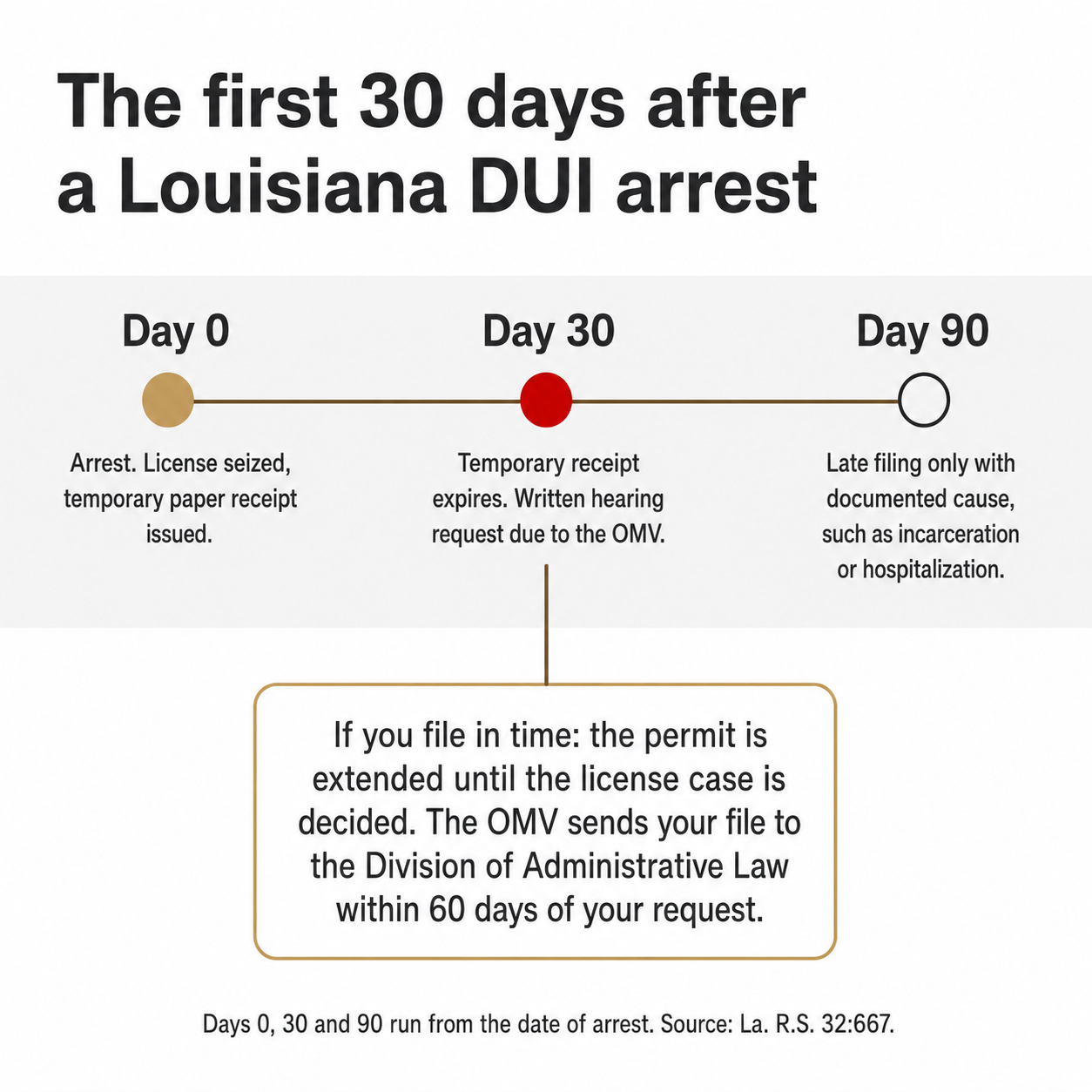
The deadline is the same whether you took the test and failed it or refused testing altogether. There is one exception, for people who could not physically file in time. Under La. R.S. 32:667(A)(2)(b), the window extends to as much as 90 days from arrest if you can show the department that incarceration, hospitalization, or another reason it accepts kept you from filing. If the department denies a request filed under that provision, the denial can be reviewed by the district court in your parish.
What the license hearing actually decides
The administrative hearing is narrow. It is not a trial over whether you were drunk. Under La. R.S. 32:668, the scope of the hearing is limited to the following:
- Whether the officer had reasonable grounds to believe you were driving or in actual physical control of a vehicle while under the influence of alcohol or drugs.
- Whether you were placed under arrest.
- Whether the officer advised you as required by La. R.S. 32:661, the implied consent warning.
- Whether you voluntarily submitted to an approved chemical test, and whether it showed 0.08 percent or higher (0.02 percent or higher if you are under 21).
- Whether you refused the test after the officer asked you to take it.
- Any additional matters relating to your legal rights, including whether the department followed its own regulations.
That last item is broader than the rest of the list, and it is where most of the real argument happens. Two other features of the hearing are worth knowing. It runs primarily on the written records the Department of Public Safety and Corrections submits, and the statute says no law enforcement officer can be compelled by you to appear or testify. In exchange, there is a rebuttable presumption that any inconsistencies in the department’s own evidence are construed in your favor.
How long is a DWI license suspension in Louisiana?
A first offense carries a suspension of 180 days to two years. Which one you get depends on your test result, whether you refused, your age, and whether you hold a commercial license. These are the administrative suspensions under La. R.S. 32:667, separate from anything the criminal court does.
| Situation | Suspension | Restricted license with interlock |
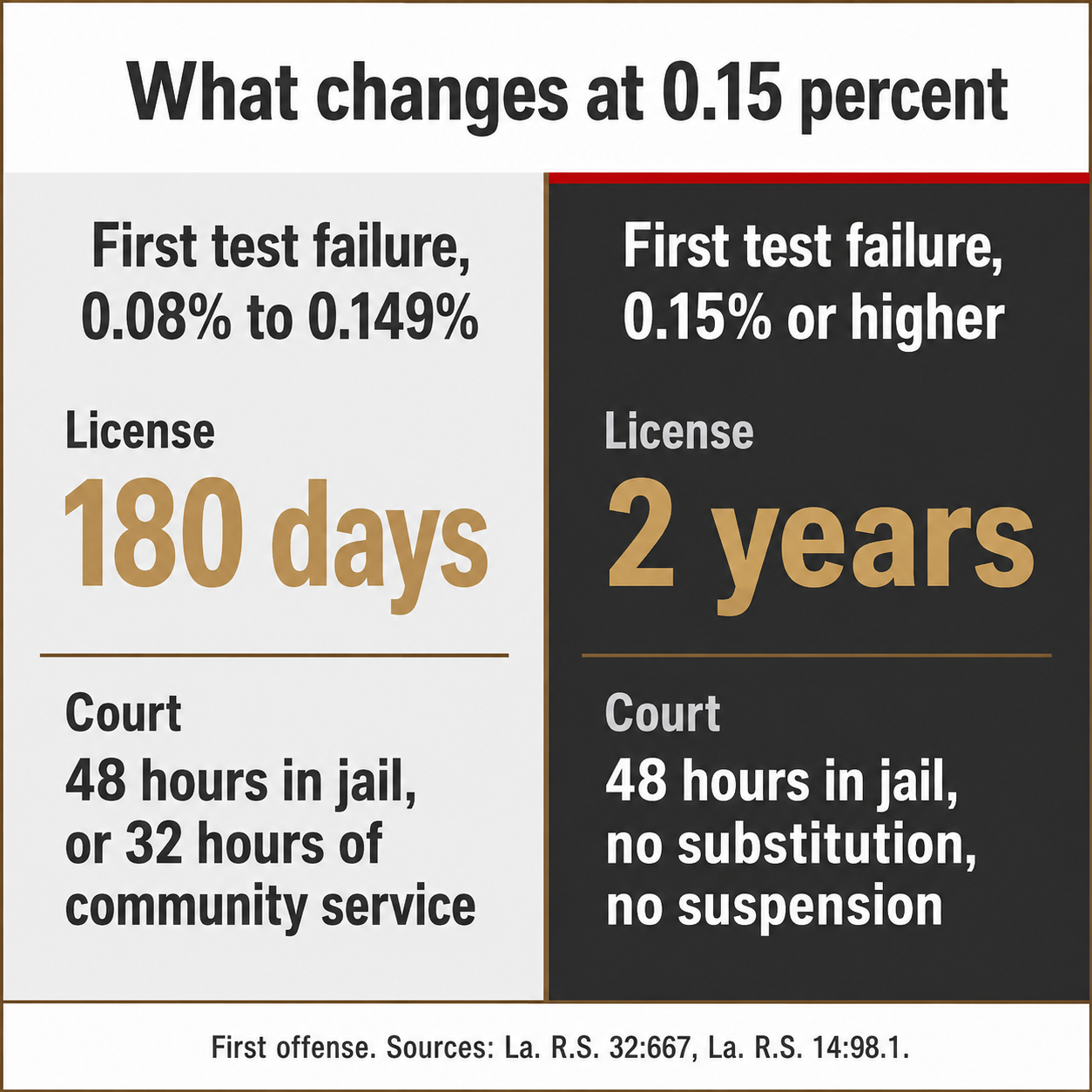
| First test failure, BAC 0.08% to 0.149% | 180 days | Available immediately on proof of interlock installation |
| First test failure, BAC 0.15% or higher | 2 years | Available for the full 2 years on proof of interlock installation |
| First refusal to test | 1 year | Available immediately on proof of interlock installation, but barred entirely if the arrest involved a fatality or serious bodily injury and intoxication is found to be a contributing factor |
| Second or later refusal within 10 years | 2 years | Same bar applies where there was a fatality or serious bodily injury |
| Under 21, BAC 0.02% to 0.079% | 180 days | Hardship provisions apply |
| Commercial license holder, any vehicle | 1 year disqualification, 3 years for hazardous materials | Not available under state or federal law |
The 0.15 percent line in that table is recent. A 2023 change lowered the high-BAC threshold from 0.20 percent to 0.15 percent, so a first-offense test result of 0.15 percent now brings a two-year administrative suspension instead of 180 days.
Ignition interlock and driving during a suspension
On a first offense, the interlock route opens right away. Under La. R.S. 32:667(B)(3), a driver suspended for a first test failure below 0.15 percent, or for a first refusal, becomes immediately eligible for a restricted license once the OMV has proof that an approved ignition interlock device is installed on the vehicle they drive, and a driver suspended at 0.15 percent or above is eligible for the whole two years on the same proof. If the department refuses to issue it, the district court in your parish can order it.
The interlock is what makes that immediate. A restricted license without one still carries a waiting period under La. R.S. 32:668(B): 30 days into the suspension after a test failure, and 90 days after a refusal.
Three other things are easy to miss:
- The OMV also requires proof of financial responsibility, usually an SR-22 filing from your insurer, and it has to stay in place. Letting it lapse can put your license back into suspension.
- The device comes off only after the OMV authorizes removal. Taking it off early puts you back in violation, and you get credit only for the time it was installed and working.
- A criminal court judge can restrict your driving separately, because probation conditions come from the court rather than the OMV. A restricted license from the OMV does not override a driving restriction a judge imposes.
What happens at your first court date
Your first court appearance is the arraignment, where the court tells you exactly what you are charged with and you enter a plea. A not guilty plea at that stage is standard. It does not commit you to a trial, and it keeps your options open while your attorney reviews the police report, the test results, and the video.
Timing depends on which court has your case and, in the 19th Judicial District Court, on when the District Attorney formally files charges. Neither court publishes a standard interval, so the date on your paperwork is the one to work from.
If your case is in Baton Rouge City Court at 233 St. Louis Street, arraignments for DWI and associated charges are held in Courtroom 128 on the first floor, and you report directly to the bailiff in that courtroom when you arrive. If the case is later set for trial, that moves to a different courtroom on the third floor.
Which court hears your case depends on the agency that arrested you and where the stop happened. Cases inside East Baton Rouge Parish go to Baton Rouge City Court or the 19th Judicial District Court, and arrests in Livingston, Ascension, West Baton Rouge, Iberville, Pointe Coupee, and the Felicianas go to that parish’s district court.
Should you plead guilty at your first appearance?
In most cases, not at the first appearance. A guilty plea at arraignment is the fastest way to end a case. It also closes off the two routes people use to keep a first offense off their record.
The first is East Baton Rouge Parish’s pretrial intervention program, which is a pre-adjudication program, meaning no guilty plea is entered. The second is the deferral process under La. C.Cr.P. art. 894. For a DWI, that one can be used only once every ten years, and the judge decides whether you get it, so it is not something you are entitled to.
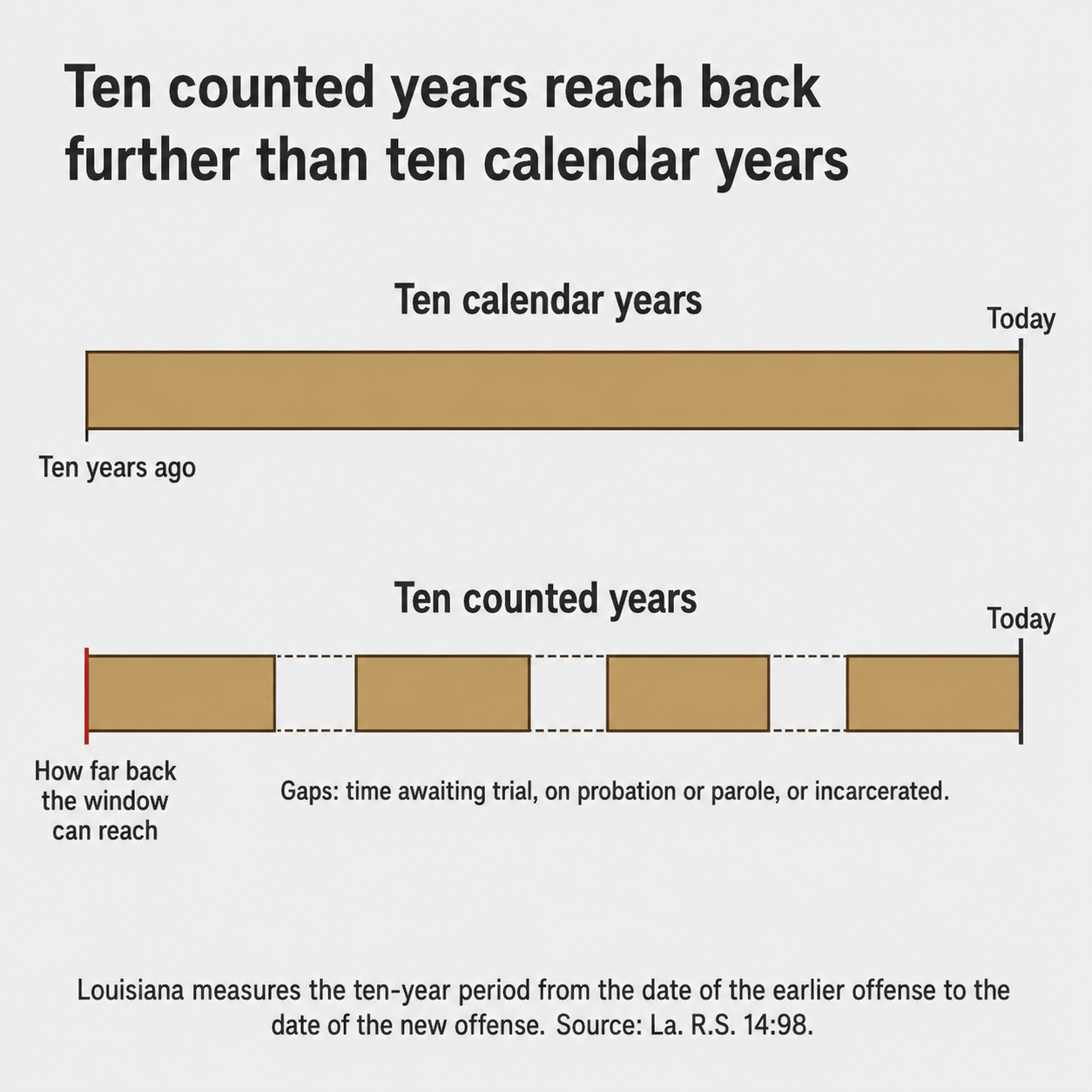
A first-offense conviction also follows you as a prior offense. Louisiana uses a ten-year lookback period, measured from the date of the earlier offense to the date of the new one. Time you spent awaiting trial, on probation or parole, or incarcerated does not count toward those ten years, which means the window reaches back further than a calendar reading suggests. A second arrest inside it is charged as a second offense, with heavier penalties.
Whether any of these options fits your case depends on the prosecutor, the judge, and the facts of the arrest. None of them is automatic, and none of them is available after a guilty plea has been entered and accepted.
What a first-offense DWI carries under Louisiana law
A first-offense DWI is a misdemeanor under La. R.S. 14:98.1. The statute sets a fine of $300 to $1,000, plus a $25 fee that goes to the Louisiana Emergency Response Network, and jail exposure of 10 days to six months.
Jail time on a first offense is frequently suspended, but the court can only suspend it by placing you on probation with all of the following conditions:
- Jail or community service. Serve 48 hours in jail, which cannot itself be suspended, or in place of that perform at least 32 hours of court-approved community service, at least half of it in a litter abatement or collection program.
- A substance abuse program. Court-approved, and see the screening requirement below.
- A driver improvement program. Court-approved.
- A driving restriction. The court orders that you not drive during probation, for at least six months, unless any vehicle you operate has a functioning ignition interlock device installed.
That last condition catches people out. It comes from the criminal court, not the OMV, and it runs on its own clock.
As of August 1, 2026, the substance abuse program has to include a screening for substance use disorder. That change came from Act 212 of the 2026 Regular Session, which named La. R.S. 14:98.1 and 14:98.2 the Judge Jules Edwards, III Impaired Driving Prevention Act. The screening tool has to be evidence-based and validated for the impaired driving population, the findings are confidential and go directly to the court, the prosecutor, and your attorney, and if the screening shows you are at risk, the court may order a fuller assessment by a licensed clinician.
Your test result can also take options away from the judge:
- At 0.15 percent to 0.199 percent, at least 48 hours of the jail sentence has to be served, with no parole, probation, or suspension available for that part.
- At 0.20 percent or higher, the fine rises to between $750 and $1,000, at least 48 hours of jail cannot be suspended, and the license suspension is longer.
- If a child 12 or younger was in the vehicle, the Child Endangerment Law in La. R.S. 14:98(B) prevents the court from suspending the minimum mandatory jail term.
Penalties climb sharply for repeat offenses. A third DWI within the ten-year window is a felony carrying a $2,000 fine and one to five years, with at least one year that generally cannot be suspended, and the state can move to seize the vehicle. A fourth or later offense under La. R.S. 14:98.4 carries a $5,000 fine and 10 to 30 years with or without hard labor, two years of which generally cannot be suspended. A 2025 amendment expanded mandatory vehicle impoundment and forfeiture on repeat felony convictions.
What happens if you refused the breath or blood test
Refusing the test does not make the case go away, and in Louisiana it carries real costs. The first is a longer suspension: one year for a first refusal, compared with 180 days for a first test failure in the 0.08 to 0.149 percent range.
The second is that the refusal itself can be used against you in court. Louisiana’s implied consent law says that by driving on public roads you have already consented to a breath, blood, or urine test if you are arrested for impaired driving. Under La. R.S. 32:666, evidence that you refused is admissible in any criminal action arising out of the arrest, and prosecutors commonly use it to argue that you refused because you knew what the test would show. The same statute makes that evidence inadmissible in a civil case, except to suspend or revoke your license. The rule on criminal admissibility is different in some other states, so refusing is not the safe default people often assume it is.
A low test result or no test result does not end the case either. La. R.S. 14:98(A)(1)(a) makes it a crime to operate a vehicle while impaired by alcohol, which is a separate charge from operating with a BAC of 0.08 percent or higher. Prosecutors can pursue that charge on the officer’s observations of your driving, your speech and balance, and your performance on field sobriety tests. Lab results showing prescription medication, over-the-counter drugs, or other substances in your system can support it as well.
Can a first offense be kept off your record in Baton Rouge?
There are two main routes in East Baton Rouge Parish, and they work differently enough that the choice matters. Neither one is granted automatically.
| Pretrial intervention | Article 894 deferral | |
| Who decides | The East Baton Rouge Parish District Attorney, after screening | The judge presiding over your case |
| Guilty plea required | No | Yes, a guilty or no contest plea |
| How the case ends | The charge is dismissed, rejected, or the prosecution drops it with prejudice | The conviction is set aside and the prosecution dismissed |
| Effect on future options | No plea is entered, so it does not use up your one-per-ten-years Article 894 option | Uses up that one-per-ten-years option |
| What it involves | An individual plan that may include classes, evaluation and treatment, community service, restitution, and program fees | Supervised probation, court-ordered classes, and conditions |
The pretrial intervention program is run out of the District Attorney’s office at the Public Safety Building on Airline Highway. All first-time, non-violent defendants are to be considered for it, and screening weighs the facts of the case, criminal history, the victim’s wishes, and the impact on the community. Fees are set case by case rather than published in advance, and the office states that no one is turned away solely for inability to pay.
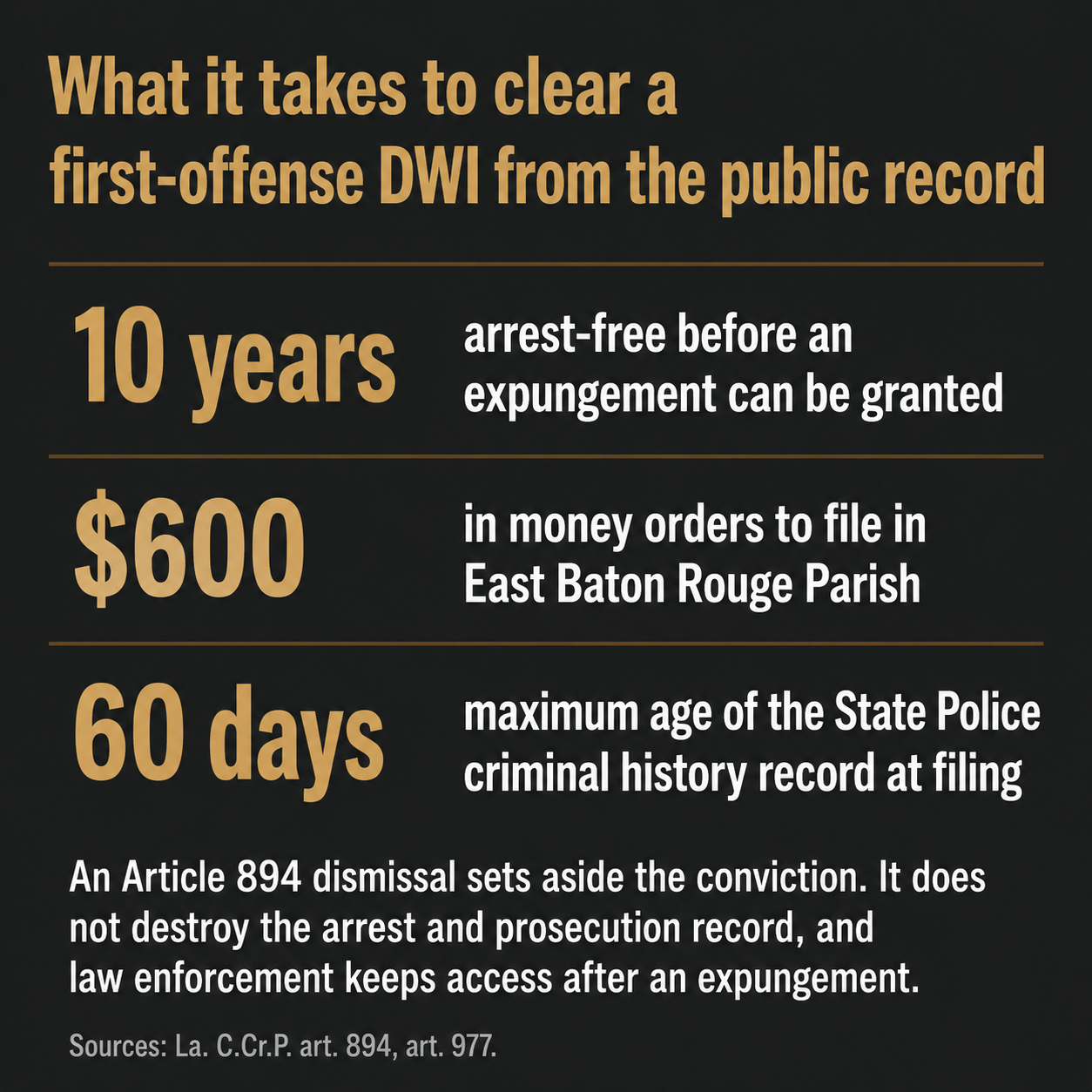
Neither route clears the public record on its own. An Article 894 dismissal has the effect of an acquittal, but the statute is explicit that it is not a basis for destroying the arrest and prosecution records, and the offense still counts as a prior conviction if you are arrested again inside the ten-year window. Clearing the public record requires a separate expungement under La. C.Cr.P. art. 977, and a misdemeanor DWI requires a ten-year arrest-free waiting period before an expungement can be granted. For cases in East Baton Rouge Parish, the filing takes $600 in money orders for a DWI, along with a criminal history record from the Louisiana State Police obtained within 60 days of filing. Even after an expungement, law enforcement retains access to the original record for investigative and prosecution purposes, though employers and landlords no longer see it.
Baton Rouge City Court also runs a Sobriety Court for drivers arrested inside city limits who have been arrested for DWI two or more times, and for other DWI offenders who want to make a change. Entry requires a guilty plea and at least a year of probation, with status conferences before the Sobriety Court judge and weekly team staffing meetings beforehand. Participants pay a $100 application and assessment fee and $160 a month covering drug screening and program costs. Finishing without sanctions can mean the court fine is waived and eligibility for dismissal and record relief on the driving record under La. R.S. 894.1.
If there was a crash, or if someone was hurt
If the arrest followed a collision, the charge itself may be different. Louisiana has separate offenses for causing injury while impaired, and they get more serious as the injury gets worse:
- Vehicular negligent injuring, La. R.S. 14:39.1, applies when someone is injured. It is a misdemeanor with a fine up to $1,000, up to six months in jail, or both, and a BAC at or above 0.15 percent adds a mandatory minimum jail term.
- First degree vehicular negligent injuring, La. R.S. 14:39.2, applies when the injury is serious, meaning things like unconsciousness, extreme physical pain, or lasting loss of function. It is a felony with a fine up to $5,000, up to ten years with or without hard labor, or both. At a BAC of 0.15 percent or above, or with a prior impaired driving conviction, the range becomes two to ten years with at least two years that cannot be suspended.
- Vehicular homicide, La. R.S. 14:32.1, applies when an impaired driver causes a death. It is a felony carrying five to 30 years with or without hard labor and a fine between $2,000 and $15,000, with at least three years that cannot be suspended, rising to five years at higher BAC levels or with a prior conviction.
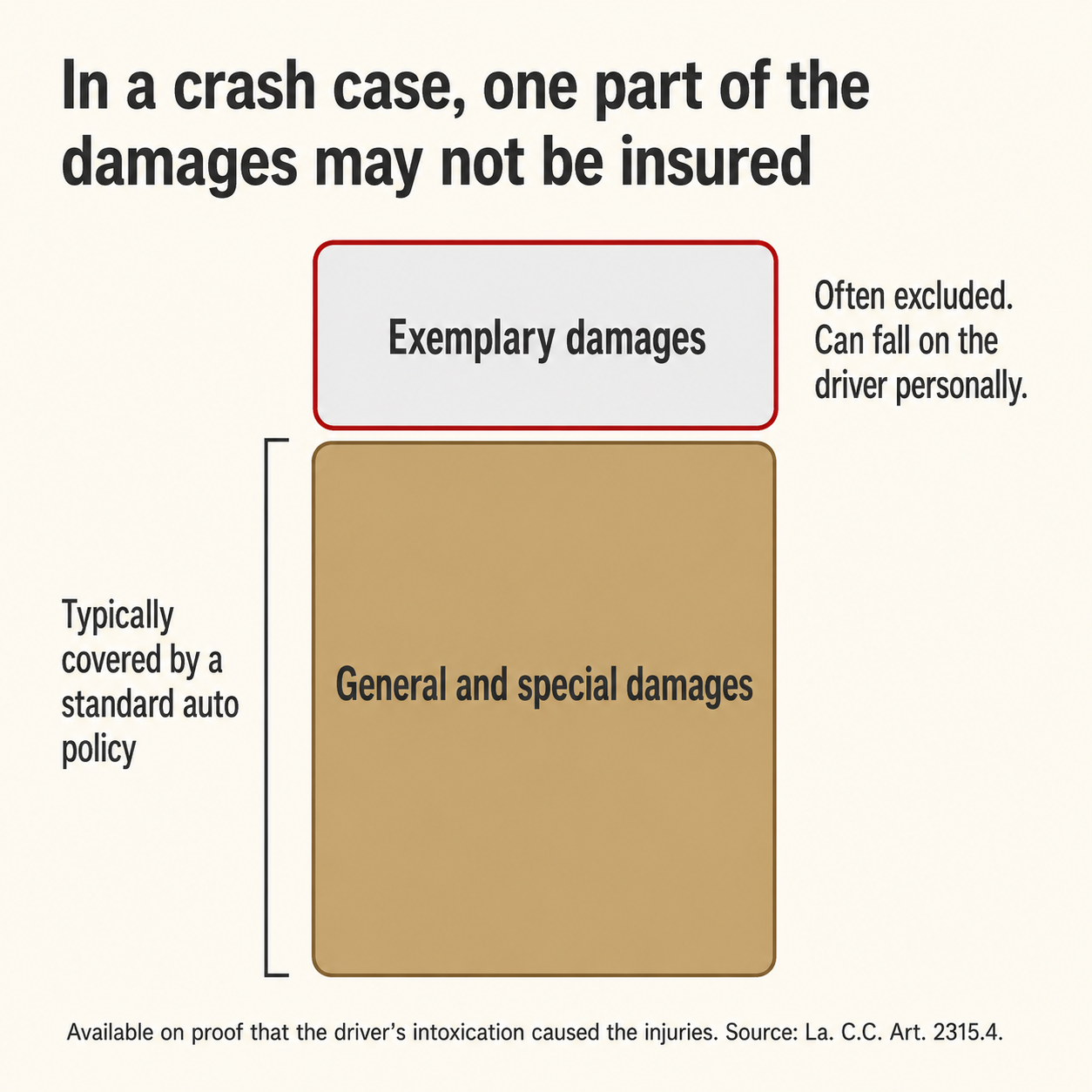
There is a civil side as well, and it is a third proceeding on top of the other two. Under Louisiana Civil Code Article 2315.4, a person injured by an intoxicated driver can seek exemplary damages, sometimes called punitive damages, in addition to ordinary damages. Standard auto policies often exclude coverage for exemplary damages, which means that portion of a judgment can fall on the driver personally.
A crash also affects the license case. Where a fatality or serious bodily injury resulted and intoxication is found to be a contributing factor, a driver who refused testing is barred from a hardship license entirely, on a first refusal as well as a later one.
How a DWI affects your job, your CDL, and professional licenses
Commercial drivers face the strictest rules, and they apply even when the arrest happened in a personal vehicle. Under La. R.S. 32:414.2, a first test submission or refusal disqualifies a commercial license for at least one year, or at least three years if you were hauling placarded hazardous materials. A second major violation brings lifetime disqualification, which federal rules may allow to be reduced to no less than ten years. There is no economic hardship license to operate a commercial motor vehicle, and losing your regular Class D or E driving privileges disqualifies you from commercial driving as well. An Article 894 disposition does not undo a disqualification, because the license statutes reach cases where the sentence was deferred under Article 893 or 894.
Insurance changes too. Standard policies are commonly cancelled or not renewed after a DWI suspension or conviction, and the SR-22 filing required to keep driving is a high-risk designation that raises premiums.
Licensed professionals should check their own reporting obligations. State boards in fields like medicine, nursing, law, engineering, and accounting generally require disclosure of impaired driving arrests or convictions, and they can open proceedings independent of the court case. Federal contractors in the Baton Rouge industrial corridor may also face security clearance review. For everyone else, the arrest record stays publicly searchable until it is expunged, which is how employers and landlords find it.
How long does a DUI case take in Louisiana?
There is no standard timeline, and neither the courts nor the OMV publish one. What determines the length is the same set of variables in every case: which court has it, how quickly charges are filed, how much evidence has to be exchanged, whether pretrial motions are filed, and whether it is set for trial.
What you can count on is the order. The license case moves on a fixed 30-day trigger and finishes sooner, which is why it needs attention first. Some obligations also outlast the case itself. Probation, interlock requirements, and the SR-22 filing continue on their own schedules after the court file is closed.
What not to do after a DUI arrest
- Do not talk to police about the arrest after you are released. That includes calls asking you to clarify something from the report. Anything you add becomes evidence.
- Do not discuss the facts of that night with friends, family, or coworkers. Anyone you tell can be asked about it later. Conversations with your attorney are protected. Conversations with everyone else are not.
- Do not post about it. Photos, check-ins, and comments about the arrest or the night in question are all findable, and so are the ones your friends post.
- Do not let the 30-day license deadline pass while you wait for a court date. The two clocks are unrelated.
- Do not drive on a suspended license or take an interlock device off before the OMV authorizes it. Both create a new problem on top of the original one.
Do you need a lawyer for a first-offense DUI?
You are not required to have one for a misdemeanor. A first offense is harder to handle than it looks, because the decisions with the longest consequences all come early. That includes whether the hearing request goes in on time, what plea you enter at arraignment, whether pretrial intervention is available in your case, and whether you use up your one Article 894 opportunity now or save it. Several of those cannot be revisited later.
At Melancon, Rimes & Daquanno, a partner handles your case directly from start to finish rather than passing it to an associate, so you talk to the attorney doing the work. Our partners are admitted in all Louisiana state courts and in the United States District Courts for the Middle, Eastern, and Western Districts of Louisiana, and we appear in the 19th Judicial District Court and the surrounding parish courts regularly. You can read more about our firm and how we work.
If you were arrested in the greater Baton Rouge area, we offer a free initial consultation to go over where your case stands and which deadlines are in front of you. Call us at (225) 303-0455 or use the contact form on our website. Our office is at 6700 Jefferson Hwy, Building 6, in Baton Rouge, and we are open Monday through Thursday from 8:30 a.m. to 4:30 p.m. and Friday from 8:30 a.m. to 3:30 p.m. If you reach us after hours, we will call you back the next business day. When you call, have the date of your arrest handy, because the 30-day license deadline runs from that date.