Look for an attorney who practices Louisiana civil law every day, knows which filing deadline applies to your specific claim, has appeared in the parish district court where your case would be heard, and has tried business cases to a verdict. Admission in Louisiana’s federal district courts belongs on that list too, because a defendant can move a business case into federal court without your agreement. Louisiana is the only state in the country built on civil law rather than common law. The rules that decide contract disputes, filing deadlines, and available damages come from the Louisiana Civil Code, and several of them have no counterpart anywhere else in the United States. Business litigation experience earned in Texas or Mississippi does not transfer here cleanly.
At Melancon, Rimes & Daquanno, we have handled commercial disputes in Louisiana state and federal courts since 2005. Our work includes a consumer fraud class action against a homeowner’s insurance company that ended in a judgment and settlement exceeding $14 million for roughly 67,000 Louisiana citizens. We also handled a vertical antitrust case that settled for $1.5 million after we defeated the defendants’ summary judgment motions and exceptions in both the district court and on appeal. Most of the questions worth asking a prospective attorney are specific to Louisiana, and you should expect clear answers to all of them in a first meeting.
What makes hiring a business litigation attorney in Louisiana different?
Louisiana courts start from the Civil Code rather than from prior court decisions. Under Civil Code articles 1 through 3, legislation and custom are the only authoritative sources of law in this state. Judicial opinions interpret that legislation and they carry real weight, but they do not create law the way binding precedent does in a common law state.
That changes how your case gets argued. Louisiana follows a doctrine called jurisprudence constante, which means a single ruling does not bind a district judge if it conflicts with the plain text of the Code, even when that ruling came from a higher court. Only a settled line of decisions all reaching the same result carries that kind of persuasive force. An attorney who builds an argument out of out-of-state opinions or one favorable appellate decision, without tying it to a codal article, can lose the point in front of a state district judge who reads the Code first.
The substance of contract law is different too. In most states, a contract binds you because of consideration, meaning each side gave up something of value. Louisiana does not use consideration at all. Under Civil Code article 1967, an obligation binds you because of cause, which is the reason a party obligated itself. That same article also recognizes detrimental reliance, so a promise your company reasonably relied on, to its financial detriment, can be enforceable here even without a signed exchange. A lawyer who reads your contract the way a Delaware or Georgia lawyer would is starting from the wrong question.
Early defenses work differently as well. Louisiana does not use motions to dismiss under the federal rules. It uses exceptions, and there are three kinds. Declinatory exceptions challenge the court itself, on grounds like improper venue. Dilatory exceptions raise procedural defects, such as a suit filed before a contractual precondition was met. Peremptory exceptions ask the court to end the case permanently, and they include prescription, no cause of action, and no right of action.
The timing rule is what catches people. Declinatory and dilatory exceptions have to be pleaded together, before an answer is filed, or they are waived for good. Peremptory exceptions can be raised almost any time before the case is submitted, which is why a well-prepared defense can end a weak claim before discovery starts.
| Legal question | Louisiana | Most other states | What it means for your case |
|---|---|---|---|
| Primary source of law | Civil Code and statutes | Judicial precedent plus statutes | Arguments have to be tied to codal articles, not just cases |
| Weight of past decisions | Jurisprudence constante, a settled line of rulings | Stare decisis, a single higher ruling binds | A prior decision can be revisited if it misreads the Code |
| What makes a contract binding | Cause, the reason a party obligated itself | Consideration, a bargained-for exchange | Enforceability turns on why the parties agreed, and reliance can be enough |
| Sale of commercial real estate | Lesion beyond moiety allows rescission if the price was under half of fair market value | Fraud, mistake, or unconscionability | A completed sale can be undone without any showing of wrongdoing |
| Early defenses | Declinatory, dilatory, and peremptory exceptions | Motions to dismiss or demurrers | Miss the timing on exceptions and the defense is waived |
Some of Louisiana commercial law does look familiar, and an honest attorney will tell you so. Louisiana adopted the core commercial articles of the Uniform Commercial Code in Title 10 of the Revised Statutes, covering negotiable instruments, bank deposits, investment securities, and secured transactions. Promissory note collection and secured lending disputes work here much as they do in other states. The civil law difference shows up most in contract formation, business torts, sales of defective goods and equipment, and the procedure for defending a case.
Does the attorney know which deadline applies to your claim?
In Louisiana the filing deadline is called prescription, and which period applies depends on the real nature of your claim rather than the label on the petition. This rule comes from Reeves v. Globe Indemnity Co., and courts still apply it the same way: they read the facts alleged and decide for themselves what kind of claim it really is.
The distinction usually comes down to which duty was broken. If the duty came from a specific obligation in a contract the parties negotiated, the claim is contractual and you generally have ten years. If the duty was a general one owed to everyone, such as the duty not to commit fraud, convert someone’s property, or make negligent misrepresentations, the claim is a tort and the period is far shorter. The same set of facts often supports both, which is exactly why the characterization matters. An attorney who pleads a tort claim as a contract action to buy time will face a peremptory exception of prescription, and that exception can end the case with prejudice before anyone takes a deposition.
The tort deadline changed recently, and attorneys who have not kept current still get it wrong. For more than a century Louisiana gave you one year to file a tort claim. Act 423 of the 2024 Regular Session repealed Civil Code articles 3492 and 3493 and replaced them with a two-year period for tort and property damage claims. The change applies going forward only. Claims arising on or after July 1, 2024 get two years. Anything that arose before that date still runs on the old one-year rule, and the Act contains no revival provision, so a claim that already prescribed stays prescribed.
| Type of claim | Deadline | When the clock starts |
|---|---|---|
| Breach of contract | 10 years | The date the obligation is breached or performance was due |
| Business torts arising on or after July 1, 2024 (fraud, conversion, negligent misrepresentation) | 2 years | The day the financial injury is sustained |
| Business torts that arose before July 1, 2024 | 1 year | The day the financial injury is sustained |
| Damage to immovable property | 2 years | The day the owner knew or should have known of the damage |
| Open account | 3 years | The date payment is due or goods and services were delivered |
| Compensation for services, commissions, and professional fees | 3 years | The date the compensation becomes due |
| Louisiana Unfair Trade Practices Act | 1 year | The date of the act or transaction |
| Redhibition, good faith seller | 2 years from delivery or 1 year from discovery, whichever comes first | Delivery of the thing, or discovery of the defect |
| Redhibition, bad faith seller or manufacturer | 1 year from discovery or 10 years from the contract, whichever comes first | Discovery of the hidden defect |
Two of those deserve a note. The three-year open account period covers revolving credit, supplier invoices, and professional billings, which makes it the deadline most often missed by companies that keep sending statements and waiting for payment.
The one-year deadline for unfair trade practice claims carries a complication worth understanding. Louisiana courts long treated it as peremptive, meaning the right itself expired and nothing could pause it. The legislature rewrote the statute in 2018 to say the claim is subject instead to a liberative prescription of one year, and in Law Industries, LLC v. State the Louisiana Supreme Court reversed a court of appeal ruling that the period was peremptive, while expressly declining to settle the question. Until a court resolves it, the practical answer does not change: treat the year as firm, and do not assume that settlement talks or a demand letter buy you more time.
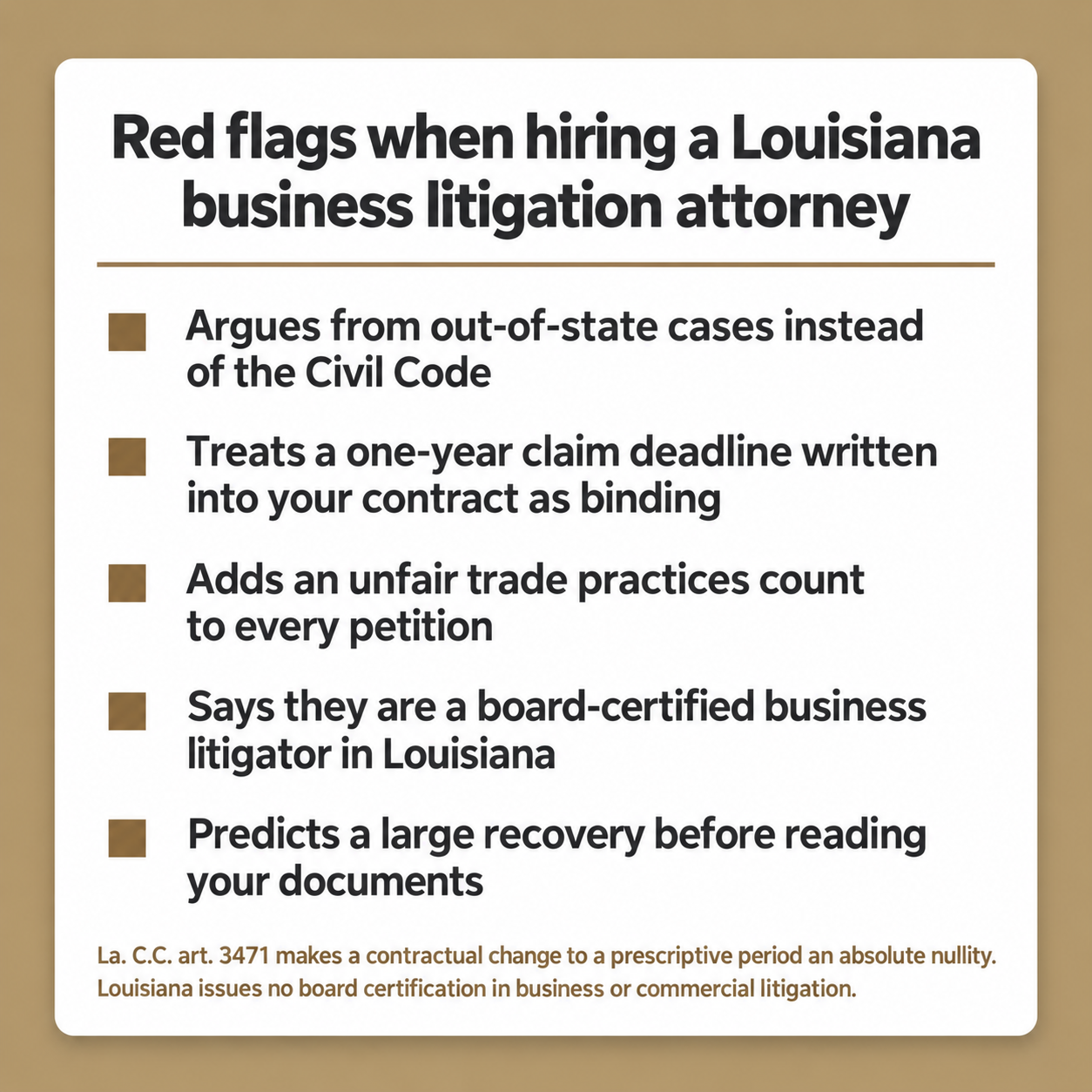
Watch for one more thing in your own contracts. Commercial agreements often include a clause requiring claims to be brought within a year of substantial completion or delivery. Under Civil Code article 3471, a private agreement that shortens or lengthens a statutory prescriptive period is an absolute nullity in Louisiana, so the clause has no effect at all. A few insurance statutes allow contractual limitation periods under narrow conditions, but a general commercial contract cannot rewrite these deadlines. An attorney who takes such a clause at face value, on either side of the case, is not fluent in this area.
When should you start preserving records and emails?
Your duty to preserve records attaches as soon as litigation is reasonably anticipated, which is usually well before a suit is filed. Competent counsel should raise this in the first conversation and put a litigation hold in place across email, cloud storage, accounting systems, operational files, and messaging apps.
There is a specific reason this cannot wait. In Reynolds v. Bordelon, the Louisiana Supreme Court held that this state does not recognize an independent claim for negligent spoliation of evidence, so if records are lost or destroyed you generally cannot file a separate suit over it later. Intentional destruction is handled inside the existing case instead. The court can apply an adverse presumption that the missing evidence would have hurt the party who lost it, and it can impose the sanctions available under Code of Civil Procedure article 1471. Under that article, a court can declare facts established for trial, bar the offending party from introducing evidence, strike pleadings, dismiss the action, enter a default judgment, or order that party to pay the other side’s fees and costs.
Has the attorney handled your type of business dispute?
Ask about the specific cause of action you are bringing or defending. General commercial experience tells you very little here, because Louisiana’s statutory business claims carry pleading requirements that are easy to get wrong, and getting them wrong is expensive.
The Louisiana Unfair Trade Practices Act is the clearest example. Companies reach for it because it allows recovery of attorney’s fees, and Louisiana courts read it narrowly. The Louisiana Supreme Court in Cheramie Services, Inc. v. Shell Deepwater Production, Inc. held that a practice is unfair only when it offends established public policy and is unethical, oppressive, unscrupulous, or substantially injurious. To sustain the claim you have to plead and prove fraud, misrepresentation, deception, or an intentional breach of trust. An ordinary breach of contract, hard bargaining, or a business disagreement does not qualify, as the court confirmed again in Law Industries, LLC v. State.
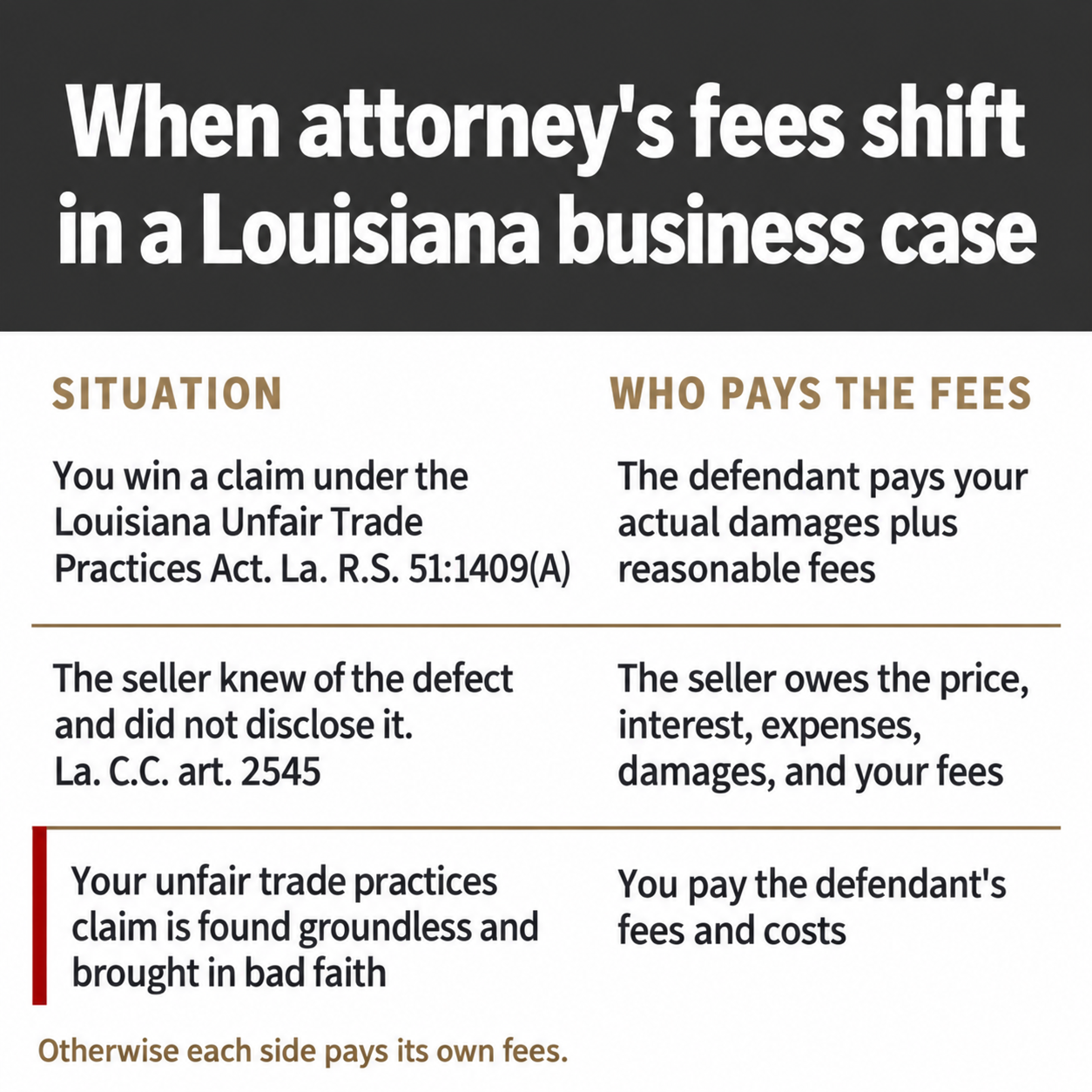
There is also a penalty for overreaching. If the court finds a private LUTPA action was groundless and brought in bad faith or for harassment, it must award the defendant reasonable attorney’s fees and costs. An attorney who attaches a LUTPA count to every petition is creating exposure for you.
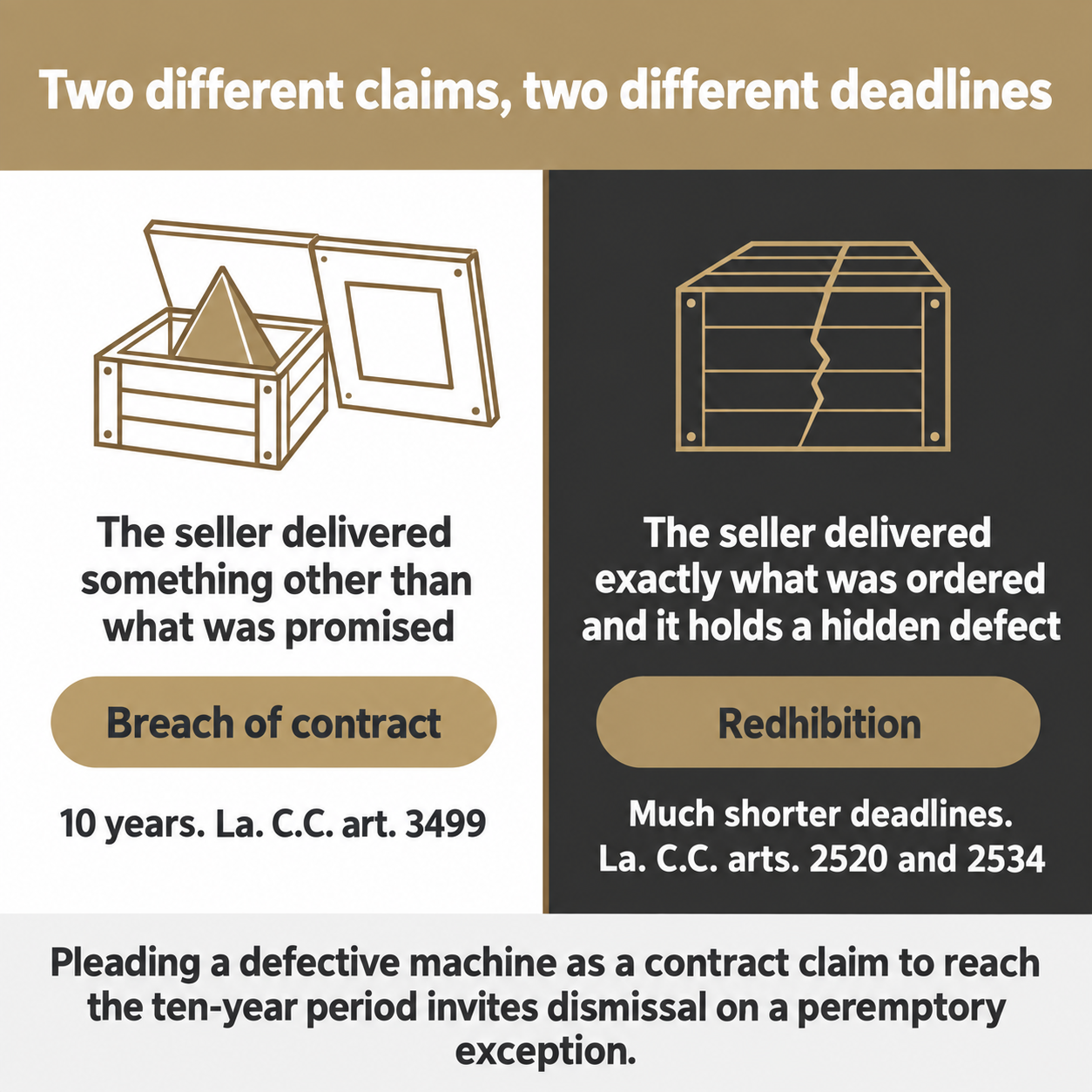
Defective equipment and property claims run through a different doctrine entirely. If a seller delivered the exact thing your company ordered and it contains a hidden defect that makes it useless or nearly so, that is redhibition under Civil Code articles 2520 and following, and it is not a breach of contract claim. Breach of contract applies when the seller delivered something other than what was promised. The line matters because redhibition deadlines are much shorter than the ten-year contract period, and pleading a defective machine as a contract case to reach the longer deadline invites dismissal on a peremptory exception.
We have taken these kinds of cases as far as they needed to go. In a trade secret matter, our client had developed a wireless video surveillance system, and the public officials overseeing the project worked with private competitors to take the technical designs and marketing strategies. We reviewed tens of thousands of pages of records to trace the financial arrangements and retained expert witnesses to establish what the technology was worth. That case ran 13 years and produced millions of dollars in settlements.
In an antitrust matter, Louisiana power companies selling coal ash coordinated prices on fly ash through vertical distribution agreements, and our client, a distributor, was terminated from its marketing agency agreement so the arrangement could proceed. We filed suit in the 18th Judicial District Court for Pointe Coupee Parish, retained an antitrust expert to evaluate the agreements, and defeated the defendants’ motions for summary judgment and exceptions in both the district court and on appeal. The case settled for $1.5 million in three years. You can read more about how we approach these matters on our commercial litigation page.
Which court will your case be heard in?
Venue in a Louisiana commercial case usually lies where the defendant company keeps its registered office, where a foreign corporation has its principal business establishment, where the contract was signed, or where the work was performed. Before you hire anyone, work out where your case is likely to land, then ask the attorney what they have done in that court.
Which parish district court will hear your case?
Louisiana’s 64 parishes are divided into more than 40 Judicial District Courts, and each one has its own local rules, internal procedures, and docket pace. Ask the attorney which division is likely to draw your case and what they have filed there recently.
The 19th Judicial District Court in East Baton Rouge Parish hears business cases no other district can. Because Baton Rouge is the seat of state government, the 19th has exclusive jurisdiction over state administrative agency appeals, regulatory enforcement actions, public procurement disputes, and state tax cases. It has 15 elected judges, and civil matters are spread across multiple divisions. The surrounding districts each see a different kind of business case:
- The 18th, covering Pointe Coupee, West Baton Rouge, and Iberville Parishes, sits in an industrial, chemical, and agricultural corridor that produces environmental and antitrust disputes.
- The 23rd, covering Ascension, Assumption, and St. James Parishes, handles heavy industry, chemical manufacturing, and energy infrastructure along the Mississippi River.
- The 21st, covering Livingston, Tangipahoa, and St. Helena Parishes, serves the logistics corridor along Interstate 12.
- The 20th, covering East and West Feliciana Parishes, sees rural commercial, timber, and land development matters.
Whether you get a jury depends on the size of the claim. Louisiana used to require $50,000 before a civil jury was available. Act 37 of the 2020 First Extraordinary Session lowered that to $10,000 effective January 1, 2021, so most business disputes now qualify. Under Code of Civil Procedure article 1732, if no individual claim exceeds $10,000, the district judge tries the case alone, which is why counsel’s familiarity with the assigned judge matters most in smaller collection and vendor cases.
Your contract may have already decided the forum for you. Louisiana courts enforce forum selection clauses, and under Shelter Mutual Insurance Co. v. Rimkus Consulting Group they are treated as valid unless the party resisting them proves enforcement would be unreasonable, unjust, procured by fraud, or contrary to strong public policy. Read the dispute resolution provisions of the agreement before you assume the case is going to your home parish. We handle commercial matters for companies throughout the greater Baton Rouge area, including St. George, Port Allen, and Denham Springs.
Is the attorney admitted in Louisiana’s federal courts?
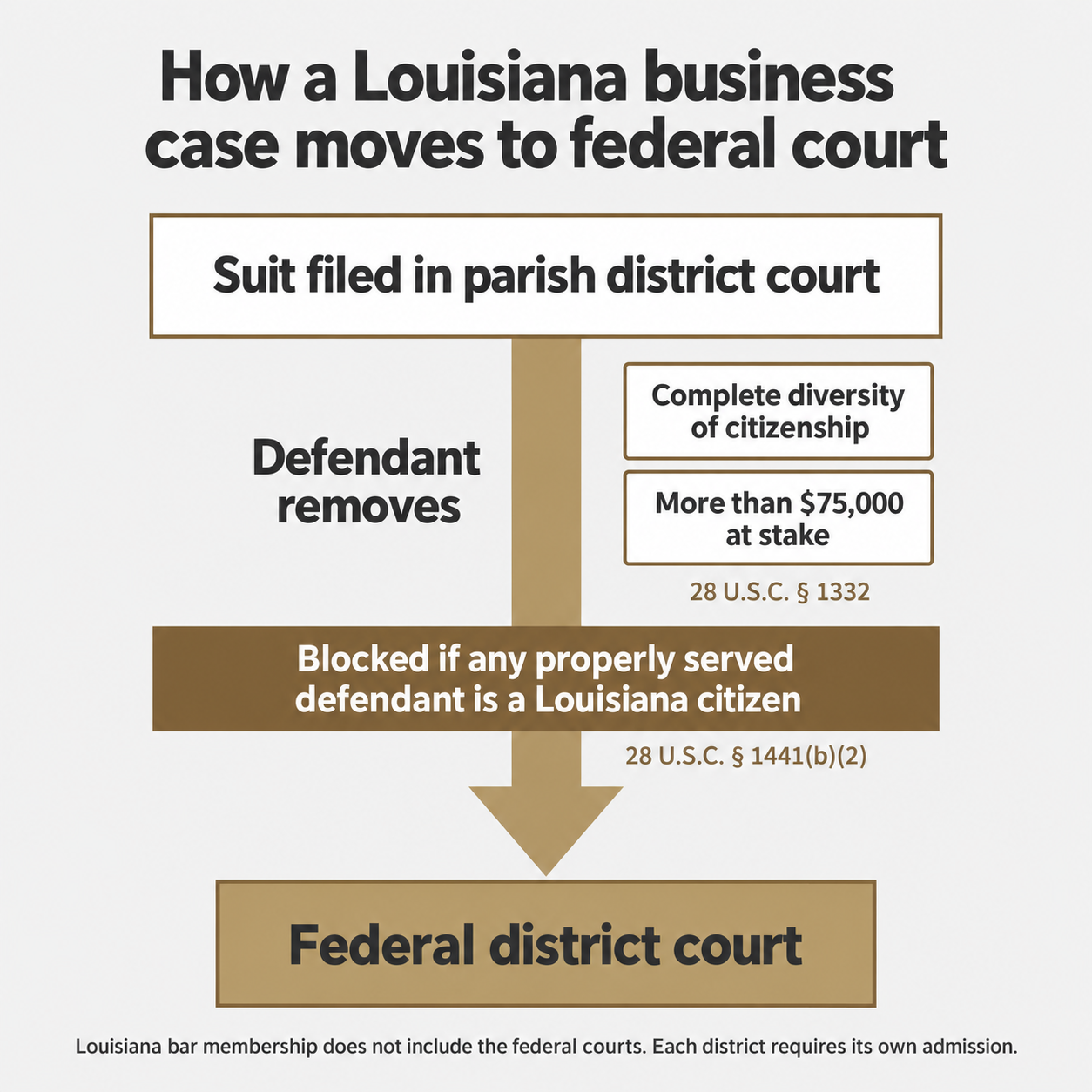
Admission to the Louisiana State Bar Association does not carry any right to practice in Louisiana’s federal courts. Each of the three federal districts here requires its own admission, with a separate petition, a certificate of good standing, local fees, and sponsorship by an admitted practitioner. The Fifth Circuit requires its own admission on top of that.
Your case can end up in federal court whether you want it there or not. A defendant can remove a case under diversity jurisdiction when the parties are completely diverse, meaning no plaintiff shares a home state with any defendant, and more than $75,000 is at stake. The forum defendant rule limits that. Removal on diversity grounds is blocked if any properly served defendant is a Louisiana citizen.
The three districts handle different work. The Middle District, seated in Baton Rouge, takes complex corporate contract disputes, regulatory challenges, employment claims, and municipal litigation. The Eastern District in New Orleans handles admiralty, maritime, and energy cases along with multidistrict litigation. The Western District covers oil and gas, manufacturing, and logistics disputes across the rest of the state.
Timing differs from state court as well. In the Middle District of Louisiana, standard civil cases run about 9 to 14 months for early dispositions and 24 to 36 months when they go through full discovery and trial. The Administrative Office of the U.S. Courts publishes median disposition times for every district, which is worth checking for the court where your case would be filed.
Our attorneys are admitted in all Louisiana state courts and in the United States District Courts for the Middle, Eastern, and Western Districts of Louisiana, as well as the United States Fifth Circuit Court of Appeals. Jason Melancon is also admitted before the United States Supreme Court. We have worked in federal courts in Georgia, Texas, California, and New York, and we are licensed to practice law in Louisiana.
Is the attorney prepared to try the case?
The large majority of business disputes settle before a verdict, and what the other side offers usually reflects what they believe will happen if the case goes to trial. That is why the trial record matters even in a case you fully expect to settle. Ask how many business cases the attorney has tried, in what courts, how recently, and how those cases came out. Ask what they will do in the first 60 days, because the investigation and evidence work done early is what gives a case value at settlement.
Ask about appeals as well. A verdict that gets reversed leaves your company back where it started, so it is worth knowing whether the attorney has handled cases at that level. At Melancon, Rimes & Daquanno, we prepare every case for full litigation from the day we take it, and we have lost one trial in more than 20 years. Our attorneys have filed appeals before Louisiana’s appellate courts and the Louisiana Supreme Court and are admitted before the Fifth Circuit. That appellate work is part of why the positions we take at trial are built to hold up on review.
Who will actually handle your case?
Ask directly: who takes the depositions, who argues the exceptions, who stands up at trial, and who returns your call once the case is deep in discovery. At many firms the attorney who takes the meeting is not the attorney who does the work, and you will not find that out until the case is underway.
At our firm, the partner you meet with is the partner who manages your case from beginning to end. We also turn matters down. Commercial litigation is time-intensive, and we look at each case carefully to be sure we can commit the attention it needs, so if we are not the right fit for a dispute, we will tell you that at the consultation. You can see the partners’ backgrounds and courtroom records on our attorneys page, and more about how the firm operates on our about page.
How do you check a Louisiana attorney’s credentials?
Start by knowing which credentials exist. The Louisiana Board of Legal Specialization, which operates under the authority of the Louisiana Supreme Court, currently certifies specialists in nine areas: appellate practice, business bankruptcy law, consumer bankruptcy law, employment law, estate planning and administration, family law, health law, labor law, and tax law. There is no certification in commercial or business litigation. If an attorney tells you they are a board-certified business litigator in Louisiana, they are citing a credential the state does not issue.
What you can verify:
- Disciplinary history through the Louisiana Attorney Disciplinary Board, which maintains a public record of formal proceedings, public reprimands, admonishments, suspensions, and disbarments.
- Current license status and compliance through the Louisiana State Bar Association.
- Court admissions, which the attorney should be able to state without hedging, including which federal districts.
- Reported decisions and case results, including the ones that went badly. An attorney with a real trial record will have some.
Peer-review directories like Martindale-Hubbell AV Preeminent, Super Lawyers, and Best Lawyers are worth a look as reputation signals. They are surveys and editorial selections, not regulatory credentials, so weigh them well behind verified admissions and an actual record of trying cases.
What should you ask about fees and costs?
Ask for the fee structure in writing, and ask what happens to costs, which are billed separately from fees and can surprise you. Under Rule 1.5(a) of the Louisiana Rules of Professional Conduct, a lawyer cannot charge an unreasonable fee, and reasonableness is measured against eight factors, including the time and labor required, customary fees in the community, the amount involved and the results obtained, and the attorney’s experience and ability.
Business litigation is handled on hourly, flat, contingency, and hybrid arrangements depending on the firm and the matter, so ask which one applies to your case before you sign anything. If a contingency arrangement is on the table, the Louisiana Rules of Professional Conduct require it to be in writing and signed by you, stating the percentage at settlement, at trial, and on appeal, whether expenses come off the recovery before or after the fee is calculated, and which expenses you owe regardless of outcome. At the end of a contingency matter the attorney owes you a written statement showing the outcome and, if there is a recovery, what you receive and how that figure was calculated. An unwritten contingency agreement is unenforceable in Louisiana.
Costs are the part clients underestimate. Rule 1.8(e) allows an attorney to advance court costs and litigation expenses with repayment contingent on the outcome, so ask whether your firm bills costs monthly as they are incurred or carries them. Filing fees, court reporters, expert witnesses, forensic accountants, and electronic discovery all fall into this category, and in a document-heavy commercial case the costs can rival the fees.
For a sense of the going rate in Baton Rouge, federal judges in the Middle District of Louisiana set reasonable hourly rates when they award fees, and those published decisions are the closest thing to a public benchmark for this market. Private commercial rate surveys are paywalled, so this is what a business owner can actually look up.
| Experience level | Hourly rate range approved in Middle District fee awards |
|---|---|
| Senior trial partners and lead counsel, 25 or more years | $350 to $450 |
| Mid-level commercial litigators, 8 to 15 years | $225 to $280 |
| Junior associates, 1 to 5 years | $150 to $200 |
| Paralegals and e-discovery specialists | $75 to $100 |
Those figures come from fee-shifting rulings, not from private engagement letters, so treat them as what a court considers reasonable and not as a quote. We do not handle commercial matters on contingency, and we will explain how our fees apply to your case before you commit to anything. The initial consultation is free.
What can your business recover?
Louisiana does not allow punitive or exemplary damages in commercial cases unless a specific statute authorizes them, and the narrow statutory exceptions are non-commercial, covering things like injuries caused by drunk driving. A demand for punitive damages in a Louisiana business case will be dismissed on a peremptory exception, which is worth knowing before you build expectations around it.
Recovery in a Louisiana business case is compensatory. You can recover your actual losses, the damages the Civil Code allows for breach of an obligation under articles 1995 through 1997, and attorney’s fees only where a statute or your contract provides for them.
Two statutes provide for fees in commercial cases. A prevailing LUTPA plaintiff recovers actual damages plus reasonable attorney’s fees, and treble damages are available only if the defendant continued the conduct after receiving written notice from the Louisiana Attorney General or the director of the Consumer Protection Section, so intentional bad faith by itself does not get you there. In redhibition, a seller who knew of the defect and did not disclose it owes the purchase price, interest, expenses, damages, and attorney’s fees. A manufacturer is conclusively presumed to know about defects in its own products, so a direct claim against one carries that fee exposure automatically.
Any attorney you are considering should be able to give you a realistic recovery range at the first meeting, along with what it will cost to get there.
When is litigation the wrong move?
Often enough, a well-drafted demand letter resolves a commercial dispute for a fraction of what a lawsuit costs, and an attorney worth hiring will tell you that instead of filing. Before you commit to litigation, ask what the alternatives look like for your specific dispute and what each one would cost.
Check your contract first, because it may have made the choice already. Under the Louisiana Binding Arbitration Law, a written agreement to arbitrate a commercial dispute is valid and enforceable, and if either party asks, the district court must stay the lawsuit and send the matter to arbitration. Arbitration is faster and confidential, though the filing fees and the arbitrator’s hourly compensation frequently match or exceed what court would have cost. The tradeoff is finality. A Louisiana court can vacate an arbitration award only for corruption, fraud, evident partiality, refusal to hear evidence, or arbitrators exceeding their powers. A mistake of law is not grounds to undo the award, so there is no meaningful appeal.
Mediation is the lower-risk option, and it is available whether or not your contract calls for it. Under the Louisiana Mediation Act, everything said, written, or produced during mediation is confidential and inadmissible in any later proceeding, and neither the mediator nor any participant can be compelled to testify about it. That protection is what lets both sides test their positions honestly. Mediation is usually scheduled within one to three months, the mediator’s fee is split, and nothing binds you unless you sign a written compromise.
| Path | Typical time to resolution | Cost profile | Can you appeal? |
|---|---|---|---|
| Demand letter and negotiation | Weeks | Lowest, a few hours of attorney time | Not applicable, nothing is binding until you sign |
| Mediation | 1 to 3 months to schedule and conduct | Mediator’s fee split between the parties, plus attorney time | Non-binding unless a written settlement is signed |
| Binding arbitration | 6 to 14 months | Administrative fees plus the arbitrator’s hourly rate | Almost never, vacatur is limited to fraud and misconduct |
| Parish district court | 12 to 36 months depending on the docket and a jury demand | Filing fees plus fees and litigation costs | Full appellate review to the Court of Appeal and Louisiana Supreme Court |
| Federal district court | 9 to 14 months for early dispositions, longer through trial | Filing fees plus discovery costs, which run higher | Appeal as of right to the Fifth Circuit |
Here is what an honest assessment sounds like at that first meeting. The attorney walks through what your claim is realistically worth, what the fees and costs will run to get a judgment, how much of your team’s time discovery and depositions will take, and whether the defendant can actually pay a judgment. Then they tell you which path makes business sense, including the possibility that no path does. An attorney who is confident about a big recovery before reviewing your documents is not doing that analysis.
Whatever you decide, do not let the deadline run while you weigh it. Prescription does not pause simply because you are negotiating, and the one-year window for unfair trade practice claims is the last deadline you want to test.
Talk to a Baton Rouge business litigation attorney
If your company is facing a commercial dispute in the greater Baton Rouge area, we are glad to look at it with you. The initial consultation is free, and you will sit down with a partner who will give you a straight read on the strength of the claim, the deadline that applies to it, what pursuing it is likely to cost, and how long it should take. Call us at (225) 303-0455 or come by the office at 6700 Jefferson Hwy, Building 6, in Baton Rouge. If litigation is not the right move for your business, we will tell you that too.