The best way to choose a car accident attorney in Baton Rouge is to check four things before you sign anything: who will personally handle your file, how quickly the firm starts collecting evidence, whether its lawyers have actually tried cases in front of a jury, and exactly how the fee and the case costs work. You can ask about all four at a free consultation, and none of them are things an advertisement can tell you.
We are Melancon, Rimes & Daquanno, and car accident claims make up about 85% of our personal injury caseload here in Baton Rouge. One of our three partners manages every case from start to finish. Louisiana rewrote several of its injury laws in 2025 and 2026, and those changes make those four questions matter more than they did two years ago. Two of them put more weight on how fault gets divided between the drivers and on how well your medical records tie your injury to the crash.
What changed in Louisiana injury law, and what to ask because of it
Five changes have taken effect since the summer of 2024, and each one has the same practical effect. Most of your case now rests on evidence somebody has to go out and collect, which is why the firm you hire matters more than it used to.
Fault now has a cutoff at 51%
If you are found 51% or more at fault for the crash, you recover nothing at all, no matter how badly you were hurt. Comparative fault is the rule that splits the blame between the drivers and reduces your compensation by your share of it. Louisiana used to apply that rule without a ceiling, so a driver who was 80% at fault could still collect 20% of their damages. Act 15 of 2025 changed Civil Code article 2323 for crashes on or after January 1, 2026. A driver who is 50% or less at fault still recovers, reduced by that percentage, and a driver at 51% or more recovers nothing. Crashes before that date are still judged under the old rule. Deutsch Kerrigan, a Louisiana defense firm, published a plain summary of the change if you want the statutory detail.
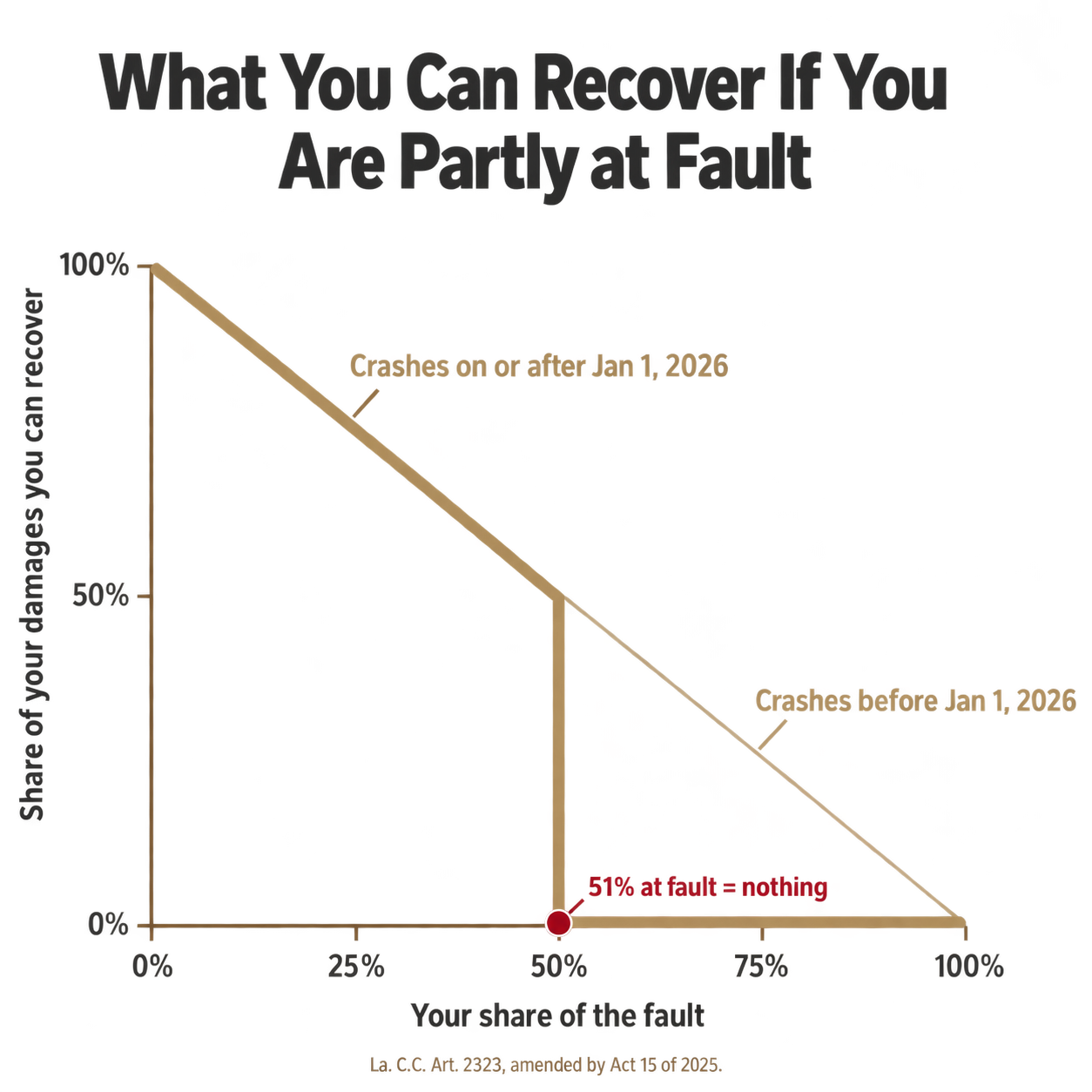
That cutoff gives the insurance company a number to aim at. Its adjusters and defense lawyers do not have to prove you caused the whole crash, only that you were more than half responsible. That is what the recorded statement an adjuster asks for in the first week is really for, and it is what the questions in a deposition, meaning sworn questioning before trial, are built around. Ask any lawyer you meet with how they fight a fault argument, and ask whether they have argued one in court.
We tried a case in the 19th Judicial District Court for a husband and wife who were hit by a driver pulling out of a private driveway. The insurance company’s defense was that our clients had been speeding, which is a fault argument. The trial judge dismissed that defense for lack of evidence, the case went five days in front of a jury, and the jury awarded over $1 million in damages.
You have to prove the crash caused your injury
Proving that the crash caused your injury is now entirely your side’s job, and it is done with medical records. For more than thirty years, someone who was healthy before a crash and hurt right after it got the benefit of a legal presumption that the crash caused the injury. Act 18 of 2025 took that away. It added Code of Evidence article 306.1, which says the absence of a prior history of an injury no longer creates any presumption about what caused it. The full explanation of the repeal is worth reading if your injury did not show up on the first day.
Proving causation now takes medical records, imaging from before and after the crash where it exists, and a physician willing to connect the collision to the diagnosis. Most of that gets gathered while you are still treating, so the earlier a lawyer starts on it, the more of it there is. Ask the firm how it proves causation now that the presumption is gone, and listen for a specific answer about records and treating physicians.
We have handled that exact argument. In a spinal injury case, the defense claimed our client’s low back pain existed before the wreck and had nothing to do with it. We built an exhaustive medical record showing that the herniated disc and the fusion surgery that followed came from the collision, and the case settled for $1.25 million.
Past medical bills are now valued at what was actually paid
You can recover what your providers were actually paid for your treatment rather than what they billed. Act 466 of 2025 rewrote Louisiana Revised Statutes 9:2800.27 effective January 1, 2026. When private health insurance or Medicare paid a discounted rate, your recovery for past medical expenses is limited to that amount, plus whatever you paid or still owe in copays, coinsurance and deductibles. The jury is told both numbers, the billed amount and the paid amount. Taylor Porter’s summary of the 2025 legislation walks through what Act 466 changed.
The practical effect is that a large billed amount no longer drives a settlement negotiation the way it used to. The rest of the claim carries more weight now: lost income, future treatment, and what the injury has done to your daily life. Ask a lawyer how they document those parts of a case, because that is where the value of a claim now sits.
No Pay, No Play now blocks the first $100,000
If you did not carry the liability insurance Louisiana requires, you cannot recover the first $100,000 of your bodily injury damages or the first $100,000 of your property damage, even when the other driver caused the crash entirely. Act 16 of 2025 raised those thresholds from $15,000 and $25,000, effective August 1, 2025. Breazeale, Sachse & Wilson has a rundown of the 2025 tort changes that covers the new numbers. There is a second penalty attached: an uninsured driver who files suit and recovers $100,000 or less can be ordered to pay the court costs of every party in the case.
The statute has exceptions, and they matter. The bar does not apply if the at-fault driver was convicted of DWI, fled the scene, caused the crash intentionally or in the course of a felony, if you were a passenger with no ownership interest in the uninsured vehicle, or if your car was legally parked when it was hit. If you were driving uninsured, say so at your first consultation and ask whether one of those exceptions covers you. Do not decide on your own that you have no case.
The at-fault driver’s insurer is usually not a defendant anymore
Louisiana used to let an injured person sue the at-fault driver’s insurance company directly and tell the jury about the coverage. Act 275 of 2024 ended that in most cases as of August 1, 2024. The insurer cannot be named as a defendant in the lawsuit, and the jury is not told about the policy, except in seven narrow situations that include claims against your own uninsured motorist carrier. Keogh Cox explains the rewritten direct action statute and the exceptions. Your suit names the driver, the insurer still pays at the end, and the jury decides the case with a person in front of it rather than a company.
Who will actually handle your case
Ask for the name of the lawyer who will actually work your file: the one who files the petition that starts your lawsuit, takes the depositions and stands up in court. Get that name at the first meeting. At some high-volume firms, your day-to-day contact and a good deal of the negotiating are handled by case managers who are not attorneys, and the lawyer you met at intake may never touch the file again. That arrangement is legal and common. It is also something you want to know about before you sign, not six months later.
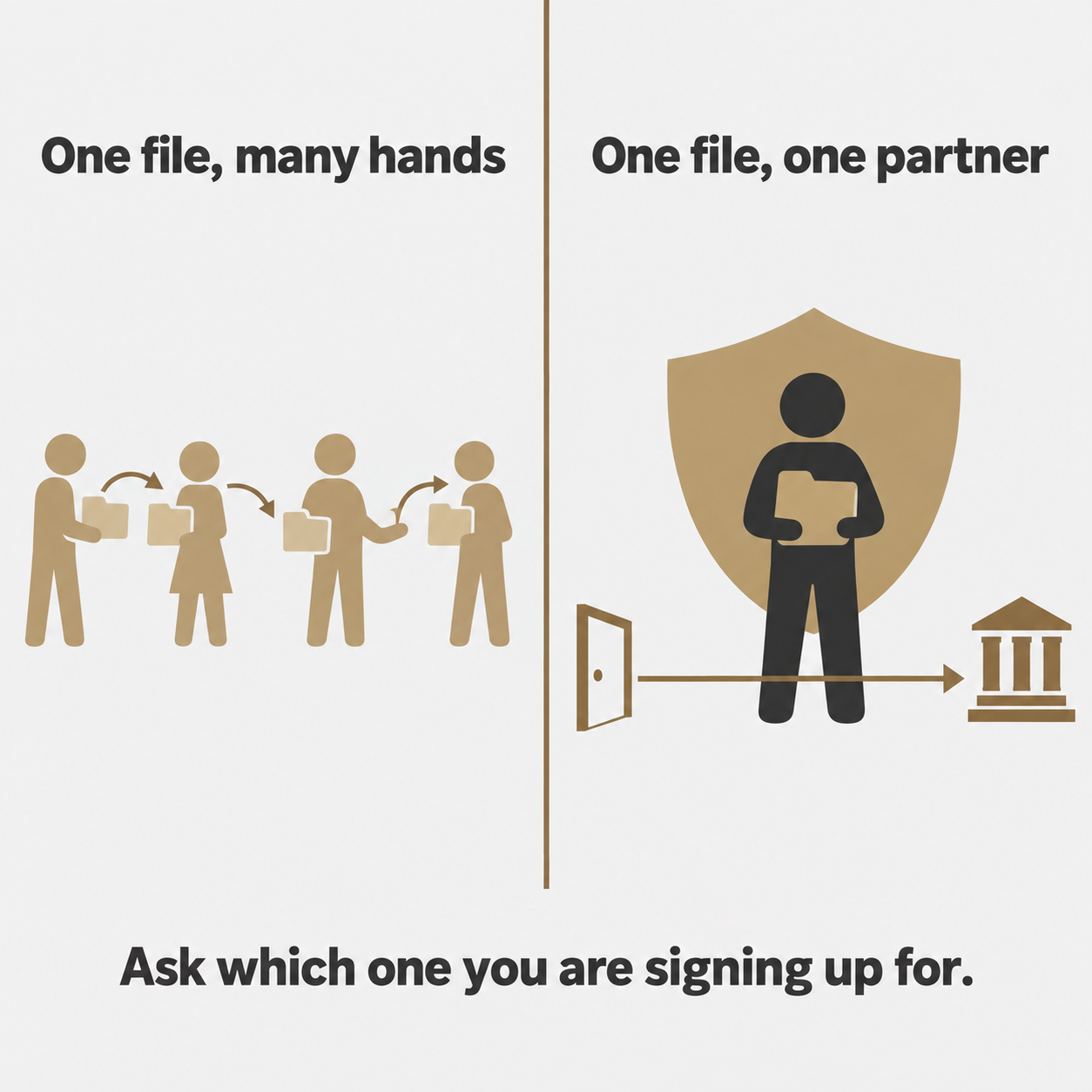
Ask the question directly. Who is my lawyer? Will you be the one taking depositions? If this case goes to trial, are you trying it? A firm that answers with a name is being straight with you. If you cannot get a name, treat that as your answer.
Availability is the other half of this, and it is worth being precise about what you actually need. Round-the-clock phone coverage usually means an answering service, and an answering service cannot tell you anything about your case. What matters is whether you can reach the attorney working on your file and how quickly that person calls you back, so ask about both. At our firm, one of our three partners manages each case personally, our partners give clients a direct line for calls and texts, and if you call after hours we call you back the next business day.
How to tell whether a firm is really prepared to try your case
Most injury claims settle without a trial, and that is exactly why trial readiness decides what you get offered. Insurance companies keep track of which firms file suit and which ones settle early, and they price their offers accordingly. When a firm has a record of taking cases to a jury, the insurer has to treat a low offer as a real risk, and that shows up in the number it puts on your claim.
A success rate percentage or a lifetime recovery total tells you nothing about whether the attorney sitting across from you has tried a car accident case. Ask for specifics. How many personal injury cases has this attorney taken to a jury verdict in the 19th Judicial District Court in the last three years? What happened to them? When did the firm last turn down an offer and go to trial?
How often you see a firm’s ads tells you nothing about how it handles cases. Stanford law professor Nora Freeman Engstrom studied twelve high-volume, heavy-advertising injury practices across ten states and published what she found in the Journal of Gender, Social Policy and the Law: little factual investigation of claims, settlements negotiated by staff who were not always lawyers, and a business built on settling rather than filing suit. A few of the firms she studied never tried a case to verdict at all. Her work also found that the people most likely to pick a lawyer from an advertisement are the ones least likely to know that advertising tells them nothing about trial experience.
By our own count, we have lost one trial in twenty years, and our partners bring more than fifty years of combined experience to the cases we take. We settled a fatal car accident case in federal court for $3.5 million. In another case, a dog bite rather than a car accident, the insurance company’s highest offer was under $100,000. We turned it down, tried the case, and the jury awarded $360,000.
What should happen in the first few weeks after your crash
Evidence disappears on a schedule, and most of it is gone long before a lawsuit is ever filed. A firm that waits for your treatment to finish before it starts investigating has already lost several categories of proof. Here is roughly how long you have:
- Video from nearby businesses, parking lots and traffic systems usually overwrites itself somewhere between 7 and 30 days. Getting it means sending a preservation letter, which is a written demand to hold onto the footage, to whoever owns the camera in the first week or two.
- Event data recorders, the black boxes built into most modern vehicles, hold speed, braking, throttle and seat belt data from the seconds before impact. That data can be lost when the car is repaired, sold at salvage or crushed, and the practical window is about two to four weeks.
- Commercial trucks carry more of it. Engine control module data can overwrite within 10 to 20 days, while federal rules require carriers to keep electronic logging device records for six months. East Baton Rouge Parish records more commercial vehicle crashes than any other parish in Louisiana, according to crash data from LSU’s Center for Analytics and Research in Transportation Safety.
- Skid marks, gouges in the pavement, fluid and debris are often gone in 24 to 72 hours, washed out by rain or swept away.
- Witness memory fades quickly, and adjusters reach witnesses early. A statement taken in the first two weeks is worth more than one taken in month four.
So ask what the firm will do in the first fourteen days. A good answer names specific steps: preservation letters out, a request to hold the vehicles, somebody at the scene, witnesses contacted.
One of our wrongful death cases turned entirely on this. A dump truck ran a red light on Airline Highway and killed the driver of the car it hit, and the defense argued the crash was unavoidable because of the truck’s weight. We retained experts immediately to secure and analyze the truck’s on-board electronic data, which showed the driver accelerating rather than braking. The insurance company paid its policy limits in full.
How car accident lawyers charge in Baton Rouge
Almost every personal injury firm here works on a contingency fee, which means the lawyer is paid a percentage of what you recover and nothing at all if you recover nothing. The standard tiers in this market are about one third of the recovery if the case settles before a lawsuit is filed, and 40% once suit is filed. Our fee follows that structure: one third if no lawsuit is filed, 40% if we file suit, nothing out of your pocket up front, and we advance the case expenses.
Case costs are separate from the fee. They cover court filing fees, medical records, court reporters, expert witnesses and trial exhibits, and in a case that goes into litigation they can run into five figures. Two questions about those costs decide how much money you actually take home.
The first is whether the fee is calculated before or after costs come out. Louisiana’s Rule of Professional Conduct 1.5(c) requires the fee agreement to say which method the firm uses, so the answer is in the document you are asked to sign. On a $100,000 settlement, the difference looks like this:
| Fee taken off the gross settlement | Fee taken after costs come out | |
| Settlement | $100,000 | $100,000 |
| Case costs advanced by the firm | $10,000 | $10,000 |
| Attorney fee at 40% | $40,000 | $36,000 |
| Medical liens paid | $25,000 | $25,000 |
| What you keep | $25,000 | $29,000 |
The second question is what happens if the case is lost. Most Louisiana personal injury agreements say the firm absorbs the advanced costs when there is no recovery. Some do not, and leave the client owing those expenses either way. Find that paragraph before you sign and ask the lawyer to walk you through it.
The cheapest fee does not always leave you with the most money. A discounted percentage of a case that settled early for less than it was worth can pay you less than a standard percentage of a case that was worked all the way through. Compare the whole arrangement rather than the advertised number.
Where Baton Rouge car accident cases are actually filed
Where your case is filed depends on where the crash happened and where the defendant lives, and it shapes how the case gets handled. Local experience means knowing which courthouse your claim belongs in, which judges sit there, and how quickly those dockets move.
| Court | Where it sits | What it handles |
| 19th Judicial District Court | 300 North Boulevard, Baton Rouge | Civil cases across East Baton Rouge Parish with no dollar limit. Serious auto injury and wrongful death cases are filed here. |
| Baton Rouge City Court | 233 St. Louis Street | Claims up to $35,000 arising inside the city limits. A judge decides, with no jury. |
| Baker City Court and Zachary City Court | Baker and Zachary | Smaller claims up to $15,000 within those municipal limits. |
| 18th Judicial District Court | Port Allen | West Baton Rouge, Iberville and Pointe Coupee parishes, including many crashes on the I-10 bridge. |
| 21st Judicial District Court | Livingston | Livingston, St. Helena and Tangipahoa parishes, including the I-12 corridor out toward Denham Springs. |
One local detail worth knowing: under Code of Civil Procedure article 1732, either side can demand a jury trial when more than $10,000 is at issue. That means the defense can pull a moderate case into a full jury trial, with the expert fees and exhibit costs that come with it. A firm that cannot fund that is at a disadvantage from the day the demand is filed, and the insurance company knows which firms those are.
How to check a Louisiana attorney’s license and record
Two free state sources let you verify a lawyer in about five minutes, and it is worth doing before you sign anything.
The Louisiana State Bar Association member directory confirms that the attorney is real and currently licensed. It shows the full legal name, bar roll number, admission date, office address, current status, and any board-certified specializations. It does not show pending complaints.
The Louisiana Attorney Disciplinary Board search shows formal public discipline: suspensions and disbarments ordered by the Louisiana Supreme Court, public reprimands, and administrative ineligibility for things like unpaid dues or missed continuing legal education. Grievances still under investigation are confidential by law and will not appear, so a clean record there means no public discipline rather than no complaints.
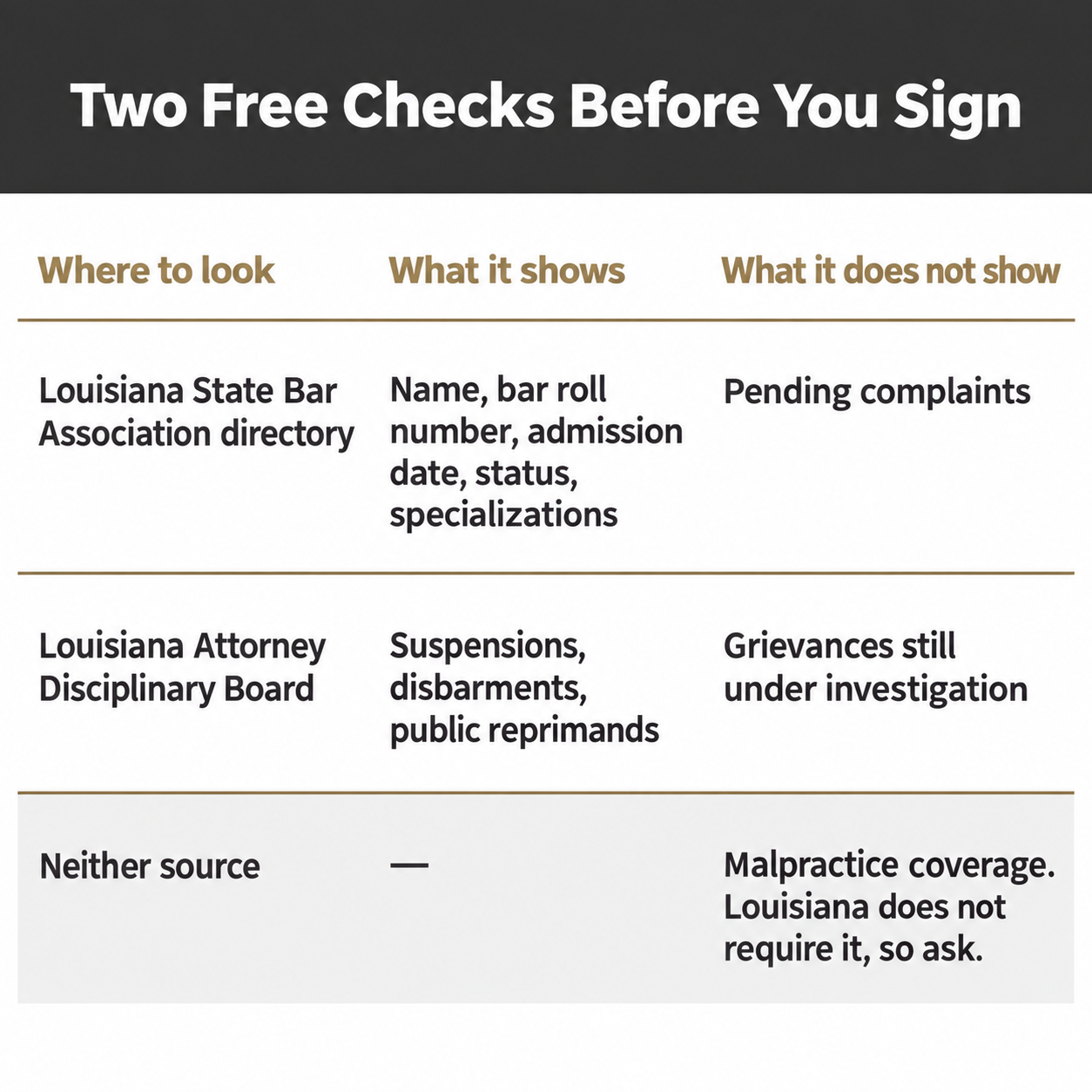
One more thing to ask about directly, because no database will tell you: Louisiana does not require attorneys to carry malpractice insurance. Ask whether the firm has it and what the limits are.
Red flags when you meet with a car accident lawyer
- A prediction of what your case is worth at the first meeting, before anyone has seen your medical records. Rule 7.1 of the Louisiana Rules of Professional Conduct bars advertising that creates unjustified expectations, and the same caution applies in person.
- No straight answer about which attorney will handle the file.
- Pressure to sign the fee agreement before you have read it, or a copy you cannot take home.
- A fee agreement that leaves you owing case costs if the case is lost, presented as though it were standard.
- Talk about settling quickly before anyone has gathered the crash evidence or seen how your treatment goes.
- Nobody asks about your medical history or the days right after the wreck. With the causation presumption repealed, that history is the case.
- A success rate percentage offered in place of actual verdicts and trial history.
- After you sign, you only ever hear from a case manager.
Questions to ask at your free consultation
Bring this list with you. The answers tell you more than anything in a brochure.
- Which attorney will handle my case day to day, and will that person try it if it goes to trial?
- How do I reach you directly, and how quickly do you return calls?
- How many personal injury cases have you taken to a jury verdict in the last three years, and where?
- What will you do in the first two weeks to preserve evidence?
- How will you prove that this crash caused my injuries, now that the presumption is gone?
- How are you going to handle the argument that I was partly at fault?
- Is your fee calculated on the gross settlement or after costs are deducted?
- What are the case costs likely to run, and who pays them if we lose?
- Do you carry malpractice insurance, and what are the limits?
- What do you think the weak points of my case are?
That last one matters. A lawyer who tells you nothing is wrong with your case either has not looked at it or is not being straight with you.
How long you have to file, and why waiting still hurts
For crashes on or after July 1, 2024, you have two years from the date of the collision to file suit in Louisiana. The rule is in Civil Code article 3493.1, and Louisiana calls this deadline prescription rather than a statute of limitations. The clock runs from the day of the crash itself, not from the day you found out how badly you were hurt, so a delayed MRI or symptoms that got worse over a month do not extend it. Crashes that happened on or before June 30, 2024 were governed by the old one-year rule, and those claims have already expired.
Wrongful death and survival claims run on their own schedule. Since August 1, 2025, families have one year from the date of death or two years from the day the injury happened, whichever is longer. Keogh Cox summarizes the amended articles. The change helps families whose loved one survived for months after the crash, where the old one-year-from-death rule could expire before the investigation was finished.
Two years sounds like plenty of time, and it is the outside limit rather than the target. The evidence that proves fault and causation disappears much sooner than that, and the adjuster is usually calling within days to ask for a recorded statement while you are still on pain medication with nobody advising you. Hiring early is what keeps the proof available.
Frequently asked questions
How much does a car accident lawyer cost in Baton Rouge?
The initial consultation is free at most personal injury firms, including ours, and the fee comes out of the recovery rather than your pocket. Expect about one third of the recovery before a lawsuit is filed and 40% after, plus case costs that the firm advances.
What happens if I was partly at fault for the crash?
For a crash on or after January 1, 2026, you can still recover if your share of the fault is 50% or less, and your compensation is reduced by that percentage. At 51% or more you recover nothing, which is why the fault fight is worth taking seriously from the first week.
What if the other driver has no insurance or only the minimum policy?
Louisiana requires only $15,000 in coverage for injury to one person, $30,000 per crash when two or more people are hurt, and $25,000 for property damage under Revised Statutes 32:900, and those limits run out fast in a serious wreck. Your own uninsured and underinsured motorist coverage is the usual answer. It is added to your policy automatically under Revised Statutes 22:1295 unless you signed a form rejecting it, so pull your declarations page and check.
How long does a car accident case take?
Most take somewhere between two months and three years, depending on how serious the injuries are, how long treatment runs, and whether a lawsuit has to be filed. A case that goes to trial sits at the longer end of that range.
Does the firm with the most advertising get bigger settlements?
Advertising budget is not a measure of how a case gets worked. Research on high-volume, heavy-advertising injury practices documents heavy delegation to non-attorney staff, limited investigation of claims, and a focus on settling rather than filing suit, with some of those firms never trying a case to verdict. What moves an insurance company is a firm’s litigation history, not how often you see its name.
Talk to us before you sign with anyone
If you or someone in your family was hurt in a crash in the greater Baton Rouge area, call us at (225) 303-0455 or come by the office at 6700 Jefferson Hwy, Building 6. The consultation is free, you will sit down with one of our partners, and we will tell you honestly what we think of the case, including the parts of it we do not like. If you call after hours, we will call you back the next business day.