A power of attorney lets you choose someone you trust to handle your legal, financial, or medical decisions if you cannot handle them yourself. In Louisiana, this document works differently than it does in the rest of the country, and those differences matter.
At Melancon, Rimes & Daquanno, we regularly help clients set up powers of attorney as part of our estate planning and family law practice. With over 50 years of combined legal experience, our attorneys understand the specific requirements Louisiana law places on these documents and how to make sure they hold up when you actually need them.
This guide covers how powers of attorney work in Louisiana, the types available, what powers require specific language, and the most common mistakes that cause these documents to fail.
What Louisiana Calls a “Power of Attorney”
Louisiana is the only U.S. state with a legal system rooted in the French civil-law tradition rather than English common law. Because of that, the document most Americans call a “power of attorney” has a different legal name here.
Louisiana uses two terms:
- Mandate (La. C.C. arts. 2989-3034): A bilateral contract between the person granting authority (the “principal”) and the person receiving it (the “mandatary”). This is the most common form.
- Procuration (La. C.C. arts. 2987-2988): A unilateral act where the principal grants authority without requiring the other party’s acceptance.
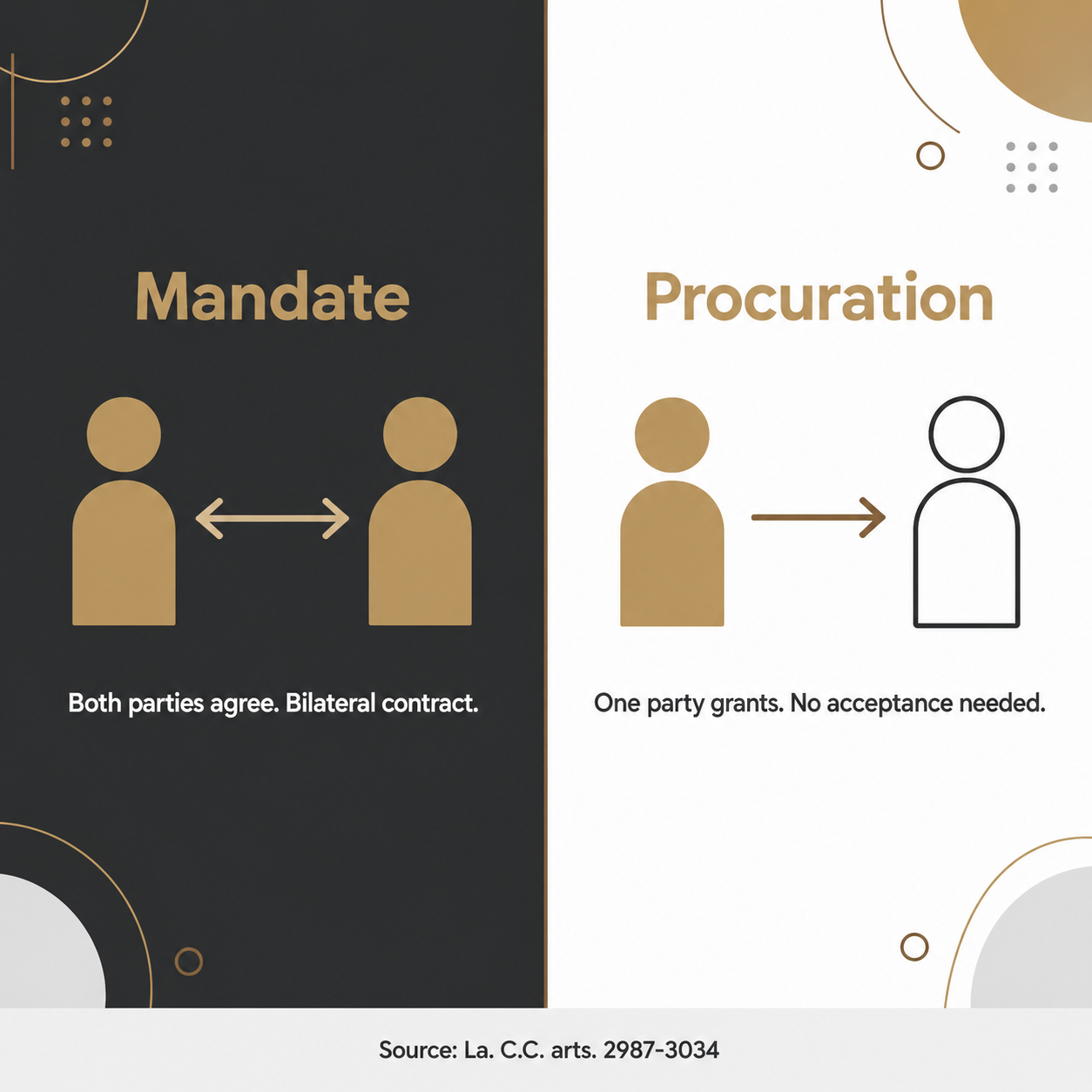
In everyday use, Louisiana attorneys, banks, and courts still use “power of attorney” interchangeably with “mandate.” State statutes reference all three terms. The practical effect is the same: one person authorizes another to act on their behalf.
How Louisiana’s POA Law Differs from Other States
The most important thing to understand about Louisiana power of attorney law is that it operates under different default rules than the other 49 states. Here are the key differences:
| Feature | Louisiana | Most Other States |
| Default durability | Durable by default (La. C.C. art. 3026) | Must include specific “durable” language |
| Legal framework | Civil Code (mandate/procuration) | Uniform Power of Attorney Act (adopted by most states) |
| Form requirements | Form follows function (authentic act for real estate) | Statutory short form available in most states |
| Court-appointed guardian | Interdiction with curator | Guardianship/conservatorship |
| Fiduciary duties | Governed by Civil Code arts. 3001-3015 | Governed by state-specific statutes |
The default durability rule is the single biggest practical difference. Under La. C.C. art. 3026, a mandate remains in effect even if the principal becomes incapacitated, unless the document specifically says otherwise. In most other states, a power of attorney automatically terminates when the principal loses capacity unless it includes specific “durable” language.
This means a Louisiana mandate is durable without any special wording. However, most Louisiana attorneys still include explicit durability language because out-of-state banks and title companies expect to see it.
Types of Power of Attorney in Louisiana
Louisiana recognizes several types, each suited to different situations.
General Mandate
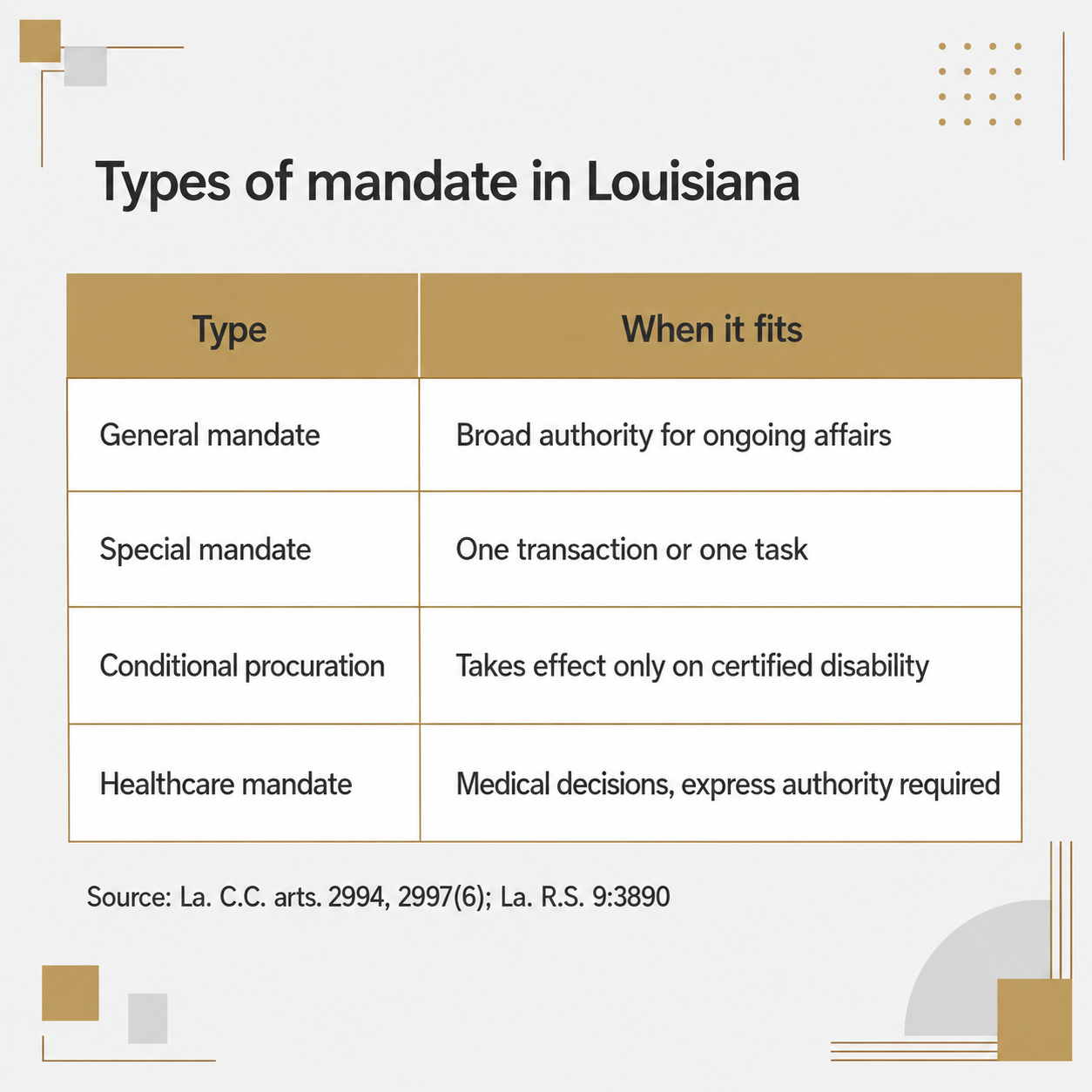
A general mandate (La. C.C. art. 2994) gives broad authority to act on the principal’s behalf “whatever is appropriate under the circumstances.” However, even a general mandate cannot authorize certain high-stakes actions (like selling property or making healthcare decisions) without express language. More on that below.
Special or Limited Mandate
A special mandate restricts the mandatary’s authority to a specific task: selling one piece of property, signing one contract, or filing taxes for a specific year. This is useful when you need someone to handle a single transaction.
Springing or Conditional Procuration
Under La. R.S. 9:3890, Louisiana allows a “conditional procuration” that only takes effect when the principal becomes disabled. Disability must be certified by two physicians (or by the attending physician plus the agent, if the document allows it). This option appeals to people who want a backup plan but are not comfortable giving someone authority over their affairs right now.
Healthcare Mandate and Advance Directive
Louisiana does not have a single “Healthcare Decisions Act.” Instead, healthcare authority comes from several overlapping statutes:
- La. C.C. art. 2997(6): Requires express authorization for a mandatary to make healthcare decisions
- La. R.S. 40:1151-1151.9: The living-will statute, which addresses life-sustaining procedures
- La. R.S. 40:1159.4: Establishes the priority order for who can consent to medical treatment
- La. R.S. 40:1155.1 et seq.: LaPOST (Louisiana Physician Orders for Scope of Treatment), a separate physician-signed order
A comprehensive plan typically requires three separate documents: a financial mandate, a healthcare mandate (or combined medical POA and advance directive), and a living-will declaration. The Louisiana Secretary of State maintains a voluntary advance-directive registry ($20 filing fee for the declaration, $5 for a revocation).
Military POA
La. R.S. 9:3861-3866 recognizes military powers of attorney executed under 10 U.S.C. Section 1044b, exempting them from Louisiana’s state-specific form requirements.
Powers That Require Express Authorization

This is where many powers of attorney fail. Louisiana law requires that certain high-stakes powers be explicitly stated in the document. A general “I grant all powers” clause is not enough.
Under La. C.C. art. 2997, express authorization is required for:
- Making gifts (inter vivos donations)
- Accepting or renouncing an inheritance (succession)
- Taking out loans, acknowledging or forgiving debts, or becoming a surety
- Drawing or endorsing promissory notes or negotiable instruments
- Entering into a compromise or referring matters to arbitration
- Making healthcare decisions (surgery, medical expenses, nursing home placement, medication)
- Restricting communication or visitation between the principal and certain relatives (added by Acts 2016, No. 110)
Under La. C.C. art. 2996, the power to sell, acquire, mortgage, or lease property must also be granted expressly.
A mandatary who acts without express authority for any of these categories has exceeded the scope of the mandate, and the action may be invalid. This is one of the most common reasons POAs get rejected at real estate closings and hospitals.
How to Create a Valid Power of Attorney in Louisiana
Writing
All mandates must be in writing. While La. C.C. art. 2993 says “no particular form” is required, verbal mandates are not enforceable in practice. Banks, title companies, and hospitals universally require a written document.
Notarization and Witnesses
The form requirement depends on what the POA will be used for. Louisiana follows a “form follows function” rule (art. 2993): when the law requires a certain form for a transaction, the POA authorizing that transaction must be in the same form.
Since selling or mortgaging real estate in Louisiana requires an authentic act (notarized before a Louisiana-commissioned notary plus two witnesses), a POA authorizing a real estate transaction must also be executed as an authentic act.
Even when not legally required, having any mandate executed before a notary with two witnesses is a best practice. It maximizes the document’s acceptance by third parties.
Witness Requirements
For mandates that require authentic-act form, witnesses must be:
- At least 18 years old
- Not interdicted
- Not the agent named in the document
- For healthcare directives: not related to the principal by blood or marriage and not entitled to inherit from the principal’s estate
Recording
A POA used for real estate transactions must be recorded with the Clerk of Court in the parish where the property is located. Without recording, the act is not effective against third parties.
Capacity
The principal must be at least 18 years old and have the mental capacity to understand what they are signing. Once a person is interdicted or has lost capacity, they can no longer execute a new POA. This makes advance planning essential.
How a Power of Attorney Ends in Louisiana
Under La. C.C. art. 3024, a mandate and the mandatary’s authority terminate upon:
- Death of the principal or mandatary
- Interdiction of the mandatary
- Qualification of a curator after the principal’s interdiction
- Revocation by the principal (at any time while competent)
- Resignation by the mandatary
- Completion of the task or expiration of any agreed-upon term
- Court order
One important nuance: under La. R.S. 6:311.1, a bank may continue honoring a POA until it receives written notice of revocation, modification, or termination. If you revoke a POA, always notify financial institutions in writing.
Power of Attorney vs. Interdiction
If a person becomes incapacitated without a valid durable POA in place, the only remaining option is interdiction, which is Louisiana’s version of guardianship or conservatorship.
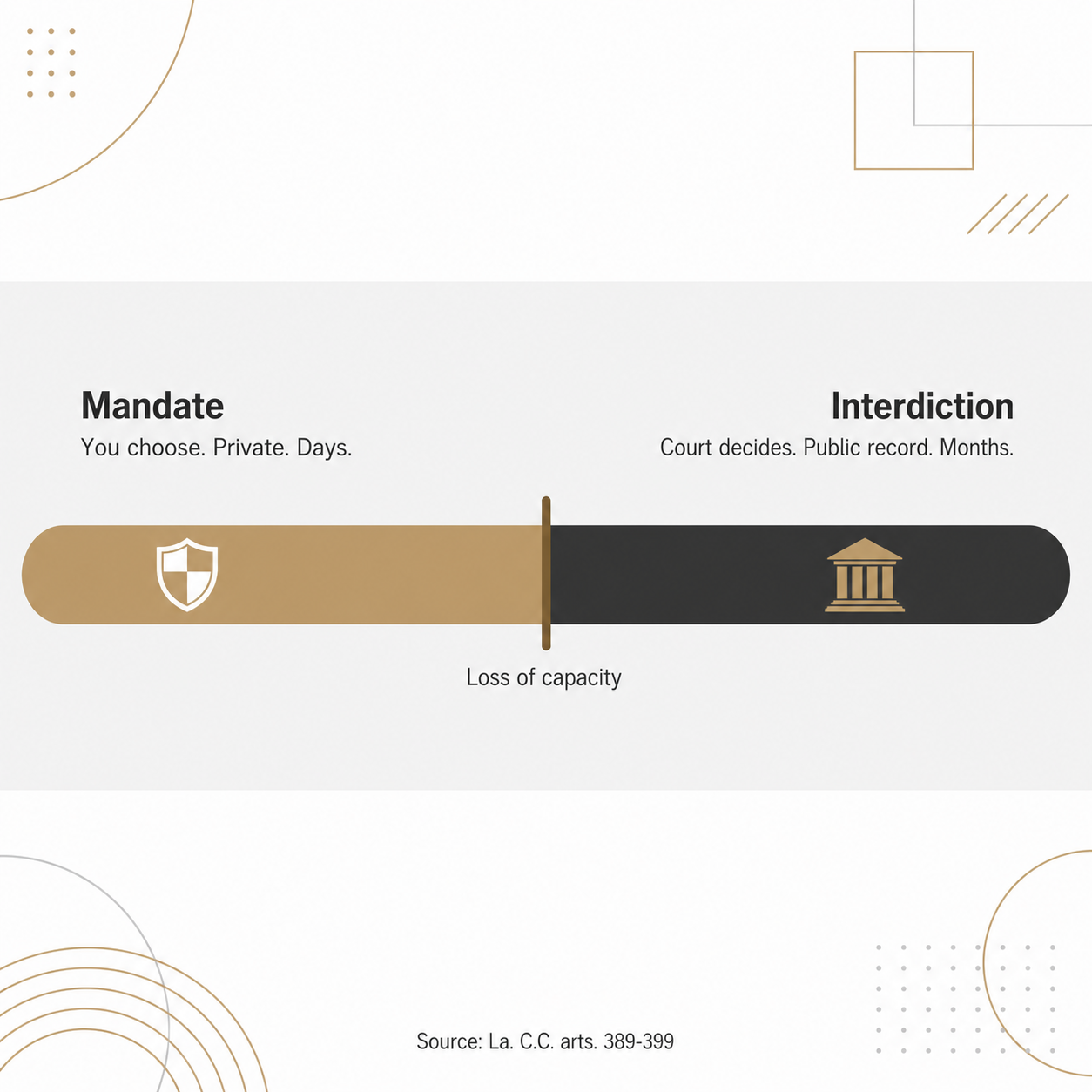
| Power of Attorney | Interdiction | |
| When it’s created | Before incapacity, voluntarily | After incapacity, through court proceedings |
| Court involvement | None | Required (La. C.C. arts. 389-399) |
| Cost | Relatively low | Expensive (attorney fees, court costs, medical evaluations) |
| Privacy | Private document | Public court record |
| Control | Principal chooses who acts for them | Court appoints a curator |
| Flexibility | Easily revocable, customizable | Requires court approval to modify |
| Timeline | Can be prepared in days | Can take weeks or months |
Louisiana courts apply a least-restrictive-alternative principle. If a valid durable mandate exists, courts generally will not order interdiction. This is one of the strongest practical reasons to have a POA in place before it is needed.
Common Mistakes That Cause a POA to Fail
Through our work with clients at Melancon, Rimes & Daquanno, we have seen several recurring issues that cause powers of attorney to fail when they are needed most.
Using a generic online template. Multi-state forms almost always omit Louisiana’s authentic-act requirements and the art. 2997 express-authority list. Some include unnecessary common-law “durable” boilerplate, which signals to Louisiana title companies that the form was prepared out of state.
Failing to include express authority for specific powers. Without the right language, a mandatary cannot sell the principal’s house, make Medicaid-planning gifts, change beneficiary designations, or settle a lawsuit.
Naming co-agents who must act jointly. This creates practical gridlock. If one co-agent is unavailable, the mandate cannot be used. Most Louisiana estate planning attorneys recommend naming a single primary mandatary with one or more successors.
Skipping a successor mandatary. If the primary agent dies, becomes incapacitated, or resigns, the mandate is useless without a named successor.
Not revoking prior POAs in writing. After a divorce or estrangement, an old POA can remain legally effective until the institution relying on it receives written notice of revocation under R.S. 6:311.1.
Failing to record real estate POAs. A POA used for a property transaction must be recorded in the parish conveyance or mortgage records. Without recording, it is not effective against third parties.
Why Advance Planning Matters
The numbers underscore why getting a POA in place now, while you have capacity, is important.
According to the Caring.com 2024 Wills and Estate Planning Study, only 32% of Americans had an estate plan in 2024, a decline from 38% the year before. Meanwhile, elder financial exploitation is increasing sharply. The FBI’s 2024 IC3 Annual Report recorded 147,127 complaints from victims 60 and older with total losses exceeding $4.885 billion, a 43% increase in losses and 46% increase in complaints over 2023.
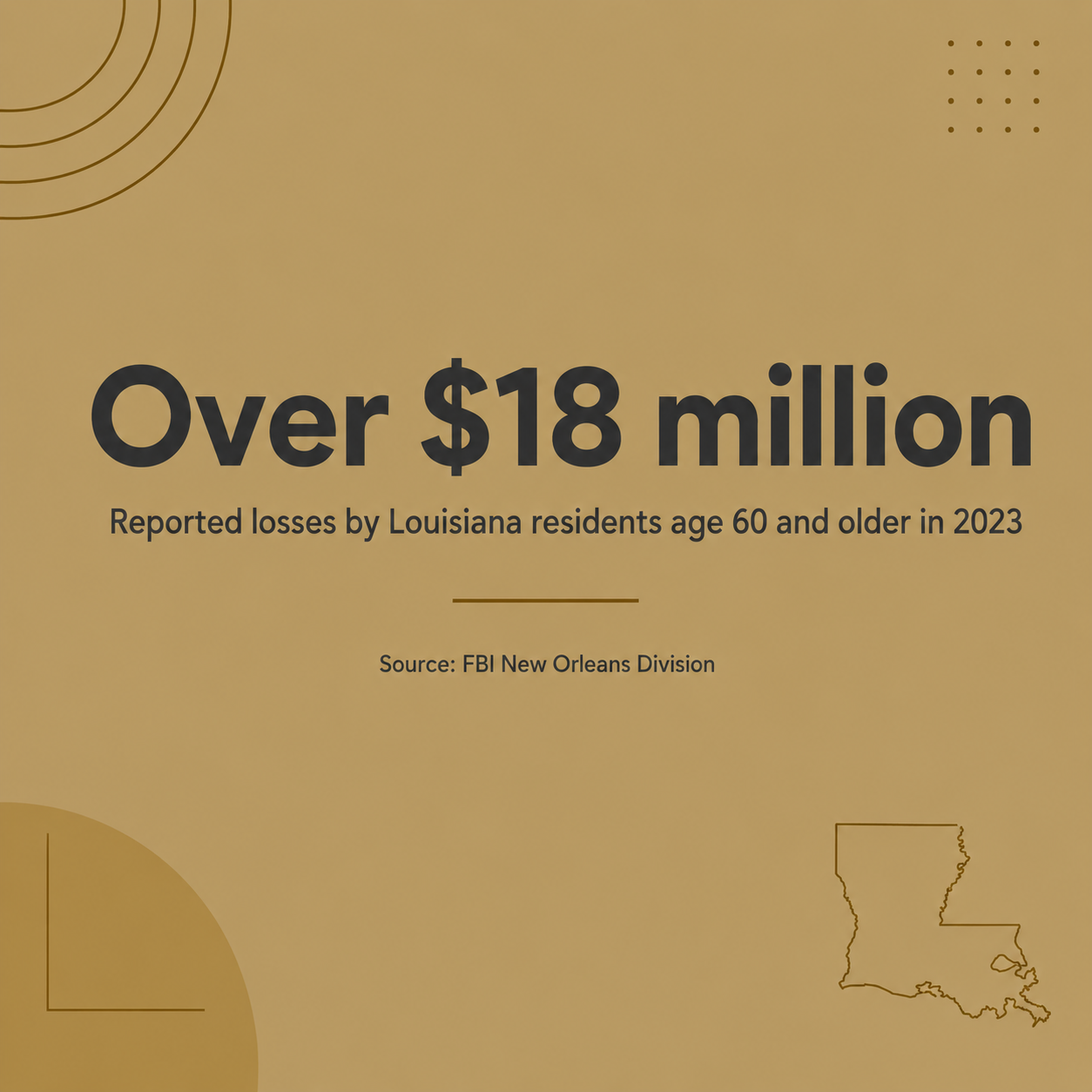
In Louisiana specifically, the FBI New Orleans Division reported over 700 victims in 2023 with losses exceeding $18 million, acknowledging the true number is likely much higher. Power of attorney misuse is a recognized mechanism for elder financial exploitation. A joint 2024 issue brief from ALTA, AARP, NCLC, and NAR identified inappropriate use of authority under a POA as a leading vector for elder real-estate fraud.
Louisiana does provide specific remedies. Under La. R.S. 9:3851-3856, courts can review the acts of a mandatary and order injunctions, accountings, and attorney-fee shifting. Suspected abuse should be reported to Louisiana Elderly Protective Services at 1-833-577-6532.
Talk to a Louisiana Attorney About Your Power of Attorney
A properly drafted power of attorney is one of the most important legal documents you can have. It keeps your family out of court, protects your finances, and makes sure the people you trust are the ones making decisions for you.
Because Louisiana’s civil-law system has specific requirements that differ from every other state, a POA prepared by someone unfamiliar with Louisiana law may not work when it matters most. Our attorneys at Melancon, Rimes & Daquanno can help you set up a mandate that meets Louisiana’s requirements and covers the powers you actually need.
[CALL (225) 303-0455][Link is – tel:2253030455] or visit our office at 6700 Jefferson Hwy (Building 6), Baton Rouge, LA 70806 to schedule a consultation. We serve clients across the greater Baton Rouge area, including East Baton Rouge, West Baton Rouge, Ascension, Livingston, Iberville, Pointe Coupee, and surrounding parishes.