In Louisiana, the statute of limitations for wrongful death claims is one year from the date of death or two years from the date of injury, whichever is longer. This important change took effect August 1, 2025, under Acts 2025, No. 176 and No. 488, providing families with additional time in cases where death occurs shortly after the injury. However, medical malpractice wrongful death claims remain strictly limited to one year from the date of death with no alternative calculation.
At Melancon, Rimes & Daquanno, we’ve guided families through wrongful death claims throughout the greater Baton Rouge area for over 20 years. We understand the challenges families face when grieving while navigating complex legal deadlines. Even with the 2025 amendments, Louisiana’s wrongful death filing deadlines remain among the shortest in the nation. Missing these deadlines typically means losing your right to seek compensation, regardless of how strong your case may be.
This article explains Louisiana’s wrongful death statute of limitations, the recent changes, who can file a claim, what exceptions exist, and why acting quickly protects your family’s legal rights.
Understanding Louisiana’s Wrongful Death Statute of Limitations
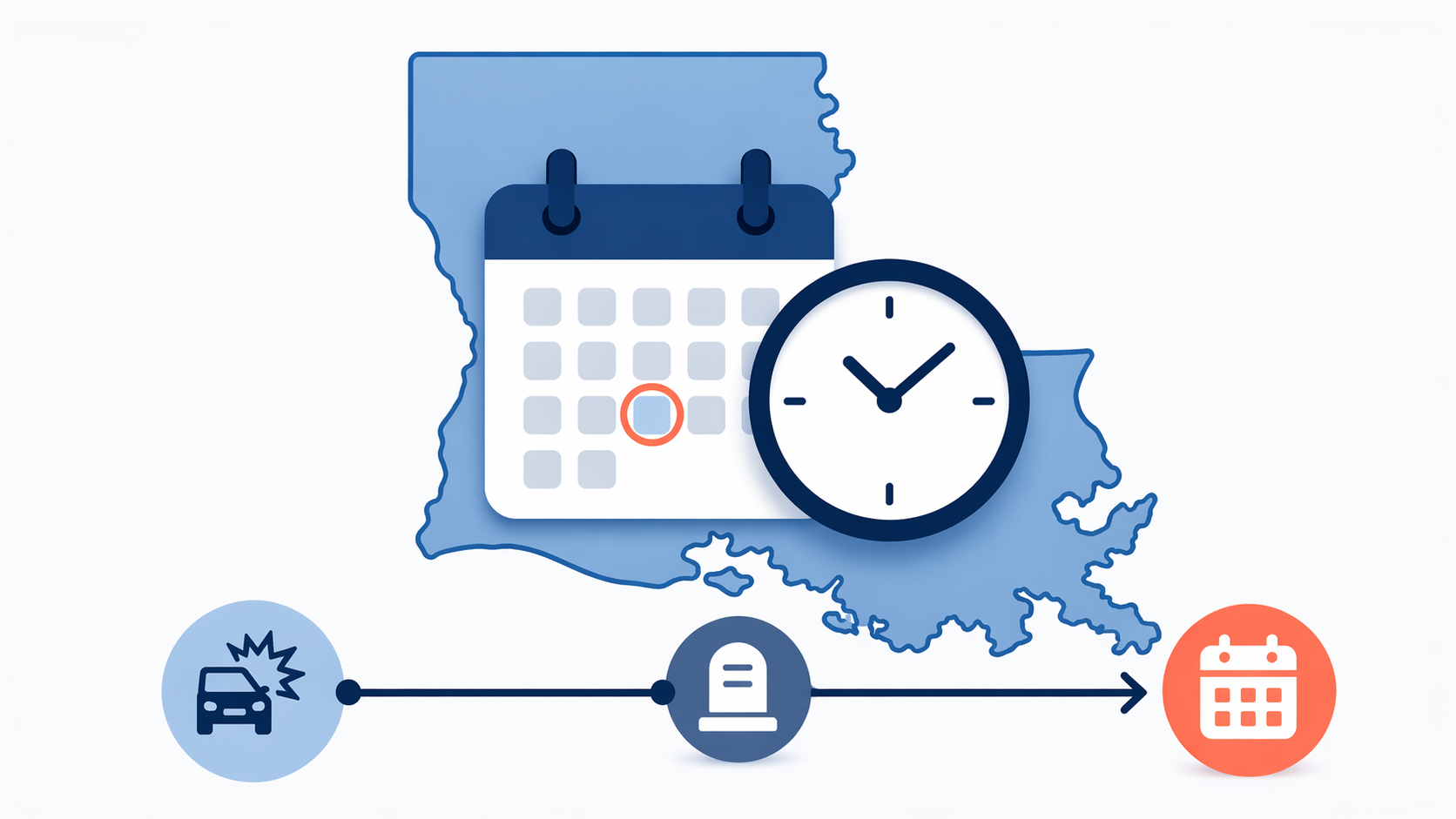
Louisiana Civil Code Article 2315.2(B), as amended effective August 1, 2025, now provides a dual-calculation framework for wrongful death claims. The prescriptive period is “one year from the death of the deceased or two years from the day that injury or damage is sustained, whichever is longer.”
This means families now have two possible deadlines, and the law grants whichever period is longer:
Option 1: One year from the date of death Option 2: Two years from the date of injury
For example, if your loved one was injured in a car accident on January 1, 2025, but died from those injuries on February 15, 2026, you would have until January 1, 2027 to file (two years from injury) rather than February 15, 2027 (one year from death), because the two-year period from injury is longer.
However, if someone died instantly in an accident on January 1, 2026, the two calculations would yield the same deadline: January 1, 2028.
Critical exception: Medical malpractice wrongful death claims under Louisiana Civil Code Article 2315.2(F) remain strictly limited to one year from the date of death with no alternative two-year calculation available.
How Louisiana’s Wrongful Death Timeline Differs from Personal Injury Claims
Louisiana has recently undergone significant changes to its prescriptive periods (statutes of limitations), making the current landscape more favorable for most claimants while maintaining some of the nation’s shortest deadlines for specific claim types.
As of July 1, 2024, personal injury cases have a two-year filing deadline. Then, effective August 1, 2025, wrongful death claims received a similar extension with the dual-calculation framework.
| Claim Type | Statute of Limitations | Effective Date | Special Notes |
|---|---|---|---|
| Personal Injury | 2 years from date of injury | July 1, 2024 | Car accidents, slip and falls, product liability |
| Wrongful Death (Non-Medical) | 1 year from death OR 2 years from injury (whichever is longer) | August 1, 2025 | Most accident-related deaths |
| Wrongful Death (Medical Malpractice) | 1 year from death (no alternative) | August 1, 2025 | Healthcare provider negligence causing death |
| Survival Actions | 1 year from death OR 2 years from injury (whichever is longer) | August 1, 2025 | Deceased person’s pain and suffering before death |
| Medical Malpractice (Personal Injury) | 1 year from discovery, 3 year maximum | Unchanged | Healthcare provider negligence without death |
Louisiana Compared to Other States
Despite the 2025 amendments, Louisiana still maintains relatively short prescriptive periods compared to most other states. The national average for wrongful death statutes of limitations is two to three years.
States with longer deadlines:
- Texas: Two years from death
- Mississippi: Three years from death
- Arkansas: Three years from death
- Florida: Two years from death
- California: Two years from death
States similar to Louisiana: Only Kentucky and Tennessee have similarly short one-year periods for wrongful death claims (without Louisiana’s new two-year from injury alternative).
This means families in Louisiana still face more pressure to act quickly than families in most other states, even with the recent improvements to the law.
This creates an important consideration for families. If your loved one survived for any period after an injury, you may have separate claims: a wrongful death claim (one year from death) and potentially a survival action for what your loved one experienced before passing (also one year from death).
Who Can File a Wrongful Death Claim in Louisiana?
Louisiana law establishes a strict priority order for who can file a wrongful death lawsuit. Only the highest available category of family members can bring the claim.
| Priority Order | Who Can File |
|---|---|
| First | Surviving spouse and children (or either spouse or children) |
| Second | Surviving parents (if no spouse or children) |
| Third | Surviving siblings (if no spouse, children, or parents) |
| Fourth | Surviving grandparents (if no spouse, children, parents, or siblings) |
This hierarchy is absolute. You cannot skip to a lower category if someone in a higher category exists. For instance, if the deceased had a surviving spouse, the parents and siblings cannot file their own claim.
Adopted family members have the same rights as biological family members. However, if a parent abandoned the deceased during childhood, that parent loses the right to file.
When Does the Prescriptive Period Start?
Understanding when the clock starts ticking is critical under Louisiana’s new dual-calculation framework. You need to identify both the date of injury and the date of death to determine which deadline applies.
The date of injury: This is when the wrongful act occurred that ultimately caused death. For a car accident, it’s the date of the crash. For medical malpractice, it could be the date of surgery or treatment. For exposure to toxic substances, it’s when the exposure occurred.
The date of death: This is straightforward, the actual date your loved one passed away.
Which date matters: Under the 2025 amendments, you calculate both potential deadlines and use whichever is longer:
- One year from death, OR
- Two years from injury
Common scenarios:
Immediate death: If someone dies instantly in an accident on March 1, 2026, both calculations yield the same result, March 1, 2028 (since the death and injury occurred on the same day).
Short survival period: If someone is injured on March 1, 2026 and dies on March 15, 2026, the two-year period from injury (March 1, 2028) is longer than one year from death (March 15, 2027). You have until March 1, 2028.
Longer survival period: If someone is injured on March 1, 2026 and dies on May 1, 2027 (14 months later), the one-year period from death (May 1, 2028) is longer than two years from injury (March 1, 2028). You have until May 1, 2028.
Medical malpractice exception: Regardless of these calculations, if the death resulted from medical malpractice, you have exactly one year from the date of death with no alternative calculation.
We’ve worked on cases where families lost their right to compensation because they calculated the deadline incorrectly. One family believed they had two full years from their loved one’s death because they confused the personal injury statute with wrongful death. By the time they consulted us, their deadline had already passed.
Exceptions to Louisiana’s Wrongful Death Deadlines
While the 2025 amendments to Louisiana Civil Code Article 2315.2 provide the most significant recent extension (allowing the longer of one year from death or two years from injury), several other limited exceptions can extend or suspend the filing period:
Defendant leaves Louisiana: If the person responsible for the death leaves Louisiana, the time they spend outside the state may not count toward the prescriptive period. This prevents defendants from evading liability by fleeing the state.
Minor beneficiaries: When the person who would file the claim is a minor, Louisiana law may extend the deadline. A child might have additional time after reaching the age of majority to file, depending on the circumstances.
Mental incapacity (interdiction): If the person with the right to file is declared mentally incapacitated, the prescriptive period may be suspended until they regain capacity or a legal representative is appointed.
Fraud or concealment: If the defendant actively concealed their role in the death or committed fraud that prevented discovery of the wrongful death, courts may extend the filing deadline. This exception requires clear evidence of intentional deception.
Prescription interruption: Filing a proper lawsuit in the correct court “interrupts” prescription and stops the clock. However, filing in the wrong court or with incorrect procedures does not interrupt the prescriptive period.
These exceptions are limited and fact-specific. Louisiana courts interpret them narrowly, so you should never assume an exception applies without consulting an attorney immediately after your loved one’s death.
What Happens If You Miss the Deadline?
Missing Louisiana’s one-year wrongful death deadline has severe consequences:
Loss of legal rights: Once the prescriptive period expires, you permanently lose your right to file a lawsuit. Courts will dismiss your case without considering its merits.
No compensation: You cannot recover damages for funeral expenses, lost income, loss of companionship, or any other losses, regardless of how strong your evidence of wrongdoing.
Impact on insurance claims: Even if you’re negotiating with an insurance company, missing the filing deadline weakens your position. Insurers know you’ve lost your leverage to file a lawsuit, which often results in reduced or denied settlement offers.
No exceptions for ignorance: Courts do not excuse missing the deadline because you didn’t know about it or misunderstood the law.
We’ve seen insurance companies deliberately delay settlement negotiations, hoping families will miss the one-year deadline. Once that happens, the insurance company has no incentive to offer fair compensation.
What Damages Can You Recover in a Louisiana Wrongful Death Case?
Louisiana wrongful death claims compensate surviving family members for their losses. Unlike some states, Louisiana typically does not cap wrongful death damages (except in medical malpractice cases and claims against government entities, which have a $500,000 limit).
| Damage Type | What It Covers | Examples |
|---|---|---|
| Economic Damages | Tangible financial losses | Funeral and burial expenses, medical bills before death, lost wages and benefits, loss of household services |
| Non-Economic Damages | Intangible losses | Loss of companionship, loss of guidance and support, emotional distress, loss of consortium (for spouses) |
| Punitive Damages | Punishment for gross negligence (rare) | Only awarded in extreme cases of intentional or grossly negligent conduct |
The specific damages available depend on your relationship to the deceased and the circumstances of the death. A surviving spouse might recover for loss of companionship and financial support, while children might recover for loss of guidance and emotional support.
Through our work handling wrongful death claims, we’ve seen how thoroughly documenting every aspect of loss makes a difference in recovery amounts. This includes not just obvious expenses like funeral costs, but also calculating the full value of future lost income, benefits, and household contributions.
Wrongful Death vs. Survival Actions: Understanding the Difference
Louisiana law recognizes two distinct claims that can arise from a fatal accident, and both received updates in the 2025 amendments:
Wrongful Death Claims compensate surviving family members for their losses. This includes loss of support, companionship, and guidance. The damages belong to the survivors. The prescriptive period is one year from death or two years from injury, whichever is longer (except medical malpractice, which remains one year from death).
Survival Actions compensate the deceased person’s estate for what the deceased experienced before death. Under Louisiana Civil Code Article 2315.1, as amended in 2025, this includes the deceased’s medical expenses, pain and suffering, and lost wages from injury to death. The prescriptive period is also one year from death or two years from injury, whichever is longer (except medical malpractice survival actions, which are governed by the medical malpractice statute).
Both claims now use the same dual-calculation framework introduced in the 2025 amendments. Families often pursue both simultaneously to maximize recovery.
For example, if someone was severely burned in a trucking accident and survived for three days before dying, a survival action could recover compensation for those three days of extreme pain and suffering plus all medical expenses incurred during that time. The wrongful death claim would separately compensate family members for losing their loved one and the future support and companionship they would have provided.
Common Causes of Wrongful Death in Louisiana
Approximately 85% of our personal injury cases involve motor vehicle accidents, and many of the most tragic cases result in wrongful death. Common causes of wrongful death in Louisiana include:
Motor vehicle accidents: Car crashes, truck accidents, motorcycle collisions, and pedestrian accidents account for a significant portion of wrongful deaths. These often involve negligent drivers, impaired driving, or aggressive driving behaviors.
Medical malpractice: Surgical errors, misdiagnosis, medication mistakes, and substandard care can result in preventable deaths. These cases have special rules and require filing with Louisiana’s medical review panel.
Workplace accidents: Industrial accidents, construction site incidents, and exposure to hazardous materials can prove fatal. These cases may involve both workers’ compensation and wrongful death claims.
Premises liability: Property owners who fail to maintain safe conditions may be liable when dangerous conditions cause fatal accidents. This includes inadequate security leading to violent crimes.
Defective products: Manufacturers and distributors can be held liable when defective products cause fatal injuries.
Intentional acts: Assault, battery, and other violent crimes can give rise to wrongful death claims against the perpetrator.
According to the Centers for Disease Control, unintentional injury is the leading cause of death for Louisiana residents ages 1 to 44, emphasizing how preventable accidents devastate families across the state.
Steps to Take After a Wrongful Death
The period after losing a loved one is emotionally overwhelming. However, taking certain steps quickly can protect your family’s legal rights:
Document everything: Keep all medical records, accident reports, death certificates, and any correspondence with insurance companies. These documents form the foundation of your case.
Preserve evidence: If the death involved an accident scene, photograph everything if possible. Physical evidence can disappear quickly. In trucking accidents, for example, electronic data from the vehicle may be overwritten if not preserved immediately.
Identify witnesses: Write down names and contact information for anyone who witnessed the incident or can speak to the circumstances surrounding the death.
Avoid giving statements to insurance companies: Insurance adjusters for the at-fault party may contact you quickly. Anything you say can be used to minimize or deny your claim. Politely decline to give a recorded statement until you’ve consulted an attorney.
Consult an attorney immediately: Even if you’re not ready to file a lawsuit, consulting an attorney protects your interests. We can begin investigating your case, preserving evidence, and ensuring deadlines are met while you focus on your family.
Don’t wait to grieve: Some families feel they should wait until they’ve fully processed their grief before taking legal action. Unfortunately, the one-year deadline doesn’t account for emotional readiness. Legal and emotional processes can proceed simultaneously.
Why Acting Quickly Still Matters
While the 2025 amendments provide additional time in many cases, wrongful death claims still require extensive investigation and preparation. The dual-calculation framework doesn’t eliminate the need for prompt action. Here’s why early consultation with an attorney remains essential:
Evidence preservation: Accident scenes change quickly. Vehicles get repaired or destroyed. Businesses routinely delete security footage after 30-90 days. Witnesses’ memories fade with each passing month. The sooner we begin investigating, the stronger your case becomes.
Calculating the correct deadline: The new dual-calculation framework requires identifying both the date of injury and date of death, then determining which deadline is longer. Making an error in this calculation could cost you your right to compensation. An attorney can immediately calculate the correct deadline and ensure all necessary actions are taken before it expires.
Medical malpractice complexity: If your loved one’s death resulted from potential medical malpractice, you only have one year from death with no alternative calculation. These cases require immediate action and often involve filing with Louisiana’s medical review panel before proceeding to court.
Expert witness recruitment: Complex cases require expert testimony. Accident reconstructionists, medical experts, and economic experts often have limited availability and need substantial time to review evidence and prepare opinions.
Insurance company tactics: Even with longer deadlines, insurers sometimes delay responses, hoping you’ll accept a low offer or miss important steps in the process. Having legal representation early prevents these tactics from succeeding.
Multiple potential claims: You may have both a wrongful death claim and a survival action, each with their own calculations and requirements. Additionally, if workers’ compensation is involved, or if multiple parties are responsible, the legal landscape becomes complex quickly.
Peace of mind: Knowing your legal rights are protected and the correct deadlines are being monitored allows you to focus on healing and supporting your family during an incredibly difficult time.
Through working with families across East Baton Rouge, West Baton Rouge, Ascension, Livingston, and surrounding parishes, we’ve found that families who consult attorneys within the first few months after a death typically achieve better outcomes than those who wait until the deadline approaches, even with the extended timeframes the 2025 amendments provide.
Protect Your Family’s Rights
Losing a loved one due to someone else’s negligence creates both emotional and financial hardship. While no amount of compensation can bring back your loved one, holding the responsible party accountable can provide financial security for your family’s future and ensure your loved one’s memory is honored.
Louisiana’s 2025 amendments improved wrongful death prescriptive periods by allowing the longer of one year from death or two years from injury. However, Louisiana still maintains among the shortest deadlines in the nation for these claims. Medical malpractice wrongful death cases remain particularly strict with only one year from death. Missing these deadlines permanently bars you from seeking compensation, regardless of how strong your case may be.
At Melancon, Rimes & Daquanno, we’ve represented families throughout the greater Baton Rouge area in wrongful death cases for over 20 years. We understand the sensitive nature of these cases and approach each family’s situation with the compassion and respect it deserves. We handle the legal complexities so you can focus on your family.
We offer free consultations to discuss your case and explain your legal options. During this consultation, we’ll listen to your situation, answer your questions, help you understand which deadline applies under the new dual-calculation framework, and explain the next steps. We work on a contingency fee basis, meaning you pay nothing unless we recover compensation for your family.
If you’ve lost a loved one due to someone else’s negligence, contact us at (225) 303-0455 or visit our office at 6700 Jefferson Hwy (Building 6), Baton Rouge, LA 70806. We’re available Monday through Thursday from 8:30 AM to 4:30 PM and Friday from 8:30 AM to 3:30 PM. Don’t let Louisiana’s prescriptive periods pass while you’re still processing your grief. Even with the 2025 improvements, these deadlines remain strict. We’re here to help protect your family’s rights and pursue the justice your loved one deserves.