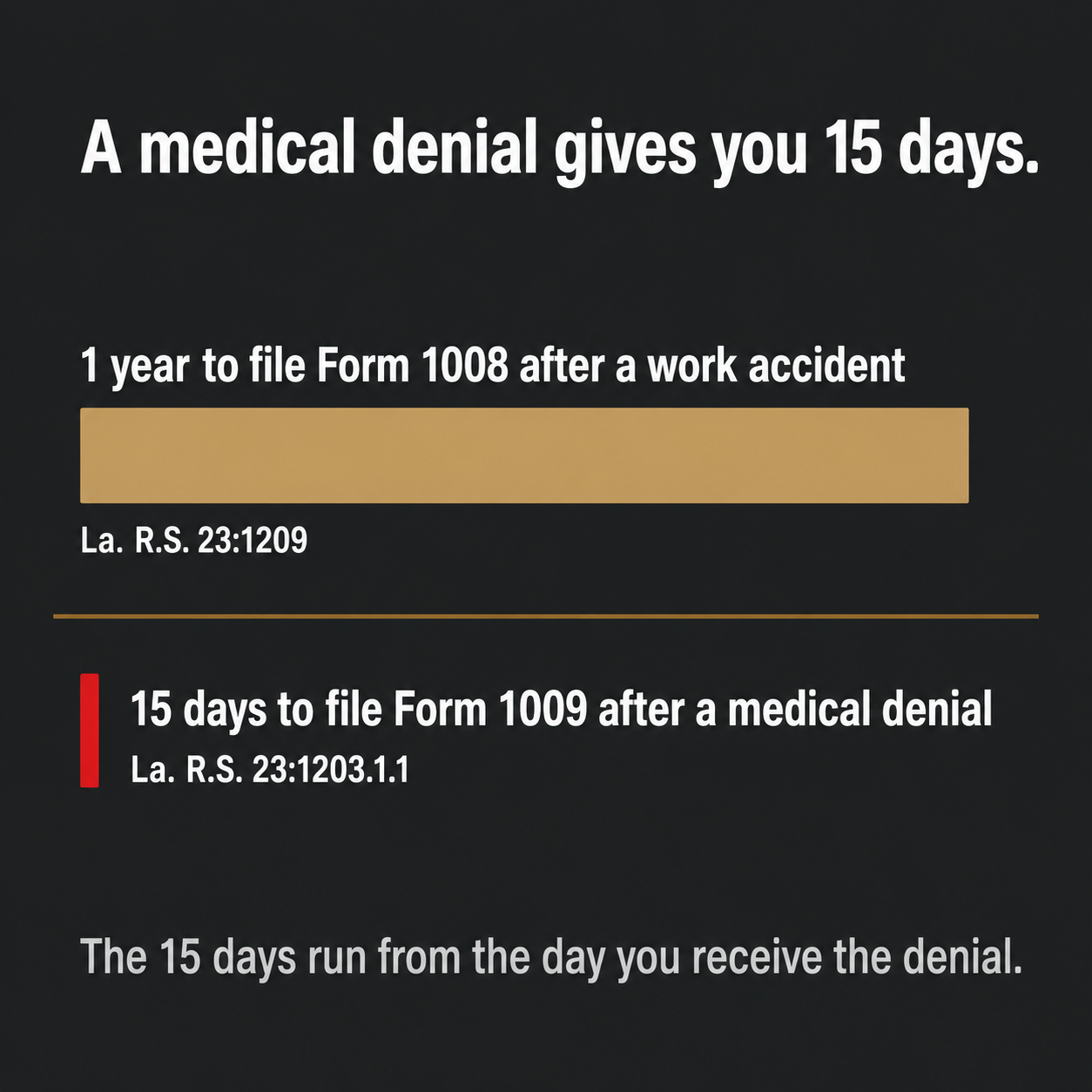
If your Louisiana workers’ compensation claim was denied, which appeal you file depends on what the insurance company actually turned down. A denial of medical treatment goes to the Medical Director at the Office of Workers’ Compensation Administration on Form 1009, and you have 15 calendar days from the day you receive that denial to file it. A denial of wage benefits, or a rejection of your claim as a whole, goes to a workers’ compensation judge on Form 1008, filed at the OWCA district office that covers your case. Under La. R.S. 23:1209, you generally have one year from the date of the accident to file that one.
At Melancon, Rimes & Daquanno, a dedicated associate focuses on Louisiana workers’ compensation cases, and we have represented injured people across the greater Baton Rouge area since 2005. The mistake we most want you to avoid is filing on the wrong track. These are two separate appeals, they go to two different decision makers, and filing one does nothing to extend your deadline on the other. So before you fill out anything, find the date on your denial letter and read what it says was denied.
Which Denial Track Does Your Case Fall Under?
Which appeal you file is decided by the type of benefit the insurer turned down, so read the letter closely. If it talks about medical necessity, treatment guidelines, or a request your doctor submitted for a procedure, test, or prescription, you are on the medical treatment track. If it says your accident was not covered, that you were not in the course of your employment, or that your weekly checks are being stopped, reduced, or recalculated, you are on the wage benefit and compensability track.
Here is how the two tracks compare.
| Medical treatment denial | Wage benefit or whole-claim denial | |
|---|---|---|
| What was denied | A treatment, test, surgery, or prescription your doctor requested | Coverage of the claim itself, or your indemnity (wage) benefits |
| Form you file | Form LWC-WC-1009 | Form LWC-WC-1008 |
| Who decides first | The OWCA Medical Director | A workers’ compensation judge |
| Where it goes | The Medical Director’s office | The OWCA district office that covers your case |
| Your deadline | 15 calendar days from receiving the denial | Generally 1 year from the accident date |
| Governing law | La. R.S. 23:1203.1 | La. R.S. 23:1310.3 and 23:1209 |
Two other denials belong on the Form 1008 track even though they feel medical. The first is a refusal to let you pick your own treating doctor. The second is a failure to provide vocational rehabilitation, which is the retraining and job placement help the law requires when your injury keeps you from returning to the work you did before.
If you are still working out why the insurer denied you in the first place, our post on what to do if your workers’ comp claim is denied in Louisiana covers the reasons insurers give most often.
How to Appeal a Denied Medical Treatment Request (Form 1009)
When your doctor asks the insurer to authorize treatment, that request goes through the insurer’s medical review process, called utilization review. Your doctor submits the request on Form 1010. If the insurer denies it, modifies it, or never answers at all, the dispute does not go to a judge first. It goes to the Medical Director at OWCA, and you get there by filing Form LWC-WC-1009.
You have 15 calendar days to file the 1009, counted from the day you or your representative received written notice of the denial. That deadline is enforced strictly. A late filing is dismissed for lack of jurisdiction, which means nobody reviews the denial at all and the insurer’s decision stands.
What the Medical Director Reviews
The Medical Director compares the treatment your doctor asked for against Louisiana’s Medical Treatment Schedule, the state’s set of guidelines for what care is appropriate for a given injury. If the requested care fits the schedule, it should be approved. If it falls outside the schedule, you can still win, but you have to show the Medical Director, by a preponderance of the scientific medical evidence, that the variance is reasonably required to treat your injury. A decision is due within 30 calendar days of the date you file your Form 1009.
This is the stage where injured workers handling an appeal on their own most often lose, and the reason is documentation. Making the case for care outside the guidelines usually takes a written opinion from your treating physician that ties your specific condition to the medical literature.
A bill in the 2026 legislative session would have replaced Louisiana’s treatment schedule with a national set of guidelines called the Official Disability Guidelines, but it did not become law. The Medical Treatment Schedule is still the standard your doctor’s request gets measured against.
If the Medical Director Rules Against You
You can take the Medical Director’s decision to a workers’ compensation judge by filing Form 1008 at the OWCA district office. The statute, La. R.S. 23:1203.1, gives you 45 days from the date the decision was issued, and note that the clock runs from issuance, not from the day the ruling reaches you.
One caution on that deadline. The statute says 45 days, but the administrative rule that governs these appeals, LAC 40:I.2715, still says 15 calendar days from the date the decision is mailed to the parties. Injured workers have had appeals dismissed on the shorter deadline. Until that conflict is resolved, treat 15 days as your real deadline and do not count on the longer one.
The standard of proof also changes at this stage, and it favors the decision that has already been made. To overturn the Medical Director, you have to show by clear and convincing evidence that the decision did not follow the Medical Treatment Schedule. A judge will not simply substitute a different medical opinion for the Medical Director’s.
If the Insurer Refuses Your Choice of Doctor
You have a right under La. R.S. 23:1121 to choose one treating physician in any field or specialty you need. When an insurer refuses to authorize the doctor you picked, you do not have to wait for an ordinary hearing date.
Under La. R.S. 23:1201.1, either side can ask the judge to handle a choice-of-physician dispute as an expedited summary proceeding. The judge’s ruling in that hearing counts as an order of the court, so the issue does not have to wait for a full trial on the merits. You are also not required to go through mediation or a pretrial conference first, and the hearing is run as a rule to show cause. If your treatment has stalled over a fight about which doctor you get to see, this is the fastest procedure the statute gives you.
How to File Form 1008 for a Denied Claim or Stopped Benefits
Form LWC-WC-1008 is the Disputed Claim for Compensation, and filing it starts formal litigation in front of a workers’ compensation judge. It is the right form when the insurer has:
- Denied your claim outright, including on grounds that the accident did not happen at work, or that intoxication or misconduct bars your recovery
- Stopped, reduced, or changed your indemnity benefits, whether temporary total, permanent total, permanent partial, or supplemental earnings benefits
- Miscalculated your average weekly wage or your weekly compensation rate
- Refused your choice of treating physician
- Failed to provide required vocational rehabilitation
- Denied medical care, after the Medical Director has already ruled
One step comes before the form in a specific situation. If your benefits were modified, suspended, terminated, or contested by a notice from the insurer, La. R.S. 23:1201.1 requires you to tell the insurer what you disagree with first, either by returning the notice form as it directs or by letter of amicable demand, and a disputed claim on that disagreement cannot be filed until you have. The insurer then has seven business days to provide the benefit you say is due. If your prescription date falls inside that seven-day window, you can file without waiting.
If you are not certain your weekly benefit was calculated correctly in the first place, our overview of Louisiana workers’ compensation laws walks through how that rate is set.
Under La. R.S. 23:1310.4, you elect where your hearings will be held, and you have three choices: the parish where the injury occurred, the parish where you were living when you were injured, or the parish where your employer has its principal place of business. For injured workers in the Baton Rouge area, that is OWCA District 05, the district office in Baton Rouge. Districts are drawn by parish, so confirm with OWCA which district covers yours before you send anything.
You can file by hand delivery, mail, or authorized electronic or fax transmission. If you mail it, the date you mailed it is what counts. Under La. R.S. 23:1209(B), a filing is timely if it went out on or before the deadline, and the postmark is what proves it, so hold on to your mailing receipt. One caution on mailed and transmitted filings: under La. R.S. 23:1310.3(A), the filing only counts as initiating your claim if the filing fee is paid within five days of the mailing or transmission.
Louisiana’s Filing Deadlines for Workers’ Comp Claims
Louisiana calls these deadlines prescriptions. Once prescription runs, the claim itself is gone, and no judge can hear it no matter how strong the facts are. La. R.S. 23:1209 sets four separate clocks, and which one applies to you depends on what has happened in your claim so far.
| Your situation | Deadline to file Form 1008 |
|---|---|
| Standard injury, no benefits paid | 1 year from the date of the accident |
| Injury that developed later instead of showing up right away | 1 year from when the injury developed, and never more than 3 years from the accident |
| Wage benefits were paid and then stopped | 1 year from the date of the last indemnity payment |
| Medical benefits were paid voluntarily | 3 years from the date of the last medical benefit payment |
There is an exception inside that third row. Where the benefits at issue are supplemental earnings benefits under La. R.S. 23:1221(3), La. R.S. 23:1209(A)(2) gives you three years from the last indemnity payment rather than one.
Separately, you have to report the injury to your employer within 30 days under La. R.S. 23:1301. That deadline is not always fatal. Where your employer failed to post the notice describing your reporting duties, La. R.S. 23:1302 extends your reporting window to 12 months from the date of injury. And Louisiana courts have generally required an employer to show it was actually prejudiced by late notice before a claim is barred on that basis, which is difficult for an employer whose supervisors knew about the incident when it happened.
The 2024 Two-Year Change Does Not Apply to Comp Claims
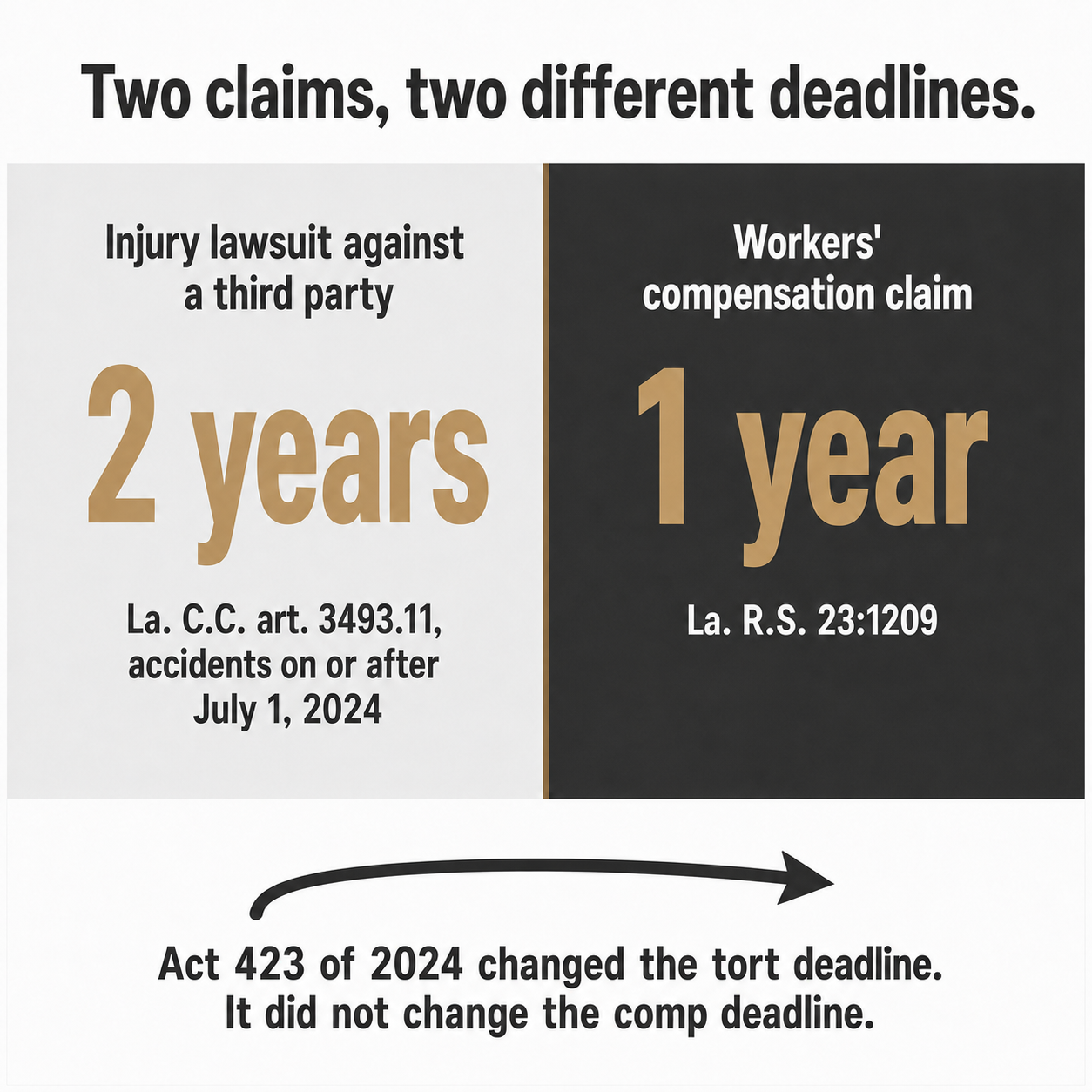
This is the most common piece of bad information about Louisiana deadlines right now, and acting on it can cost you your claim. In 2024, the Legislature passed Act 423, which extended the general deadline for personal injury lawsuits from one year to two, effective July 1, 2024. That change was made in the Civil Code, at La. C.C. art. 3493.1. It did not amend La. R.S. 23:1209.
Workers’ compensation claims are still governed by Title 23, and the deadline to file a Form 1008 after a work accident is still one year. Wait two years to file a comp claim and it will be dismissed as prescribed. The two-year period does apply to a lawsuit against a negligent third party, which is a separate case from your comp claim with its own deadline.
The Filing Fee and How to Ask for a Waiver
Filing a Form 1008 requires paying a filing fee to the district office. If you cannot afford it because you have lost wages from the injury, you can ask to proceed in forma pauperis, which is the legal term for filing without paying costs up front. That request is made under Louisiana Code of Civil Procedure articles 5181 through 5188 and needs two sworn statements:
- An affidavit from you listing your household income, assets, debts, and monthly living expenses
- An affidavit from a third party who is not a relative and not your lawyer, confirming that you cannot pay court costs
If the judge grants it, the fees are waived up front and charged to the losing party at the end of the case.
The Employer’s Answer
Once your Form 1008 has been served on the employer and insurer by certified mail or sheriff, they have 15 days from service to file an answer with the district office. The judge can extend that by up to 10 more days if they ask in time. The answer is where you first see the defense in writing, and it usually tells you what the case is really going to turn on.
What Happens Between Filing and Your Hearing
Filing the 1008 opens a case that runs much like a civil lawsuit. Both sides gather evidence through depositions, written questions, requests for documents, and vocational evaluations. Along the way, a few things happen that are specific to comp cases.
Mediation
Mediation can be scheduled when both sides ask for it or when the judge orders it. Each side has to send someone with real authority to settle, in person or by phone. A party who skips a court-ordered mediation can be fined up to $500 under La. R.S. 23:1310.3(E), plus the other side’s fees and costs.
One warning about mediation, because people lose claims this way every year. Asking for mediation does not pause prescription, and neither does sitting through one, sending a demand letter, or having a friendly phone call with an adjuster. If your deadline is close, file the Form 1008 and negotiate after it is filed.
Second Medical Opinions and Independent Medical Examinations
Your employer has the right to send you to a doctor of its choosing, in each relevant specialty, for a second medical opinion. When that doctor and your treating physician disagree about what caused your injury, how disabled you are, or whether you can work, the judge can appoint a neutral physician to perform an independent medical examination under La. R.S. 23:1123. That report goes straight to the judge and carries real weight at trial, so prepare for the appointment as carefully as you would for any other part of the case.
Preliminary Determination Hearings
If the insurer sent you a Form 1002 notice modifying, suspending, terminating, or contesting your benefits, it can ask for a preliminary determination hearing in its answer. That hearing is held no later than 90 days from the scheduling conference, with one 30-day extension available for good cause, and the judge issues a preliminary determination no later than 30 days after it. The judge decides on the evidence and physician depositions submitted under La. R.S. 23:1201.1. Either side then has 10 calendar days to accept the determination or reject it, and a rejection sends the case to a full trial on the merits, where the preliminary determination does not bind the judge.
The Hearing Before a Workers’ Compensation Judge
A workers’ compensation hearing is a real trial. Witnesses testify under oath, the rules of evidence apply, medical proof comes in through certified records and physician depositions, and both sides file written briefs after the record closes. The judge then issues a written judgment with findings of fact and conclusions of law.
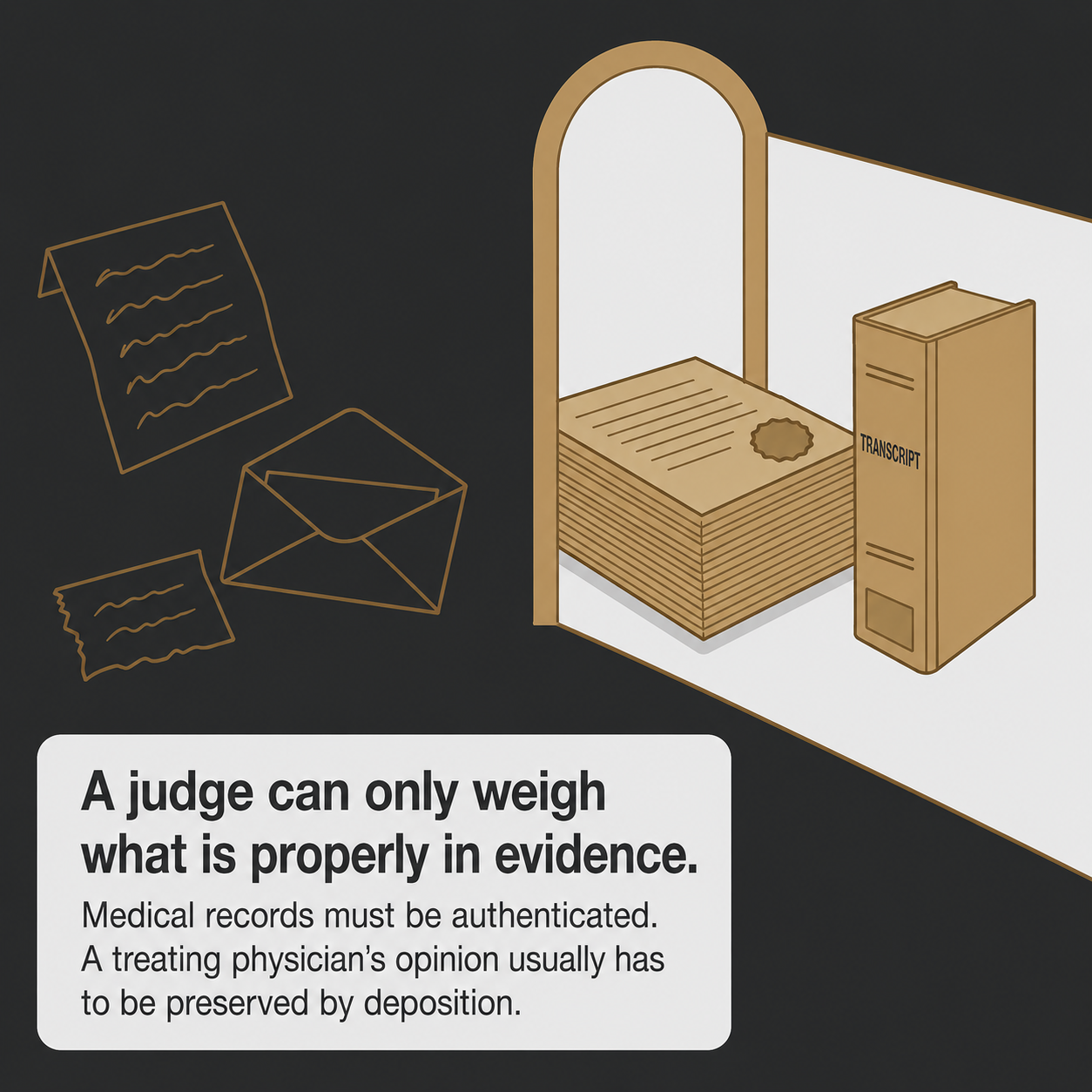
Those formalities are where workers handling their own cases lose claims they should win. Medical records have to be properly authenticated before a judge can consider them at all, and a treating physician’s opinion usually has to be preserved by deposition rather than a letter. A real injury can still produce a losing case if the proof never makes it into the record the right way.
We prepare every case for trial from the beginning rather than assuming it will settle, and in twenty years of practice we have lost one trial. Our partners directly manage cases from start to finish, which for you means the attorney who knows your file is the one who stands up at the hearing.
Penalties and Attorney Fees When a Denial Was Arbitrary
Louisiana penalizes insurers that deny or delay benefits without a reasonable basis, and those penalties belong to you. Under La. R.S. 23:1201:
- Failing to timely pay indemnity or medical benefits, or refusing your choice of physician when consent is required, carries a penalty of up to the greater of 12% of the unpaid benefits or $50 per calendar day, plus reasonable attorney fees. The per-day figure is capped at $2,000 per claim, and none of it applies where the insurer reasonably contested the claim
- Total penalties awarded at a single hearing on the merits are capped at $8,000
- Arbitrarily or capriciously cutting off payments carries a penalty of up to $8,000 plus reasonable attorney fees
- A final, nonappealable award that goes unpaid for 30 days adds a penalty of 24% of the award or $100 per day, whichever is greater, with the per-day figure capped at $3,000, plus fees
Attorney fees in a comp case work differently than in a personal injury case. Under La. R.S. 23:1141, a claimant’s attorney fee cannot exceed 20% of the amount recovered, has to be approved by the workers’ compensation judge, and comes out of the benefits awarded to you.
There is an important exception. When the insurer is held liable for fees under La. R.S. 23:1201, including for an arbitrary or capricious denial, La. R.S. 23:1201(I) removes the statutory limit on fees for that award. Those fees are assessed against the insurer on top of your benefits, and they are not taken out of your recovery.
How to Appeal a Workers’ Comp Judgment to the Louisiana Court of Appeal
A workers’ compensation judge’s judgment is appealed to the state court of appeal, and for cases decided in District 05 that is the Louisiana First Circuit Court of Appeal. La. R.S. 23:1310.5 sets two different windows, and which one you use depends on whether you want the judgment put on hold while the appeal is pending. The clock starts the day after the judgment was signed or the day after the district office mailed notice of it, whichever is later.
| Type of appeal | Deadline | Bond required | What happens to the judgment |
|---|---|---|---|
| Suspensive | 30 calendar days | Yes, in an amount set by the judge | Enforcement is put on hold during the appeal |
| Devolutive | 60 calendar days | Not to take the appeal | The judgment stays enforceable and can be collected |
The bond column simplifies one thing. Under La. R.S. 23:1310.5(C), where the judge has awarded benefits, an employer’s appeal is not entertained at all unless the employer secures a bond approved by the judge covering the award, interest, and costs. In practice, the 30-day suspensive appeal with a bond is the route an employer or insurer takes when it does not want to pay while it appeals. If you won benefits and want to keep collecting during the appeal, you generally have no reason to suspend the judgment.
What an Appellate Court Will and Will Not Reconsider
The court of appeal reviews the record from your hearing. It does not hold a new trial, take new testimony, or accept evidence you wish you had presented. Findings of fact, including whether an accident happened, how disabled you are, and which witnesses the judge believed, are reviewed under the manifest error standard. That means the appellate court leaves those findings alone unless there was no reasonable factual basis for them in the record. Legal errors get a harder look than factual ones.
So appeals are won or lost on the record built at the hearing. Whatever did not make it into evidence in front of the workers’ compensation judge is not available to you later.
Which Orders Stay in Effect During an Appeal
Two kinds of medical orders are protected while an appeal is pending. An order granting physical therapy or a work hardening program is not suspended, regardless of any bond. And where the judge makes a specific finding that delaying surgery would result in death, permanent disability, or irreparable injury, the appeal moves on an expedited schedule: the record has to be prepared and filed within 15 days of the order of appeal, and the court has to hear the case within 30 days of the appellee’s brief.
Is There Anything After the Court of Appeal?
Yes, but it is discretionary. Under La. C.C.P. art. 2166, you can ask the Louisiana Supreme Court to review a First Circuit decision by applying for a writ of certiorari within 30 days of the transmission of the notice of that judgment. The Court chooses which writs to take, and it generally takes cases involving significant legal error or a constitutional question rather than disagreements about the facts of one claim.
Our attorneys are admitted in all Louisiana state courts, in the U.S. District Courts for the Middle, Eastern, and Western Districts of Louisiana, in the U.S. Fifth Circuit Court of Appeals, and before the U.S. Supreme Court, and appellate litigation is one of our practice areas. We mention it for one reason. If a comp case has to go past the workers’ compensation judge, you want a firm that can carry it there. Appellate work is demanding enough that we are selective about it, so whether an appeal makes sense in your case is a conversation we will have with you honestly.
When Your Work Injury Also Supports a Claim Outside Workers’ Comp
A denial of your comp claim does not necessarily close off every avenue. When someone other than your employer caused your injury, La. R.S. 23:1101 preserves your right to sue that party in ordinary court while your comp claim proceeds. Common examples are a driver who hit you while you were working, a subcontractor on the same job site, and equipment that failed because it was defectively designed or inadequately labeled.
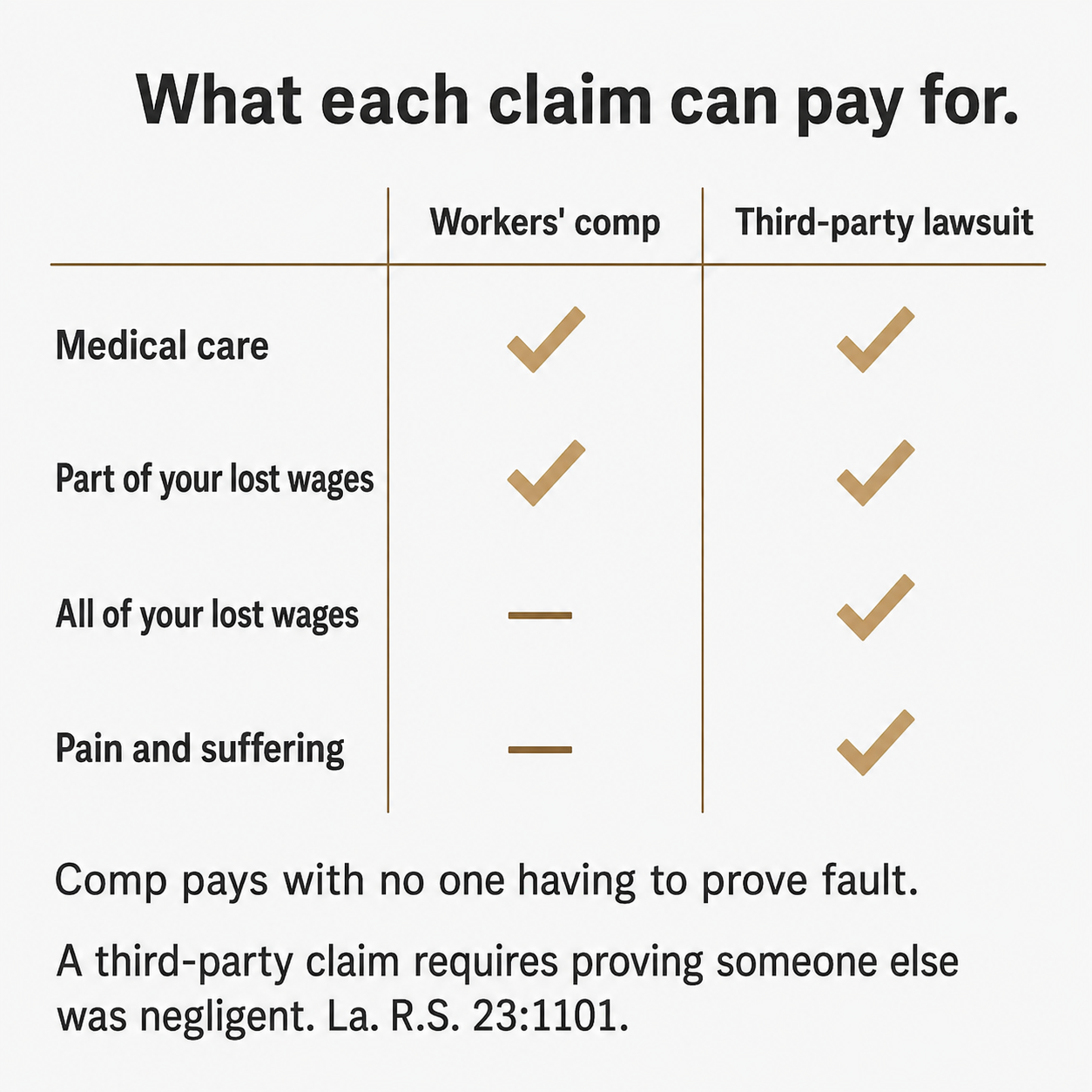
The two claims are worth different amounts. Workers’ compensation pays medical care and a portion of your lost wages without anyone having to prove fault. A civil suit against a negligent third party can recover full lost wages and general damages for pain and suffering, which comp does not pay at all. The deadlines are different too. The comp claim runs on the one-year period under Title 23, while the third-party suit gets the two-year period under La. C.C. art. 3493.1 for accidents on or after July 1, 2024.
There is a tradeoff to understand up front. Your employer or its insurer can intervene in your civil suit to recover what it paid you, and under La. R.S. 23:1102 it receives a dollar-for-dollar credit against future comp benefits out of what you recover from the third party. So the order in which the two cases resolve, and the numbers you agree to, are worth working out with a lawyer before you settle either one. What you accept in one case changes what you keep from the other.
We have handled these cases. One of our clients was an air conditioning repairman who was using a manual pump sprayer to clean coils when the hose came loose from the pump and shot pressurized sodium hydroxide into his eye, causing permanent injury. The manufacturer argued he should have been wearing full goggles and that its warning labels prohibited the chemical he was using. We retained product liability experts who established that the hose connection was defectively designed, and warnings experts who established that the labels were unreadable as placed on the sprayer. We turned down the manufacturer’s pre-trial offers, and the case settled for $750,000 on the second day of a scheduled jury trial.
If a product or another person’s negligence had anything to do with your injury, say so early. A comp denial and a third-party lawsuit get investigated differently, and evidence like the equipment involved needs to be preserved before it disappears.
Louisiana Workers’ Comp Appeal Timeline
Here is the sequence in one place, with the deadlines that are set by statute.
| Stage | Timing |
|---|---|
| Report the injury to your employer | Within 30 days of the accident |
| File Form 1009 after a medical denial | Within 15 calendar days of receiving the denial |
| Medical Director’s decision | Within 30 calendar days of the date you file Form 1009 |
| Appeal the Medical Director to a judge | 45 days from issuance under the statute, 15 days from mailing under the OWCA rule. Work to 15 days |
| File Form 1008 after a wage or claim denial | Generally within 1 year of the accident |
| Employer’s answer | Within 15 days of service, extendable by up to 10 days |
| Accept or reject a preliminary determination | Within 10 calendar days of receiving it |
| Suspensive appeal to the court of appeal | Within 30 calendar days of notice of judgment |
| Devolutive appeal to the court of appeal | Within 60 calendar days of notice of judgment |
| Writ application to the Louisiana Supreme Court | Within 30 days of notice of the court of appeal’s judgment |
The one stage nobody can give you a firm number for is the wait between filing your Form 1008 and getting a trial date. OWCA does not publish average times, and the real answer depends on the district office’s docket, how much discovery the case needs, and how hard the defense fights it.
Common Questions About Louisiana Workers’ Comp Appeals
Can I file a workers’ comp appeal in Louisiana without a lawyer?
You can, and nothing in the statute requires representation. The difficulty is evidentiary. Hearings follow formal rules of evidence, and claims are regularly dismissed because medical records were not properly authenticated or a physician’s opinion was never preserved by deposition.
Does asking for mediation give me more time to file?
No. Mediation, settlement talks, and demand letters do not interrupt prescription under La. R.S. 23:1209. File the Form 1008 before your deadline and keep negotiating after it is filed.
What if I did not report my injury within 30 days?
You may still have a claim. If your employer failed to post the required notice explaining your reporting duties, your window extends to 12 months from the date of injury under La. R.S. 23:1302. Separately, Louisiana courts have generally required the employer to show it was actually prejudiced by the delay, which is hard to establish when the employer already knew about the incident.
How much does a workers’ comp attorney cost in Louisiana?
Claimant attorney fees in comp cases are capped by statute at 20% of the amount recovered under La. R.S. 23:1141, and they have to be approved by the workers’ compensation judge before they are paid out of your benefits. That is a different arrangement from the contingency fee in a personal injury lawsuit. When an insurer is penalized for a bad-faith denial, the fees for that portion are assessed against the insurer instead of coming out of your award.
Which OWCA office handles Baton Rouge workers’ comp claims?
District 05 is the OWCA district office for the Baton Rouge area. Districts are drawn by parish, and filing in the wrong district office puts your claim at risk, so confirm with OWCA which district covers your parish before you send anything.
Can the insurer stop paying while I appeal?
It depends on what stage you are in and what the order says. An order granting physical therapy or work hardening stays in effect during an appeal no matter what. For a money judgment, the insurer has to file a suspensive appeal within 30 days and post a bond to put enforcement on hold. And where the judge awarded you benefits, the employer cannot appeal at all without securing a bond approved by the judge.
Talk With Us About Your Denied Claim
If you are holding a denial letter, find the date on it before you do anything else. Both appeal deadlines run from that date, and the medical treatment deadline is only 15 days long.
Consultations are free, and a dedicated associate at our firm focuses on Louisiana workers’ compensation cases. Call us at (225) 303-0455 or get in touch here, and tell us what the letter says was denied. If a defective product or someone outside your workplace played any part in your injury, please mention that too. It may mean you have a second claim worth more than the comp claim.