A Louisiana car accident claim is worth the damages you can prove, reduced by your share of the fault, and limited by the insurance money available to pay it. Louisiana does not cap damages in an ordinary car accident case, so there is no legal limit on what your injuries are worth. In practice, the limit is the insurance coverage available, and the starting point is whatever your medical records and wage records can actually document.
At Melancon, Rimes & Daquanno, car accident cases are about 85% of the personal injury work we handle, and personal injury is about 85% of our practice. The question we hear most often is whether the number an adjuster has offered is a fair one. Answering it has gotten harder since 2024. Louisiana rewrote five rules that affect what a claim is worth between July 2024 and January 2026, and the date of your crash decides which version of each rule applies to you.
What Decides the Value of a Car Accident Claim in Louisiana
Three things set the number, and you can look at all three yourself before you ever talk to a lawyer.
- The damages you can prove. Medical bills, treatment notes, pay stubs, and testimony about how the injury changed your daily life. If it is not documented somewhere, it is hard to get paid for it.
- Your share of the fault. Whatever percentage gets assigned to you comes straight off your recovery, and for crashes in 2026 and later, being 51% or more at fault ends the claim entirely.
- The insurance available to pay. A claim worth $500,000 against a driver who carries a $15,000 policy and has no other coverage is not a $500,000 recovery.
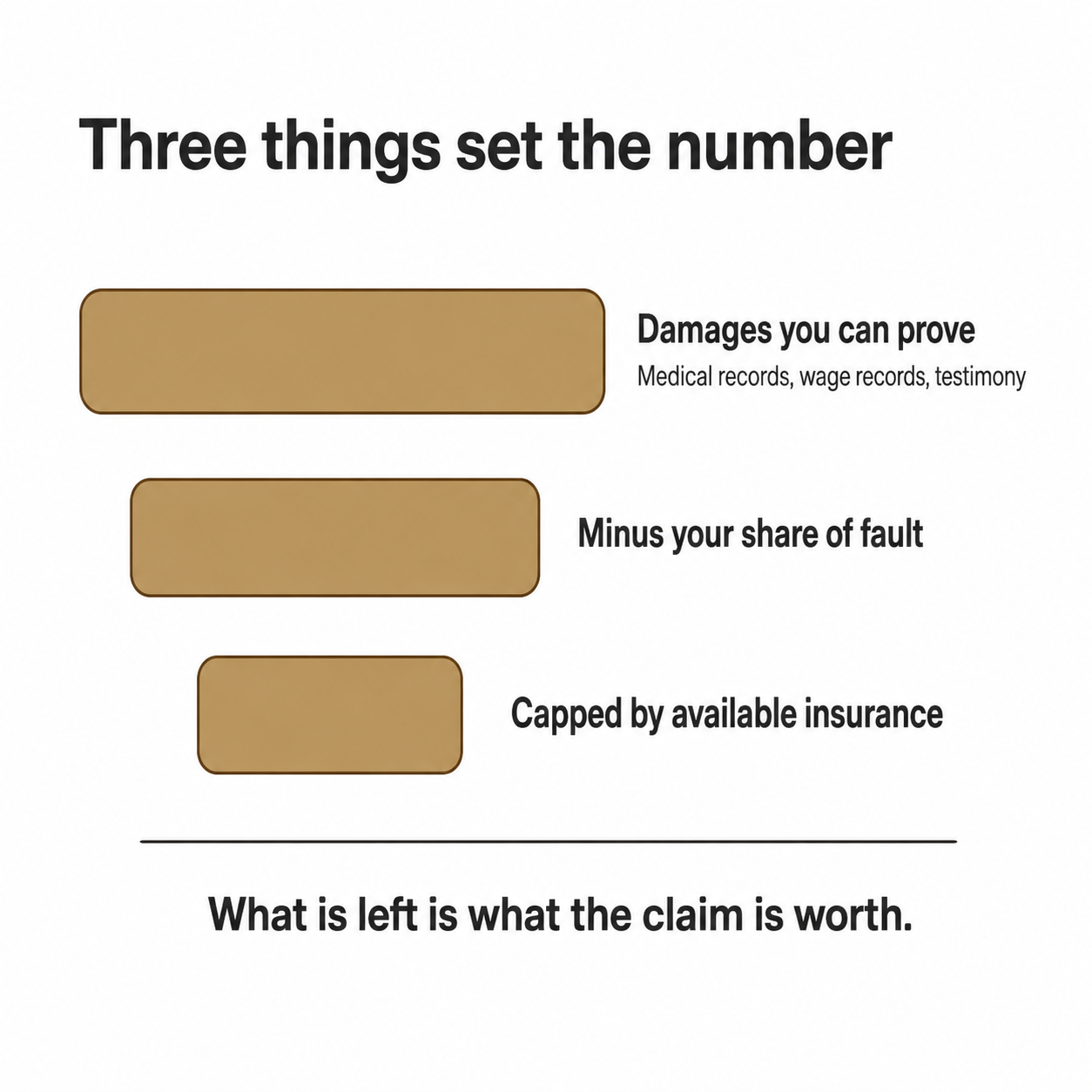
Everything else, including how the claim gets negotiated and whether it ends up in front of a jury, builds on those three.Five Louisiana Rule Changes That Affect Claim Value
Four of these lower what a claim is worth. The fifth, a longer filing deadline, helps. Which version applies to you depends on the date of your accident, not the date you file.
What changed Authority Applies to The deadline to file went from one year to two years La. C.C. art. 3493.1 (Act 423, 2024) Injuries on or after July 1, 2024. One year before that date. Having no prior history of an injury no longer stands in for proof that the crash caused it La. Code Evid. art. 306.1 (Act 18, 2025) Causes of action arising on or after May 28, 2025 An uninsured driver cannot recover the first $100,000 of bodily injury damages or the first $100,000 of property damage La. R.S. 32:866 (Act 16, 2025) Accidents on or after August 1, 2025. The old thresholds were $15,000 and $25,000. A claimant 51% or more at fault recovers nothing. Below 51%, recovery drops by that percentage. La. C.C. art. 2323 (Act 15, 2025) Accidents on or after January 1, 2026. Pure comparative fault before that date. Past medical expenses are measured by what was actually paid plus what is still owed, not the full billed amount La. R.S. 9:2800.27 (Act 466, 2025) Effective January 1, 2026 What Damages Can You Recover After a Car Accident in Louisiana?
Louisiana Civil Code article 2315 says that whoever causes damage to another has to repair it. In a car accident claim, that repair comes in two forms.
Economic damages Non-economic damages What it covers Past and future medical expenses, past lost wages, future loss of earning capacity, property damage Past and future physical pain, mental anguish, permanent disability, disfigurement, loss of enjoyment of life How it gets proven Bills, payment records, pay stubs, and expert projections of future cost and lost earning capacity Medical testimony, your own account of how the injury changed your life, and testimony from people who know you A spouse or immediate family member can also bring a loss of consortium claim for the companionship, affection, and support they lost because of your injuries.
Punitive damages in drunk driving crashes
Louisiana does not allow punitive damages in most car accident cases. The exception is La. C.C. art. 2315.4, which allows exemplary damages when the driver who hit you was intoxicated, the intoxication caused your injuries, and the driver acted with wanton or reckless disregard for the safety of others. The possibility of that award gives a drunk driving claim more weight in settlement talks than an ordinary negligence claim carries.
Does Louisiana Cap Car Accident Damages?
No. There is no statutory cap on general damages, economic losses, or total recovery in an ordinary Louisiana car accident case. Caps exist in two narrow places. Medical malpractice claims against qualified healthcare providers are capped at $500,000 in general damages under La. R.S. 40:1231.2, not counting future medical care. Claims against the state or a political subdivision are capped at $500,000 under La. R.S. 13:5106. Neither one applies to a crash with another private driver.
How Is Pain and Suffering Calculated in Louisiana?
There is no formula. Louisiana law uses no multiplier, so the “three times your medical bills” math that circulates online has no basis in the Civil Code. The judge or jury who hears the case decides the amount.
If an award gets appealed, Louisiana courts review it in two steps, following the framework the Louisiana Supreme Court set out in Pete v. Boland Marine & Manufacturing Co. The court first weighs the particular injury to the particular person, alongside awards in genuinely similar cases, to decide whether the amount was an abuse of discretion. If it was, the court then moves the award to the highest or lowest amount that would have been reasonable. The Supreme Court applied the same framework again in Barber Brothers Contracting Co. v. Capitol City Produce Co. in December 2024.
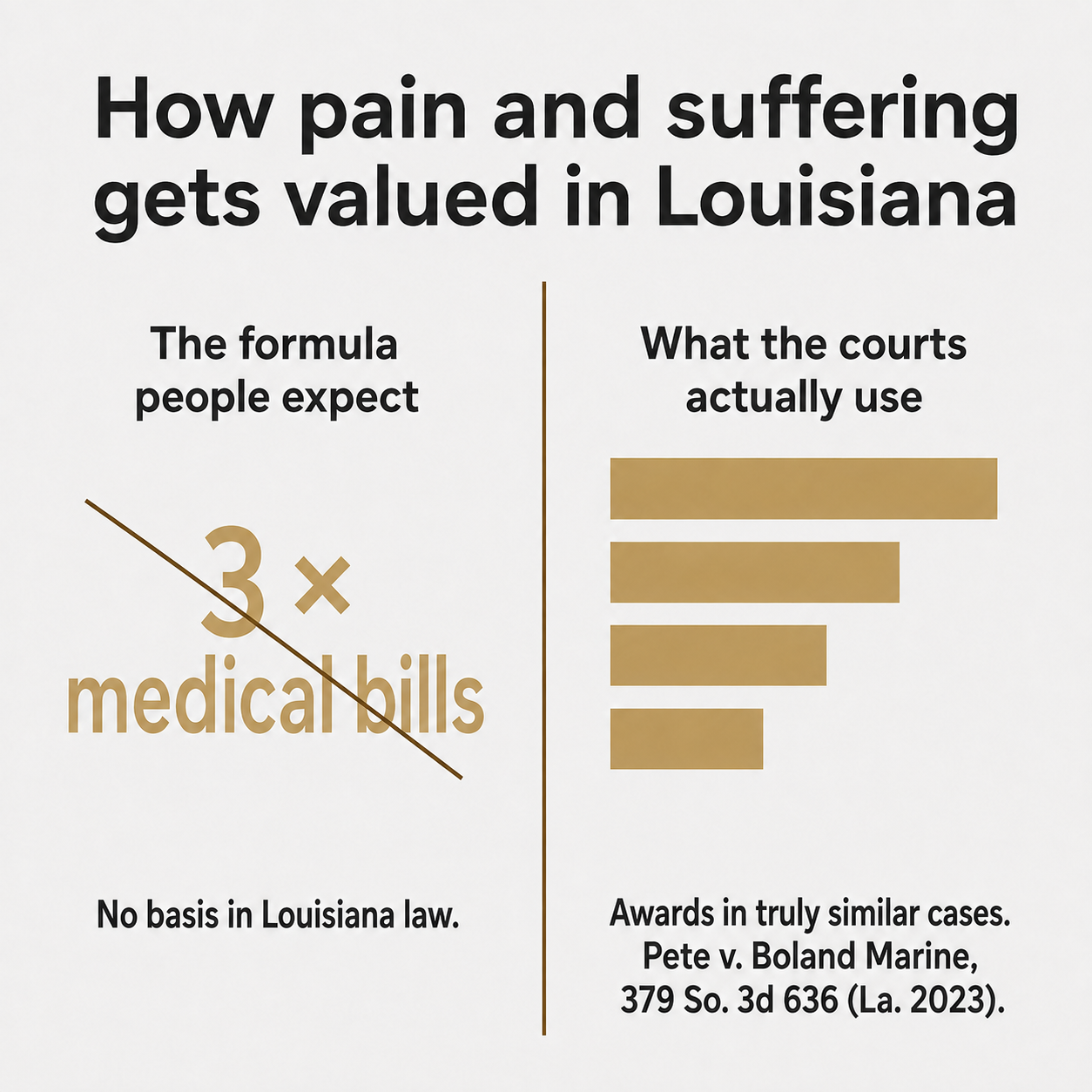
For your claim, the benchmark that matters is what juries and courts have actually awarded people with injuries like yours. An offer built on a multiplier of your medical bills is a negotiating position, not a legal standard.
Louisiana Removed the Presumption That the Crash Caused Your Injury
For decades, a Louisiana plaintiff who was healthy before a crash and hurt right after it got the benefit of a presumption that the crash caused the injury. That rule came from a 1991 case, Housley v. Cerise. The Legislature ended it. Under La. Code Evid. art. 306.1, the absence of a prior history of an illness, injury, or condition creates no presumption that the accident caused it. Causation now has to be established with medical evidence. The change applies to causes of action arising on or after May 28, 2025, and workers’ compensation claims are excluded from it.
In practice, an adjuster can now agree that you were fine on Monday and hurt on Tuesday and still argue your herniated disc came from somewhere else. Consistent treatment records and a treating physician willing to put the causal connection in writing carry more weight than they did before.
We have been answering that argument for years, well before the presumption went away. One of our clients was rear-ended and developed pain, numbness, and tingling in the lower back and legs that eventually required a low-back fusion surgery. The insurance company’s defense attorneys claimed the pain was pre-existing and had nothing to do with the wreck. We gathered the full medical history and used it to show that the crash caused the herniated disc that made the surgery necessary. The case settled for $1.25 million after three years of litigation. If you are dealing with a back or neck injury, our spinal injury attorneys can walk you through what your records need to show.
How Much of Your Medical Bills Counts Toward Your Claim
Starting January 1, 2026, past medical expenses are measured by what was actually paid rather than what the provider billed. Under La. R.S. 9:2800.27 as amended by Act 466 of 2025, when health insurance or Medicare paid a discounted contract rate, the jury is shown both figures, the billed amount and the paid amount. What you recover is tied to what was paid, plus anything you still owe. The same act repealed the old rule that gave plaintiffs 40% of the difference between the two.
Two exceptions are worth knowing about. Bills that are still outstanding and secured by a healthcare provider’s lien, which Louisiana calls a privilege, remain recoverable as amounts still owed. And where an attorney negotiated a set price with a provider ahead of time, recovery on that bill is limited to the agreed amount.
The rule works going forward and does not reach causes of action filed before January 1, 2026. For anyone whose health insurer paid a fraction of what the hospital billed, the paid figure is now the number that counts for that part of the claim.
What Evidence Raises the Value of a Car Accident Claim
The evidence that moves a claim’s value the most is the kind that does not come down to your word against the other driver’s.
- Electronic data from the vehicle that hit you. Commercial trucks carry onboard recorders that capture speed, braking, and acceleration in the seconds before impact.
- Complete medical records, starting with the first visit. Gaps in treatment give an insurer room to argue that you recovered, or that something else caused the problem.
- Employment and wage records covering the time you missed and any change in what you are able to earn going forward.
- Independent witnesses and scene evidence, gathered before it disappears.
One of our wrongful death cases turned entirely on that electronic data. A dump truck driver on Airline Highway sped up to beat a yellow light, entered the intersection after it turned red, and struck a car in the driver’s side door, killing the driver instantly. We represented her husband and children. The defense argued the crash was unavoidable because of the truck’s weight. We retained experts to secure and analyze the truck’s onboard electronic data collection device, and the data showed the driver accelerated rather than braked. The insurance company then tendered its full policy limits. That data would have been gone if nobody had gone after it early, which is one reason truck accident claims have to be worked faster than ordinary car claims.
What Happens If You Were Partly at Fault?
The answer depends on when your accident happened.
For accidents before January 1, 2026, Louisiana applied pure comparative fault. Your recovery was reduced by your percentage of fault, and you could still collect something even if most of the blame was yours.
For accidents on or after January 1, 2026, La. C.C. art. 2323 as amended by Act 15 of 2025 bars recovery completely for a claimant found 51% or more at fault. Below 51%, your damages are reduced by your percentage. In a jury trial, the judge now has to explain that 51% bar to the jury.
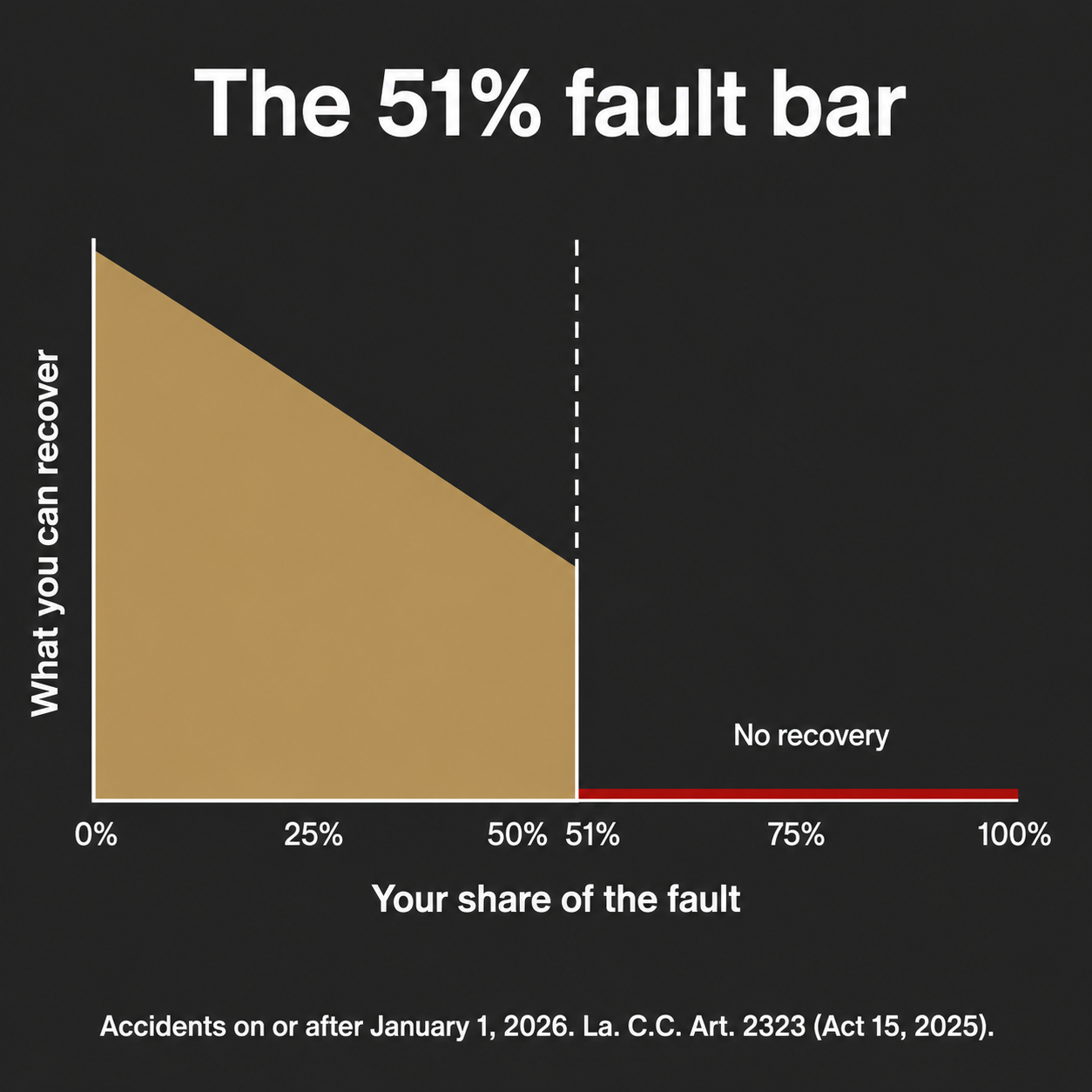
The change matters most in disputed and multi-vehicle crashes. In a rear-end collision, a red-light case, or a drunk driving crash where the other driver carries all of the fault, your recovery is not reduced at all.
Fault is also more negotiable than most people expect, because insurers routinely assign a share of it to the injured driver to bring the offer down. A husband and wife we represented were struck in the side by a driver who pulled out of a private driveway into their right of way. The insurance company argued our clients had been speeding and were partly responsible for their own injuries. The trial judge granted our motion for directed verdict and threw out the comparative fault claim because the defense had no evidence to support it. After a five-day trial in the 19th Judicial District Court, the jury awarded more than $1 million.
The Other Driver’s Policy Limits Can Cap What You Collect
Louisiana requires drivers to carry only 15/30/25 in liability coverage under La. R.S. 32:900: $15,000 for bodily injury to one person, $30,000 total for everyone hurt in one accident, and $25,000 for property damage. A driver carrying the minimum can cause a catastrophic injury and still have only $15,000 of liability coverage behind them.
Cost is part of the reason so many Louisiana drivers carry the minimum. Experian put average full coverage in Louisiana at $3,314 a year in 2026, against $1,890 for minimum coverage.
When your damages run past the at-fault driver’s limits, three other sources are worth checking:
- The at-fault driver’s personal assets. A driver who carries minimum limits usually does not have assets worth pursuing, so this rarely produces anything.
- Your own uninsured and underinsured motorist coverage.
- Any other policy that covers the vehicle or the driver, such as an employer’s commercial policy on a work truck.
Why Your Own Uninsured Motorist Coverage Often Matters More Than the Other Driver’s
Uninsured and underinsured motorist coverage, usually shortened to UM or UIM, pays when the at-fault driver has no insurance or not enough of it. Under La. R.S. 22:1295, every auto liability policy issued in Louisiana automatically includes UM coverage at the same limits as your liability coverage. The only way to waive it or reduce it is to sign the Commissioner of Insurance’s rejection form.
A valid rejection stays in force for the life of the policy, including renewals. That is why people are sometimes surprised to learn they have no UM coverage on a policy they have carried for years.
That coverage matters here because about 13.7% of Louisiana drivers carried no liability insurance as of 2022, roughly one in seven, according to the Insurance Information Institute. Pull your declarations page and look for UM or UIM limits. In a serious injury claim against a minimum-limits driver, that coverage is often the difference between a real recovery and a token one.
What Happens If You Were Driving Without Insurance
Louisiana’s No Pay, No Play law penalizes uninsured drivers even when someone else caused the crash. For accidents on or after August 1, 2025, an uninsured owner or operator cannot recover the first $100,000 in bodily injury damages or the first $100,000 in property damage under La. R.S. 32:866 as amended by Act 16 of 2025. The prior thresholds were $15,000 and $25,000. An uninsured owner who files suit and is awarded $100,000 or less in bodily injury damages is also assessed the court costs of every party.
The statute carves out situations where those bars do not apply:
- Passengers in an uninsured vehicle, unless the passenger also owns that vehicle.
- Vehicles that were legally parked at the time of the collision.
- Crashes where the other driver was convicted of DWI, intentionally caused the collision, fled the scene, or was committing a felony at the time.
Should You Accept the Insurance Company’s First Offer?
Usually not, and the main reason is timing. A first offer typically arrives before anyone knows what your treatment will cost or whether you will fully recover. Once you sign the release, the claim is closed, even if you need surgery six months later.
The second reason is that a first offer reflects what the insurer believes it can close the file for. Whether that is anywhere near what a jury would award is a separate question, and the gap can be wide.
A child we represented was attacked by a neighbor’s dog and suffered facial and emotional injuries. The insurance company would not offer more than $100,000. We turned it down and tried the case, and after a week-long trial the jury returned $360,000, more than three and a half times the insurer’s maximum offer, plus legal interest and court costs. That was not a car accident case, but we see the same pattern in car accident claims all the time. What an insurer is willing to pay and what a jury will award for the same injuries are often far apart.
Why Trial Readiness Changes the Number
An insurance company’s evaluation of your claim includes an evaluation of your lawyer. Adjusters keep track of which firms file suit and take cases to verdict, and which ones accept whatever is offered.
We prepare every personal injury case as though it will be tried, and we do not assume anything will settle. In twenty years, we have lost one trial.
In one products case, our client suffered a permanent eye injury when the hose on a chemical pump sprayer came loose under pressure and sprayed sodium hydroxide into his eye. The manufacturer made pre-trial offers and we turned them down. The case settled for $750,000 on the second day of a scheduled week-long jury trial.
Is There an Average Car Accident Settlement in Louisiana?
No neutral source publishes one. The agencies that collect Louisiana crash and insurance data, including LSU’s Center for Analytics and Research in Transportation Safety and the Louisiana Department of Insurance, publish crash counts, fatality figures, and premium data, but none of them publish settlement amounts. The “average Louisiana car accident settlement” figures that turn up in search results come from law firm marketing pages and lead generation calculators.
An average would not tell you much anyway. A soft tissue claim that resolves in three months and a spinal fusion claim with permanent work restrictions both count as car accident settlements. The only number that matters to you is what your own damages, your share of fault, and the available coverage support.
How Long Do You Have to File a Car Accident Lawsuit in Louisiana?
Two years from the date of the injury for accidents on or after July 1, 2024, under La. C.C. art. 3493.1, enacted by Act 423 of 2024. Accidents before July 1, 2024 fall under the old one-year deadline. Louisiana calls this prescription, and missing it ends the claim no matter how strong the case is.
How Long Does a Car Accident Claim Take?
Claims that settle without a lawsuit generally resolve within three to nine months after you finish medical treatment. Claims that go into litigation in a parish like East Baton Rouge usually take twelve to twenty-four months from the filing of the petition to a verdict. Two to three years is common for the cases we take all the way to trial, or that settle shortly before one.
Your medical treatment is what sets the pace. Settling before treatment is complete means guessing at your own damages, and the guess is almost always low.
What You Actually Take Home
The settlement figure and the check are two different numbers. Attorney fees, case costs, and medical liens all come out of a gross recovery.
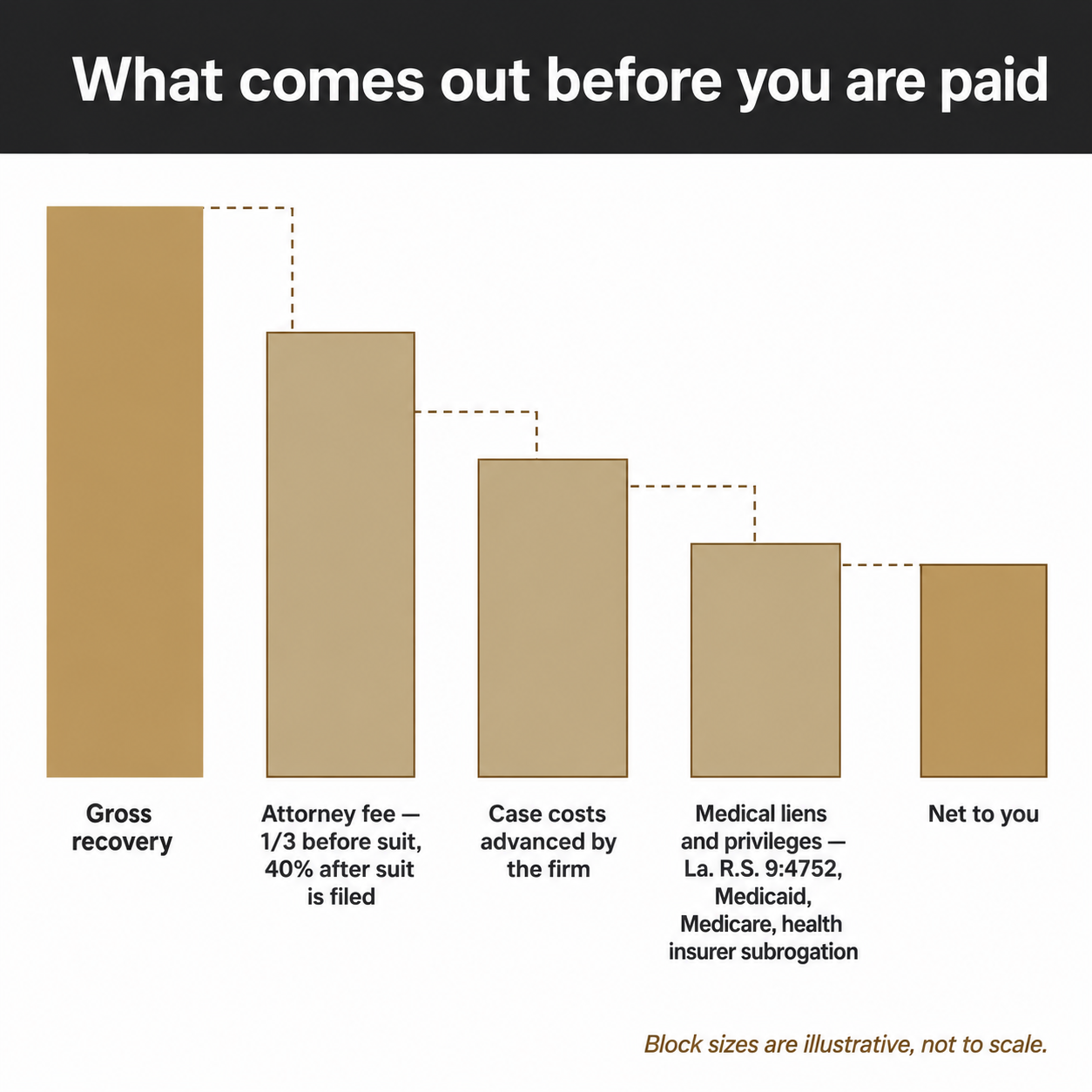
Our fee is one third of the recovery if we resolve the claim without filing a lawsuit, and 40% if a lawsuit is filed. We advance all case costs, including court filing fees, expert witness fees, and the cost of obtaining medical records, and those costs are reimbursed out of the recovery at the end. The consultation is free, and if we do not win, you owe us nothing.Liens come out as well. Under La. R.S. 9:4752, hospitals, physicians, and ambulance services hold a privilege on the net proceeds of your settlement for their reasonable charges. Medicaid has statutory recovery rights, Medicare has federal ones, and a health insurer that paid your bills usually has a subrogation claim too. All of it gets resolved out of the settlement before you are paid, which is why the size of the liens deserves as much of your attention as the size of the offer.
Common Questions About Louisiana Car Accident Claims
Does the 51% fault rule apply to my crash?
Only if your accident happened on or after January 1, 2026. Crashes before that date fall under pure comparative fault, where your share of the fault reduces your recovery but does not eliminate it.
I was a passenger in an uninsured car. Does No Pay, No Play apply to me?
The $100,000 bars do not apply to you as long as the vehicle was not yours. Passengers who do not own the uninsured car they were riding in are excepted, as are vehicles that were legally parked when they were hit.
How long do families have to file a wrongful death claim in Louisiana?
Act 176 of 2025, effective August 1, 2025, sets the deadline at one year from the date of death or two years from the day the injury was sustained, whichever period is longer. Before that, the deadline was one year from the date of death. Medical malpractice wrongful death and survival actions are the exception and still prescribe one year from the date of death. Our wrongful death attorneys can tell you which period applies to your family’s case.
Do I need a lawyer if the insurance company already made me an offer?
You can have the offer reviewed at no cost, and it is worth doing before you sign anything. An offer made before your treatment is finished is priced on incomplete information, and the release you sign to accept it closes the claim permanently.
Talk to a Baton Rouge Car Accident Attorney Before You Accept an Offer
If you were hurt in a crash in East Baton Rouge, Ascension, Livingston, or any of the surrounding parishes, we will look at what happened, tell you what we think the claim is worth, and explain how we got there. The consultation is free, you will speak directly with one of our partners, and you owe us nothing unless we recover money for you. Call us at (225) 303-0455 or reach out through our Baton Rouge car accident attorney page.