A divorce in Louisiana costs anywhere from about $300 to more than $30,000 per spouse. The low end is an uncontested filing where both spouses agree on every issue and neither one hires an attorney, so the only expenses are the parish filing deposit and service of process. The high end is a contested case with minor children, a house, and retirement accounts, where each spouse pays for their own attorney, property appraisals, and a custody evaluation. What moves a case from one end of that range to the other is almost entirely how much you and your spouse disagree.
At Melancon, Rimes & Daquanno, we have practiced in Baton Rouge since 2005, and our three partners bring more than 50 years of combined experience to the East Baton Rouge Family Court and to the district courts in the surrounding parishes. Our family law practice covers divorce, child custody and visitation, child support, community property division, and protective orders.
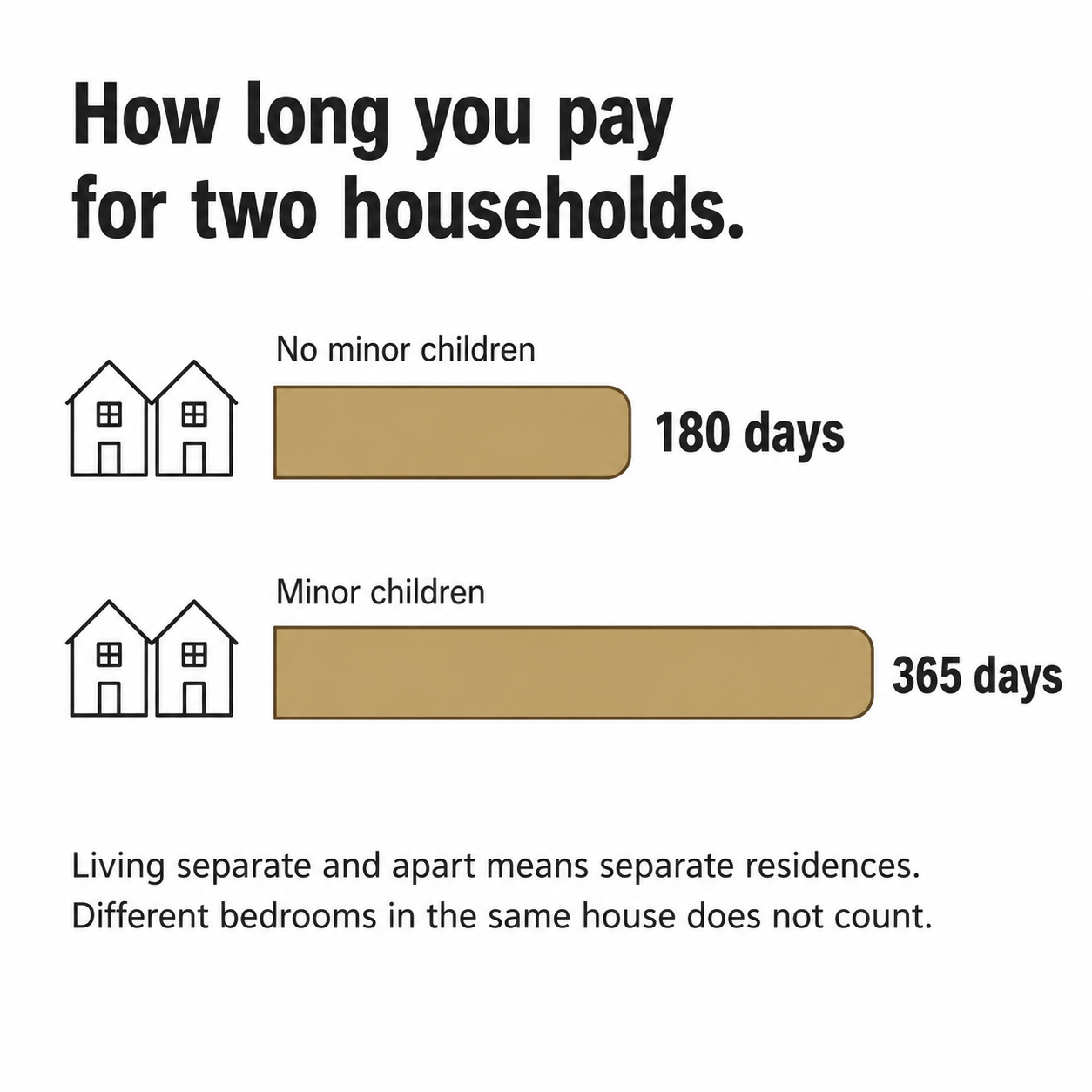
Two parts of Louisiana law surprise most people who start pricing this out. The first is the mandatory separation period. You have to live separate and apart for 180 days before a no-fault divorce can be granted, or 365 days if you have minor children, which means running two households for six months to a year. The second is that dividing your community property is a separate legal proceeding from the divorce itself, so a quoted price for a divorce often does not include it.
Average Cost of a Divorce in Louisiana by Type of Case
| Type of divorce | Typical total cost | What that covers |
| Uncontested, self-represented | $300 to $800 | Parish filing deposit and service costs. Both spouses agree on everything and neither hires an attorney. |
| Attorney-led uncontested | $2,500 to $7,000 | An attorney drafts, files, and finalizes everything. Legal fees alone commonly run $1,500 to $3,500 in the Baton Rouge market, plus court costs. |
| Mediated uncontested | $3,000 to $8,000 | A mediator at $100 to $300 per hour, drafting the settlement agreement, and filing costs. |
| Fully contested, tried in court | $10,000 to $30,000 or more per spouse | Attorney time at typical Baton Rouge rates, formal discovery, property appraisals, and custody experts. |
You will see a $12,600 average for a Louisiana divorce quoted in a lot of articles, rising to $18,900 when minor children are involved. Treat that as a midpoint, not as a budget, and note how old it is. Those figures come from a 2015 Martindale-Nolo survey of attorneys, recirculated ever since by legal directories and national news outlets. The survey averaged high-conflict litigated cases together with simple filings, and it did not cover uncontested divorces at all. An agreed divorce and a heavily contested one both sit thousands of dollars away from that average, in opposite directions, so it tells you very little about what your own case will cost in 2026.
Court Costs and Filing Fees in East Baton Rouge Parish
East Baton Rouge Parish is the only parish in Louisiana with a court dedicated entirely to family matters. The Family Court of East Baton Rouge Parish sits on the fourth floor of the courthouse at 300 North Boulevard in Baton Rouge, and it has exclusive jurisdiction over divorce, child custody, spousal and child support, community property partitions, and protective orders. Four elected judges preside over Divisions A through D. In every other Louisiana parish, domestic cases go on the general district court docket alongside everything else.
What you pay the clerk at the outset is an advance deposit, not a flat price. The clerk estimates what it will cost to file and process your pleadings, collects that up front, and draws costs against it as the case moves. Under La. R.S. 13:842, if the deposit runs out, the clerk can stop working on your case until you top it up.
These are the current figures from the East Baton Rouge Clerk of Court’s advance cost fee schedule for family filings:
| Family filing in East Baton Rouge Parish | Advance deposit |
| New suit, without service of process | $150 |
| New suit, with one service of process | $240 |
| Each additional service of process | $90 |
| Issuance of a TRO, rule, or citation | $90 each |
| Rule to show cause, Article 102 divorce (issuance of one rule only) | $145 |
| Judgment of divorce | $125 |
| Appointment of a curator for a spouse who cannot be located | $825 |
Two things in that table drive real money. The first is that every rule or motion you file after the petition carries its own issuance cost, so a case with a dozen motions in it has a dozen charges attached. The second is the curator fee: if your spouse cannot be found and the court has to appoint an attorney to represent them, that single line item costs more than three times the price of filing the divorce.
The clerk also collects a fee for the Family Court Judicial Expense Fund on family filings. Act 642 of the 2022 Regular Session raised the cap on that fee from $25 to $35 under La. R.S. 13:996.3, and the current $35 charge is built into the initial deposit above. It does not apply if you are exempt or the court has allowed you to proceed without paying costs.
Filing is now largely electronic. The East Baton Rouge Clerk of Court stopped keeping paper civil suit files on October 1, 2020, and fax filing ended statewide on January 1, 2026. Since that date, anything filed by an attorney has to go in either through a clerk-approved e-filing system or on paper in person. If you are representing yourself, you have more options than your attorney would: self-represented filers may still file by mail or commercial courier as well as in person or electronically.
Filing Deposits in the Surrounding Parishes
Deposits differ from parish to parish, and the differences are larger than most people expect, because each clerk sets a schedule covering its own judicial expense fund, law library, and court reporter costs under Title 13 of the Louisiana Revised Statutes. West Baton Rouge Parish charges nearly double what East Baton Rouge does to open the same divorce.
| Parish | Court | Published divorce filing deposit |
| East Baton Rouge | Family Court of EBR Parish | $150 without service, $240 with one service of process |
| West Baton Rouge | 18th Judicial District Court | $475 for a petition for divorce |
| Ascension | 23rd Judicial District Court | Not published in a public schedule; call the clerk |
| Livingston | 21st Judicial District Court | Not published in a public schedule; call the clerk |
| Iberville, Pointe Coupee | 18th Judicial District Court | Not published in a public schedule; call the clerk |
| East and West Feliciana | 20th Judicial District Court | Not published in a public schedule; call the clerk |
West Baton Rouge publishes its advance deposit schedule online. Several of the smaller parishes do not, and their figures are set by local administrative order rather than a posted chart. If you live outside East Baton Rouge Parish, call your own clerk of court and ask what the advance deposit is for a petition for divorce before you budget anything. Do not assume the Baton Rouge number applies.
What It Costs to Serve Divorce Papers
In East Baton Rouge Parish, one service of process is folded into the initial deposit, which is the $90 difference between filing with service and filing without it. Each additional service costs another $90. If your spouse cannot be located in Louisiana but still has a legal connection to the state, service through the Louisiana Secretary of State costs $50 on top of the sheriff’s delivery.
You can avoid that expense if your spouse is willing to sign an Acceptance and Waiver of Service. Under La. C.C.P. art. 3957, a written waiver executed after the petition is filed and entered into the record takes the place of formal service, which saves both the service cost and the wait for the sheriff to make contact. The waiver also affects your timeline. When a petition is filed before the spouses have finished living separate and apart, the separation period starts running on the date of service or on the date the waiver is executed. Getting that signature promptly starts the clock sooner than waiting on the sheriff.
How Louisiana Divorce Attorneys Charge
Attorney fees are the largest variable in any Louisiana divorce. They are the reason two cases filed in the same parish in the same week can differ by thousands of dollars.
Louisiana does not publish an official schedule of family law rates, so any figure you see is a market estimate rather than a fixed price. Family law attorneys in the Baton Rouge market commonly quote hourly rates in the range of $250 to $450, depending on experience, board certification, and the complexity of the case, and initial retainers are frequently in the range of $3,000 to $7,500. Ask any firm you speak with for its own current numbers rather than relying on a published range.
A retainer is an advance deposit against future work, not a flat price for the divorce. It sits in the attorney’s client trust account under Louisiana Rule of Professional Conduct 1.15, and the firm draws from it as work is performed and costs are advanced. In a contested case that balance runs down, and you will be asked to replenish it once it drops below an agreed threshold. The retainer figure a firm quotes you is what it takes to open the case. What the case costs in the end depends on how many hours it takes to resolve.
For an uncontested divorce handled by an attorney in the Baton Rouge area, legal fees commonly run $1,500 to $3,500, separate from court costs. For a contested matter, total attorney fees of $8,000 to $20,000 or more per party are routine once discovery, motion practice, and trial preparation are involved.
One question worth asking any firm you talk to is who will actually do the work on your file. Rates differ between partners, associates, and paralegals, and the answer tells you what your hourly dollars are buying. At our firm, a partner directly manages each case from start to finish, and you can read about our attorneys and their backgrounds before you decide who to hire.
Why Divorce Attorneys Cannot Work on Contingency
Personal injury attorneys commonly work on contingency, where the fee comes out of the recovery and the client pays nothing up front. Louisiana does not allow that arrangement in family law. Rule 1.5(d)(1) of the Louisiana Rules of Professional Conduct prohibits any fee in a domestic relations matter that is contingent on securing a divorce or on the amount of support or property awarded. The rule exists so that no attorney has a financial stake in whether a marriage ends or in how large a support award turns out to be.
The rule is generally understood not to reach the collection of support a court has already ordered and the other party has failed to pay, because a fee tied to recovering an existing arrearage does not raise the same concern. Everything else in family law is billed hourly or at a fixed fee, so expect to talk about money at the first meeting.
Article 102 vs. Article 103: Which Filing Costs Less
Louisiana gives you two routes to a no-fault divorce. The one you choose changes both what you pay and what protection you have while you wait.
An Article 103 divorce is filed after you and your spouse have already lived separate and apart for the required period without reconciling. It is a single filing, and the judgment comes shortly after your spouse is served, or by default if your spouse does not respond.
An Article 102 divorce is filed first, before the separation period has run. The period starts when your spouse is served or signs a waiver. Once 180 days have passed, or 365 days if there are minor children when the rule is filed, you file a Rule to Show Cause asking the court to grant the divorce. That rule has to be verified by the affidavit of the moving party and served on your spouse under La. C.C.P. art. 3952. If the rule is never filed within two years of service of the original petition, the action is abandoned under La. C.C.P. art. 3954 and you start over from the beginning.
In East Baton Rouge Parish you can price the difference exactly. The second step of an Article 102 divorce, issuing the rule to show cause, is a $145 charge on top of what you already deposited to open the case, before any attorney time.
| Article 102 | Article 103 | |
| When you file | Before the separation period has run | After the separation period has already run |
| Number of filings | Two: the petition, then a rule to show cause | One: the petition |
| Cost | Higher. Two filings and more attorney time | Lower. Generally the cheapest route to a judgment |
| Relief while you wait | A case is pending, so a judge can set temporary custody, child support, interim spousal support, and use of the family home | No case is pending, so there is nothing for a judge to rule on |
| Community property | Ends retroactively as of the date the petition was filed, under La. C.C. art. 159 | Keeps accumulating during the separation period, including debt either spouse takes on |
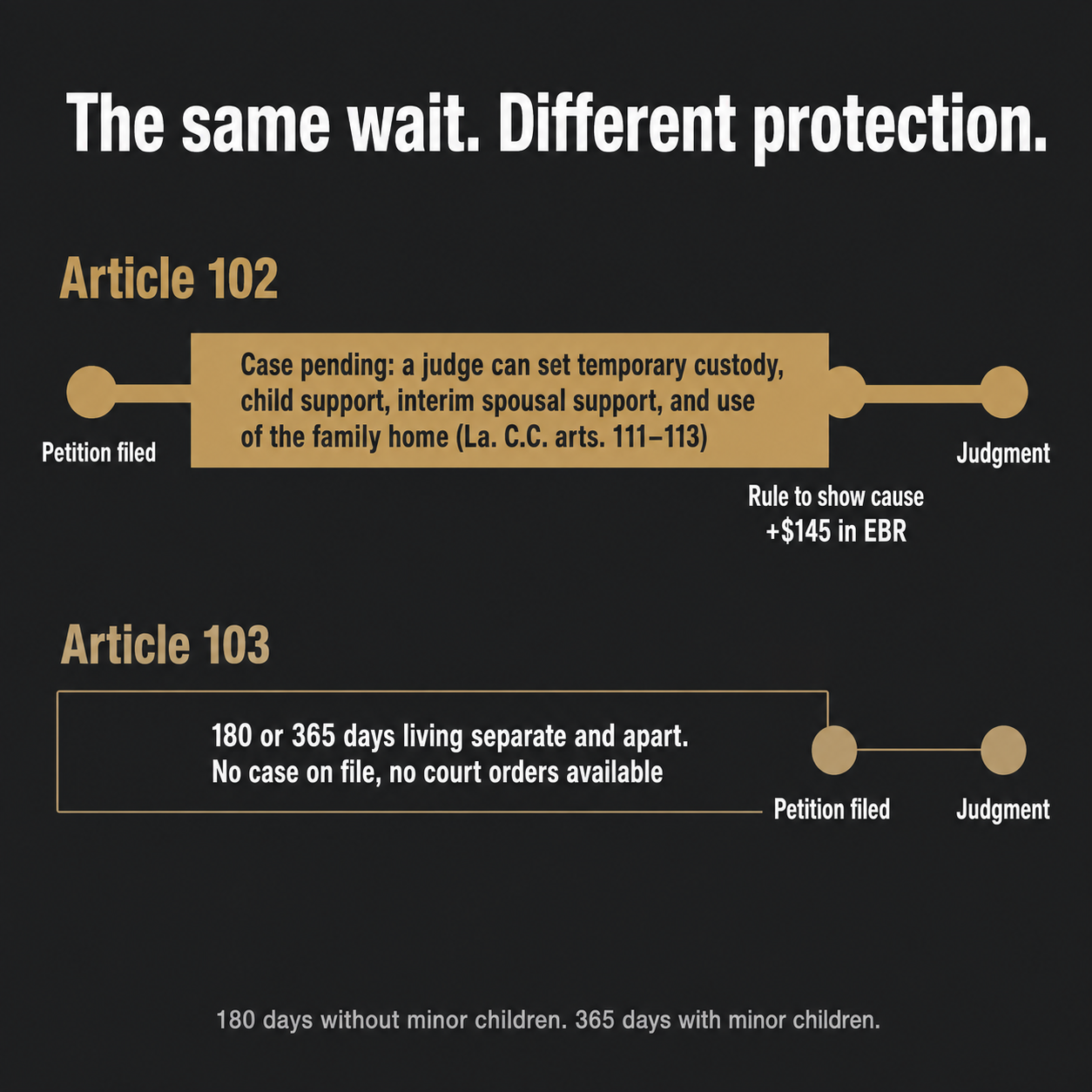
Choosing Article 103 to save on filing costs can cost you far more than it saves. Waiting out 180 or 365 days with no case on file means no court-ordered child support, no custody order, and no protection from community debt your spouse runs up in the meantime. Interim spousal support and the other temporary relief under La. C.C. arts. 111 through 113 only become available once a case is pending. For a lower-earning spouse, or for a parent who needs a custody schedule in writing, the extra filing is usually the better financial decision.
What the 180-Day and 365-Day Separation Period Costs You
Louisiana requires spouses to live separately and apart continuously, without reconciling, for 180 days when there are no minor children and 365 days when there are. Living separate and apart means separate residences. Sleeping in different bedrooms of the same house does not satisfy the requirement.
For most couples this is the single largest expense of the divorce, and it is the one almost nobody budgets for. You are paying two rents, or a rent on top of the mortgage, plus two power bills, two internet bills, two sets of groceries, and often a second car. Carried for six months to a year, those costs dwarf a $240 filing deposit. If you are working out whether you can afford to divorce this year, start with the household budget rather than with the court costs.
Louisiana Civil Code Article 103 also provides grounds that remove the waiting period entirely: adultery, a felony conviction with a sentence of death or imprisonment at hard labor, physical or sexual abuse of the filing spouse or a child of either spouse, and a protective order or injunction issued against the other spouse after a contradictory hearing or consent decree. Each of those has to be proven with evidence. Litigating fault means evidentiary hearings and witness testimony, and it frequently costs more in attorney fees than waiting out the no-fault period would have. Proving adultery in particular often involves hiring a private investigator, which adds cost before the case even reaches a courtroom.
What a Covenant Marriage Divorce Costs
If you signed a Declaration of Intent and completed premarital counseling before your wedding, you may have a covenant marriage under La. R.S. 9:272 through 9:309. Louisiana is one of a small number of states that offers this option, and it is deliberately harder to end than a standard marriage.
Three requirements push the cost above a standard divorce:
- Counseling is required before the court will grant the divorce. Those sessions are an out-of-pocket expense with no court involvement at all. The one exception is important: under La. R.S. 9:307(D), the counseling requirement does not apply where the other spouse has physically or sexually abused you or a child of either spouse.
- A no-fault covenant divorce requires two years of continuous separation under La. R.S. 9:307, rather than 180 or 365 days.
- The alternative is a judgment of separation from bed and board followed by one year of separation, or one year and six months if you have minor children. That path means two separate lawsuits, two sets of filing deposits, and two rounds of attorney time.
Immediate grounds do exist for covenant marriages, and they are narrow: adultery, a felony conviction with a hard labor sentence, abandonment of the matrimonial domicile for one year, or physical or sexual abuse.
Dividing Community Property Is a Separate Case
Louisiana is a community property state under Civil Code Article 2334 and following. Property and debt acquired during the marriage generally belong to both spouses, and dividing it, called a partition, is a legal proceeding separate from the divorce itself. This is the most common reason a quoted divorce price turns out to be incomplete.
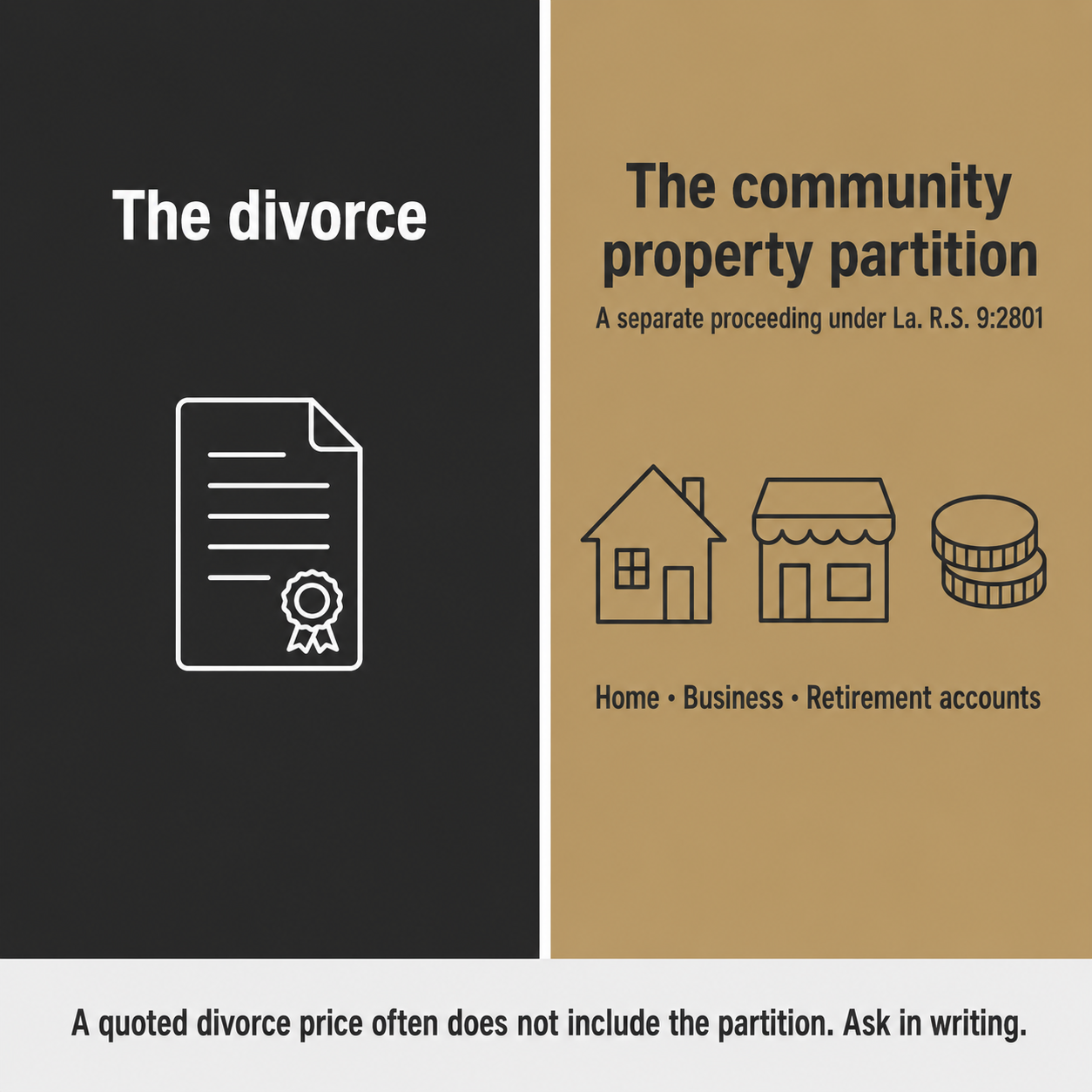
If you and your spouse agree on how to split things, you can sign a voluntary partition agreement, and the cost is limited to drafting it. If you do not agree, the partition is litigated under La. R.S. 9:2801. Each spouse files a sworn detailed descriptive list of every community asset and debt, the other side can challenge it at a traversal hearing, the court may appoint experts, and a judge allocates the property.
In a contested partition, the expense comes from the experts rather than from court fees. Typical market ranges look like this:
- Real estate appraisal, $400 to $800 per property. Establishes fair market value for the family home or any other real estate.
- Business valuation, $5,000 to $15,000 or more. Performed by a certified valuation analyst or CPA when one spouse owns a closely held company. This is the line item that most often pushes a partition into five figures on its own.
- QDRO drafting, $500 to $1,500 per account. A Qualified Domestic Relations Order is the document that actually divides a pension or a 401(k). Without one, a judgment awarding you half of a retirement account cannot be carried out by the plan administrator.
- Forensic accounting, billed hourly. Used to trace assets one spouse may be hiding, or to sort out reimbursement claims between community and separate property.
Before you accept a flat-fee divorce quote from anyone, ask in writing whether it includes the community property partition. Often it does not, and when there is a house, a business, or a retirement account to divide, the partition can cost more than the divorce itself.
How Child Custody Disputes Raise the Cost
Custody disputes are the most common reason a four-figure divorce becomes a five-figure one. The added cost comes from three places.
Court-ordered mediation and parenting classes. Under the East Baton Rouge Family Court rules, parents in a contested custody dispute attend an educational program on the effects of divorce on children. Mediation arranged through the court is taxed as court costs, which means it is added to the costs assessed at the end of the case. Private mediation runs $100 to $300 per hour, and a case resolved through mediation, including the settlement agreement and filing, generally totals $3,000 to $8,000.
Custody evaluations. When parents cannot agree on a custody arrangement under La. C.C. art. 131, the court can appoint a licensed psychologist or psychiatrist to evaluate the family and make a recommendation. These evaluations commonly cost $5,000 to $15,000 and are usually split between the parties.
An attorney appointed for the children. In some cases a judge appoints an attorney or a guardian ad litem to represent the children’s interests, and the parents pay those fees. The amount depends on the appointee’s hourly rate and how contested the case becomes.
Child support itself is comparatively inexpensive to establish. Louisiana calculates it with a formula written into the statute, La. R.S. 9:315 and following, so once both parents’ gross incomes are documented, there is not much left to argue about. Spousal support is a different matter. Interim support under La. C.C. art. 113 and final periodic support under La. C.C. art. 112 both require proving financial need, earning capacity, and freedom from fault. Every one of those is billable time.
Uncontested vs. Contested Divorce: What Each One Costs
| Cost component | Uncontested | Contested |
| Filing deposit | $150 to $240 in East Baton Rouge Parish | The same to open, plus $90 for every additional rule, citation, or service |
| Service of process | $0 with a signed waiver | Built into the deposit, $90 for each additional service |
| Attorney fees | $1,500 to $3,500 | $8,000 to $20,000 or more per spouse |
| Mediation | Optional, $100 to $300 per hour | Frequently ordered by the court in custody disputes |
| Property valuation | $0 when you agree on the split | $400 to $800 per appraisal, $5,000 to $15,000 or more for a business |
| Custody evaluation | Not needed | $5,000 to $15,000, usually split between the parties |
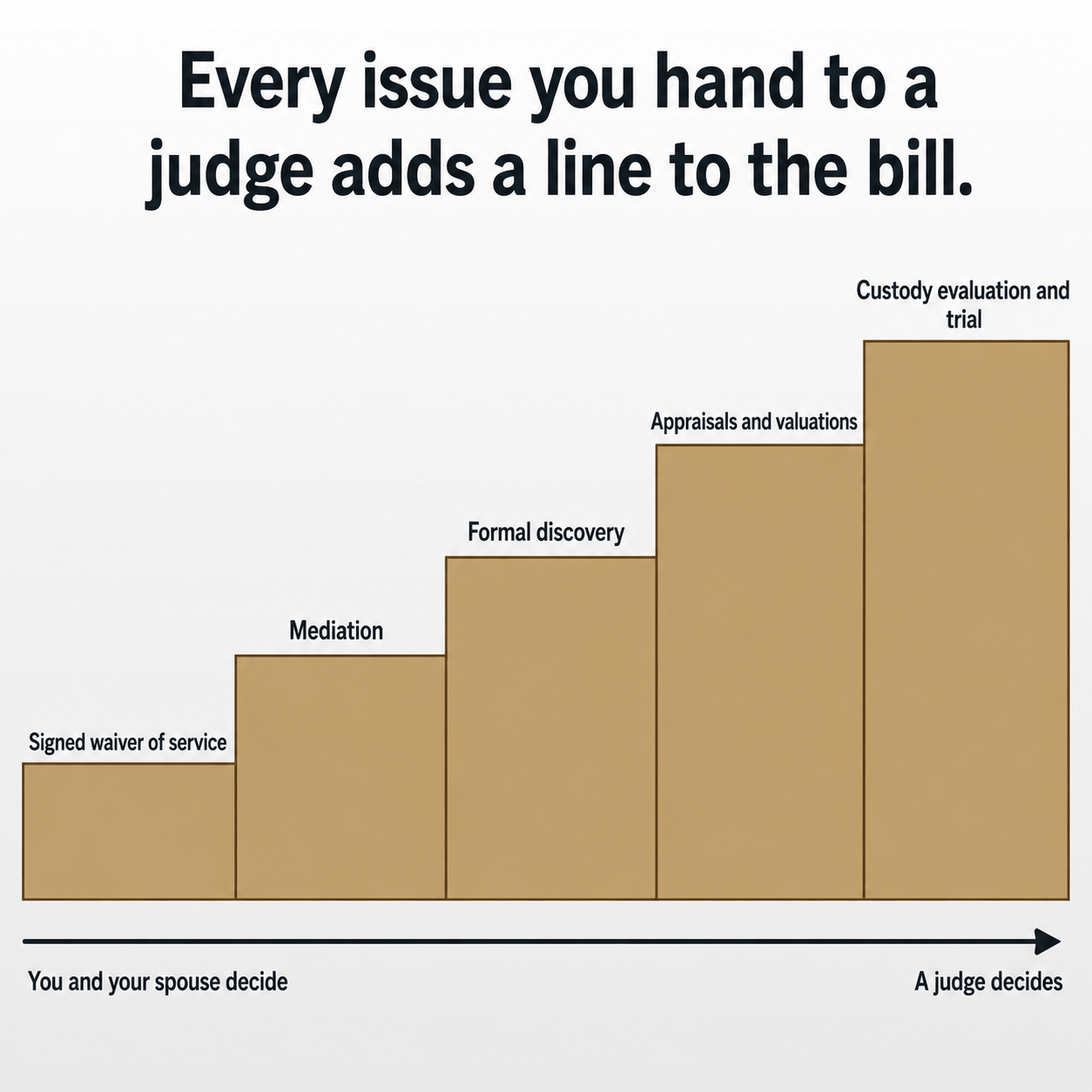
Every row in that table is decided by the same thing: whether the two of you settle the issue or a judge has to decide it for you. Time spent working out terms while you are both still willing to talk is what keeps items out of the contested column.
Who Pays the Attorney Fees in a Louisiana Divorce?
Each spouse pays their own attorney’s fees, regardless of who prevails. Louisiana follows the American Rule in domestic litigation, so a judge will not shift fees simply because one side won.
Louisiana law does create four exceptions where a court can order one spouse to pay the other’s legal fees:
- A spouse who willfully violates a custody, visitation, or support order can be held in contempt under La. R.S. 13:4611 and ordered to pay the other party’s reasonable attorney’s fees and costs.
- Under La. R.S. 9:375, when a court renders judgment on delinquent child or spousal support, the prevailing party must be awarded attorney’s fees and court costs unless the court finds good cause for the nonpayment.
- Pleadings filed for an improper purpose, or with no basis in law or fact, expose both the party and the attorney to sanctions under La. C.C.P. art. 863, and those sanctions can include paying the other side’s fees.
- A spouse found to have committed domestic abuse can be assessed the attorney’s fees and court costs connected to the protective order proceeding and the divorce action.
These matter for budgeting in both directions. If your spouse is ignoring court orders, part of what you spend enforcing them may be recoverable. If you are the one filing repeated motions that go nowhere, you can be made to pay for that too.
If You Cannot Afford the Court Costs
Louisiana lets you file without paying court costs up front. The process is called proceeding in forma pauperis, and it is available under La. C.C.P. art. 5181 and following. You submit a detailed financial affidavit listing your income, assets, and debts, along with a supporting affidavit from someone who is not a relative confirming that you cannot pay.
East Baton Rouge Parish has a specific procedure worth knowing before you go. Both you and the person who signed your supporting affidavit are expected to appear before the duty judge in the morning so the court can question you and satisfy itself that you qualify. If the judge denies the application, you are typically given fifteen days to pay the costs before the case can be dismissed.
Approval waives the advance deposits for filing, service, and court reporter transcription. One point is often misunderstood: this defers the costs rather than cancelling them. When the case ends, court costs are assessed against the party the court orders to pay them, which is usually the losing side. If you prevail, the costs are taxed to your spouse.
Free and low-cost help is also available in the Baton Rouge area:
- The Self-Help Resource Center at the East Baton Rouge Family Court. Staffed by volunteer attorneys and law students on the fourth floor of the courthouse, it helps self-represented litigants with court forms, access to case information, and general questions about how the system works. The court publishes free form packets for Article 103 divorces, with and without minor children, along with a fee waiver form. The center is open Tuesdays and Thursdays from 10:00 a.m. to 2:00 p.m., and you need an appointment.
- Southeast Louisiana Legal Services. Free civil legal assistance for low-income residents of East Baton Rouge and surrounding parishes, with priority given to domestic violence, protective orders, and custody matters.
- The Baton Rouge Bar Association’s Ask A Lawyer clinics. Held several days a month at locations around the parish.
- The Louisiana Civil Justice Center. A statewide legal hotline that answers family law questions.
- Louisiana Law Help. A statewide portal for finding legal service providers and self-help resources in your area.
How to Keep the Cost of Your Divorce Down
Most of what determines the final bill is within your control.
- Settle what you can before anyone files. Every issue the two of you resolve privately is an issue nobody bills you to argue about in court.
- Ask your spouse to sign a waiver of service. It saves the service cost, and the separation period starts the day the waiver is executed.
- Use mediation for custody. At $100 to $300 per hour, a mediator costs a fraction of what two attorneys preparing for a custody trial cost, and it can avoid a $5,000 to $15,000 evaluation on top of that.
- Bring your documents to the first meeting: tax returns, pay stubs, mortgage statements, retirement account statements, vehicle titles, and a list of debts. Time your attorney spends collecting paperwork is billed at the same hourly rate as time spent negotiating your settlement.
- Batch your questions. Six questions in one email cost less than six separate phone calls.
- Do not file motions to make a point. Every rule or citation issued in East Baton Rouge Parish carries its own charge plus attorney time, and a pattern of pointless filings can expose you to sanctions.
- Ask exactly what a quoted price includes, specifically whether it covers the community property partition and what happens to the price if custody becomes contested.
Frequently Asked Questions About Divorce Costs in Louisiana
How much does an uncontested divorce cost in Louisiana?
Handling it yourself costs roughly $300 to $800, covering the parish filing deposit, service of process, and the judgment. With an attorney drafting and filing everything, budget $2,500 to $7,000 in total, of which roughly $1,500 to $3,500 is legal fees in the Baton Rouge market.
What are the divorce filing fees in East Baton Rouge Parish?
The Clerk of Court collects an advance deposit of $150 to open a new family suit without service of process, or $240 with one service. Each additional service or issuance of a rule or citation costs $90, the rule to show cause in an Article 102 divorce costs $145, and the judgment of divorce costs $125. The $35 Family Court Judicial Expense Fund fee is included in the initial deposit.
Can court costs be waived in a Louisiana divorce?
They can be deferred. Filing in forma pauperis under La. C.C.P. art. 5181 lets you proceed without paying court costs up front, provided you submit a financial affidavit and a supporting affidavit from someone who is not a relative. In East Baton Rouge Parish both of you are expected to appear before the duty judge. The costs are still assessed at the end of the case against whichever party the court orders to pay them.
Does having children make a divorce more expensive in Louisiana?
Yes, in two separate ways. The mandatory separation period doubles from 180 to 365 days, which means twice as long paying for two households. And if custody is disputed, mediation and a possible $5,000 to $15,000 custody evaluation get added to the case.
How much does it cost to divorce a covenant marriage in Louisiana?
More than a standard divorce in every scenario. Counseling is required before the court will grant the divorce, except where the other spouse has committed physical or sexual abuse, and the no-fault route calls for two years of continuous separation under La. R.S. 9:307. The alternative is a separation from bed and board followed by one year apart, or one year and six months with minor children, which requires two lawsuits instead of one.
Can a Louisiana divorce lawyer take my case on contingency?
No. Rule 1.5(d)(1) of the Louisiana Rules of Professional Conduct bars contingency fees in domestic relations matters. Divorce work is billed hourly or at a fixed fee. The rule is generally understood not to reach fees for collecting support that has already been ordered and is past due.
Talk With a Baton Rouge Family Law Attorney
What your divorce will cost depends on facts specific to your marriage: whether there are minor children, whether you own a home or a business, and how much you and your spouse can settle before anyone walks into a courthouse. A consultation is where those facts turn into a number you can plan around instead of a range.
Our family law practice handles divorce, child custody and visitation, child support, community property division, protective orders, paternity, and adoptions throughout East Baton Rouge, West Baton Rouge, Ascension, Livingston, Iberville, Pointe Coupee, West Feliciana, East Feliciana, and St. Helena parishes, including Port Allen, Zachary, Baker, Central, Denham Springs, Clinton, and St. George. A partner handles your case personally, from the first meeting to the final judgment.
Call us at (225) 303-0455 or come see us at 6700 Jefferson Hwy (Building 6), Baton Rouge, LA 70806 to schedule a consultation and talk through what your situation is likely to cost.