The best wrongful death attorney in Baton Rouge is one who personally handles your family’s case, prepares every case as if it will go to trial, acts in the first days after a death to preserve evidence, and knows Louisiana’s wrongful death laws in detail. You can test any lawyer on those four points at a free consultation by asking direct questions and listening for specific answers.
At Melancon, Rimes & Daquanno, our three partners have more than 50 years of combined legal experience. We have lost only one trial since we founded the firm in 2005. We represent families in wrongful death cases across the greater Baton Rouge area, and most of our clients come to us through referrals from former clients and other attorneys.
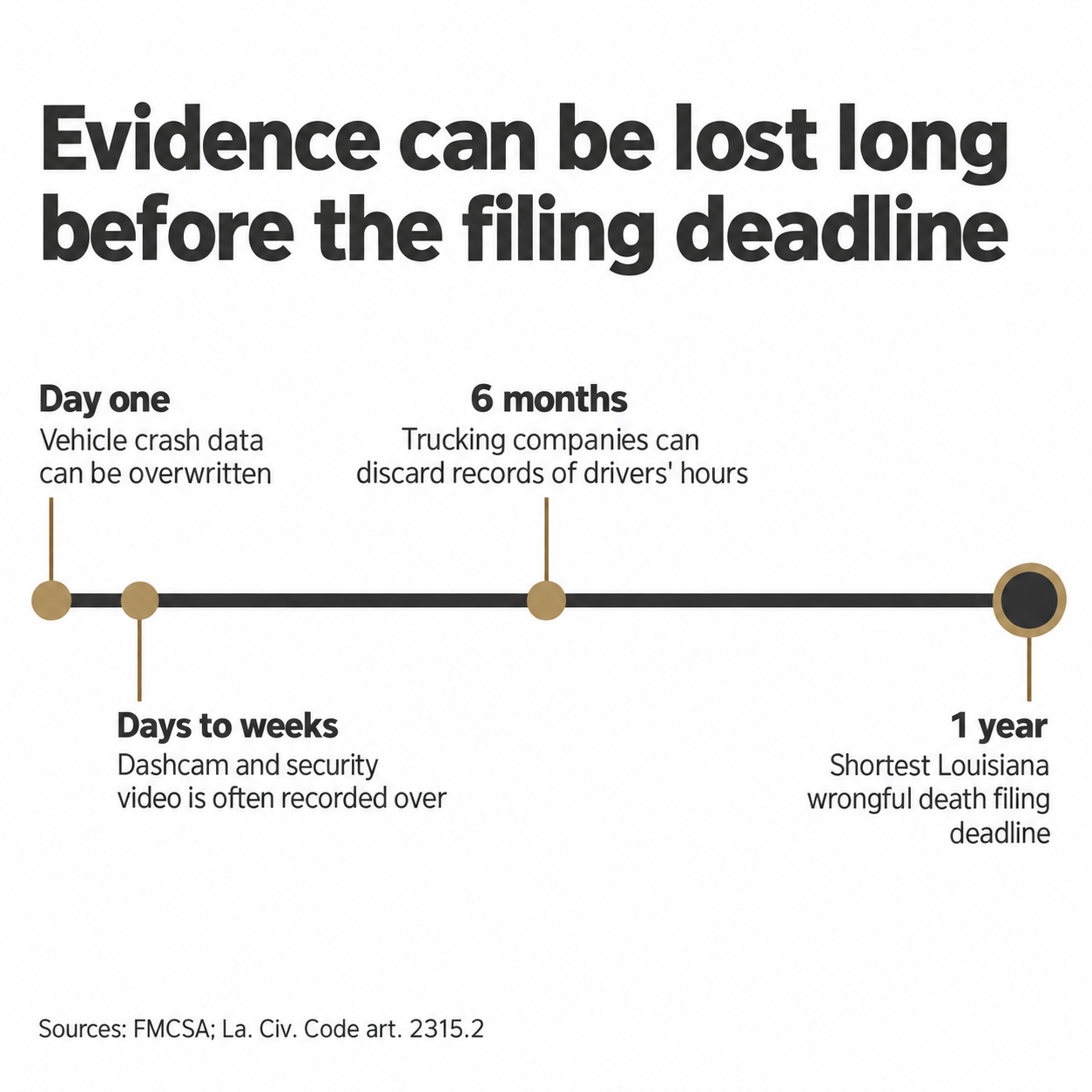
We know this decision comes at a painful time. Even so, it helps to talk with a lawyer soon. Some Louisiana wrongful death claims must be filed within one year of the date of death, and evidence from a fatal crash can be lost within weeks.
Who Will Actually Handle Your Wrongful Death Case?
The attorney you meet at your consultation should be the attorney who handles your case. At some firms, a senior lawyer meets with the family and then passes the file to an associate or a case manager. From that point on, the family makes hard decisions about experts, depositions, and settlement offers with someone they did not meet at the consultation.
Ask each firm directly: Who will take the depositions? Who will call me when an offer comes in? Who will try the case if it goes to court? A good answer names one person and describes what that person will do. If the answer is “our whole team works on it,” ask which attorney is responsible for your case.
At our firm, a partner directly manages each wrongful death and personal injury case from the first meeting until the case ends, and that partner is the person you talk with. You can learn about Jason L. Melancon, Robert C. Rimes, and R. Lee Daquanno, Jr. on our attorneys page.
Has the Lawyer Tried Serious Injury and Death Cases?
Choose a lawyer who has taken serious injury or death cases to a verdict and who prepares your case for trial from the start. A lawyer’s trial record affects what the insurance company offers, even though most cases settle. Only about 3% to 4% of tort lawsuits in state courts end in a trial verdict, according to the Bureau of Justice Statistics.
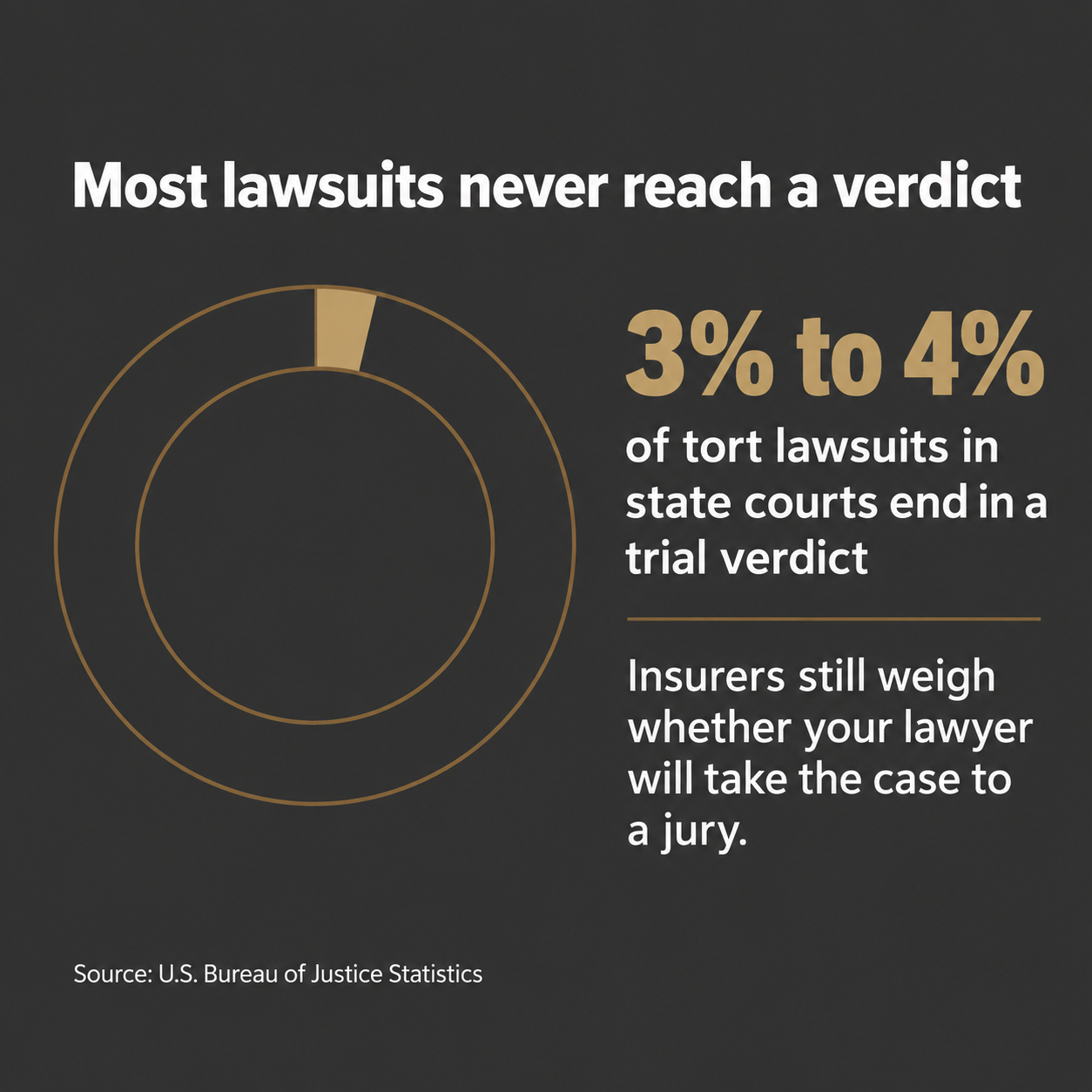
Trial experience matters in cases that settle because an insurer sets its offer partly by estimating what a jury would award and whether this particular lawyer will actually take the case to a jury. Insurers keep track of which lawyers try cases and which ones accept early offers. A lawyer with a real trial record gives the insurer a reason to offer more before trial.
Ask how many cases the lawyer has tried to get a verdict in the last five years, what kinds of cases they were, and which courts heard them. At our firm, we prepare every case as if it will go to trial, starting on the first day. Results from cases we prepared for trial include:
- A $360,000 jury verdict for a child injured in a dog attack in Livingston Parish. The verdict was more than 3.5 times the insurance company’s best offer, which was under $100,000.
- A $750,000 settlement for a repairman who suffered a permanent eye injury from a defective pump sprayer. We turned down the manufacturer’s pre-trial offers, and the case settled on the second day of a scheduled jury trial.
- Jason Melancon’s results include a $3,225,000 jury verdict in Lafayette Parish and a $1,750,000 judge verdict in West Baton Rouge Parish. Robert Rimes obtained a $1,020,000 jury verdict in East Baton Rouge Parish.
Past results do not guarantee a similar outcome.
Preparing for trial keeps a family’s options open. A good lawyer will also tell you plainly when a settlement offer is the better choice. Honest advice about settlement matters even more for incidents on or after January 1, 2026, when Louisiana’s new fault rule took effect. Under the new rule, a family recovers nothing if a jury finds the person who died 51% or more at fault, so a fair settlement can be the safer choice when fault is in dispute.
How Fast Will the Attorney Move to Preserve Evidence?
A wrongful death attorney should start protecting evidence within days of being hired. Much of the proof in a fatal crash is held by other people and businesses, such as a trucking company, an insurer, or a store with security cameras. Some of it can be legally thrown away after a set period, and some of it is lost through routine use.
- Trucking companies only have to keep records of their drivers’ hours on duty, and the documents that support those records, for six months under federal rules. After that, the company can throw them out.
- A truck’s engine control module and a car’s event data recorder capture speed, braking, and gas pedal use in the seconds before a crash. Some of that data can be overwritten if the vehicle is driven, left idling, or towed with the ignition on.
- Dashcams and business security cameras usually record over old footage automatically, often within days or weeks. Some traffic cameras only show a live feed and don’t save any footage.
- Wrecked vehicles get repaired, sold, or scrapped, and the physical evidence on them is lost when that happens.
The main tool for keeping crash evidence from disappearing is a preservation letter. It is a formal written demand that a trucking company, insurer, tow yard, or nearby business keep specific evidence.
Preservation letters matter even more in Louisiana because the law offers families few remedies once evidence is gone. In Reynolds v. Bordelon (2015), the Louisiana Supreme Court held that a family cannot bring a separate lawsuit against someone who carelessly loses or destroys evidence. A court will usually assume lost evidence would have hurt the party that destroyed it only when the destruction was intentional or in bad faith. An early preservation letter puts each company on notice, so it becomes much harder for any of them to claim the evidence was thrown out in the normal course of business.
A good firm also brings in experts early. An accident reconstruction expert with the right equipment can download a vehicle’s data without corrupting it and document the crash scene before it changes.
Our dump truck wrongful death case shows why the first days matter. On Airline Highway, a dump truck driver approached a light as it turned yellow and sped up instead of stopping, then ran the red. The truck hit the driver’s side of a car and killed the woman driving it instantly. She was a wife and a mother. The defense argued the crash was unavoidable because of the truck’s weight. We immediately retained experts to secure and analyze the truck’s onboard electronic data, and the data showed the truck accelerating toward the light. We sued the truck driver, the truck driver’s employer, and the insurance company. After the data came out, the insurer tendered its full policy limits, meaning it offered the most its policy would pay.
Jason Melancon earned a biological engineering degree from LSU before law school. That background helps our firm when a case depends on technical evidence, such as vehicle data, a product’s design, or the medical cause of a death. If a commercial vehicle was involved in your family member’s death, you can read more about our truck accident cases.
Louisiana Wrongful Death Laws Your Attorney Should Know
Louisiana’s wrongful death rules differ from other states’ rules, and several changes took effect in 2025 and 2026. A lawyer you’re considering should be able to explain in plain language who can file, how the two types of death claims work, what the filing deadline is, and how fault is divided.
Who Can File a Wrongful Death Claim in Louisiana?
Louisiana Civil Code article 2315.2 lists the family members who can file a wrongful death claim, in order of priority. If anyone in a higher group is alive, no one in a lower group can file.
| Priority | Who can file | When they can file |
| First | The surviving spouse and children, including adopted children | Always first in line |
| Second | The surviving parents | Only if there is no surviving spouse or child |
| Third | The surviving brothers and sisters | Only if there is no surviving spouse, child, or parent |
| Fourth | The surviving grandparents | Only if there is no surviving spouse, child, parent, or sibling |
An unmarried partner cannot file a wrongful death claim under Louisiana law, even after many years together. If no one on the list survives, no one can bring a wrongful death claim. A legal representative of the estate may still bring a survival action, which is the claim for the harm the person suffered before death.
What Is the Difference Between a Wrongful Death and a Survival Action?
A wrongful death action compensates the family for their own losses from the death. A survival action compensates for the harm the person who died suffered between the injury and the death. Families usually bring both claims together.
| Survival action (La. Civ. Code art. 2315.1) | Wrongful death action (La. Civ. Code art. 2315.2) | |
| Whose losses it covers | The person who died | The surviving family members |
| What it can include | The physical pain, suffering, and fear the person experienced before death, plus medical bills from that time | Loss of love, companionship, and guidance; grief and mental anguish; lost financial support and household services; funeral and burial costs |
| What the value depends on | What the person experienced between the injury and death | What the family lost, including the support the person would have provided over a working life |
If the person died instantly with no awareness of what was coming, there may be no survival claim for pain and suffering. Survival damages can include the fear a person felt in the moments before a crash, so evidence about those moments matters even when a death seemed instant.
How Long Do You Have to File a Wrongful Death Lawsuit in Louisiana?
For deaths on or after August 1, 2025, a Louisiana wrongful death or survival claim generally has to be filed within one year of the death or within two years of the injury, whichever date is later. Act 176 of 2025 set this rule in Civil Code articles 2315.1 and 2315.2.
For example, if a person was injured in a crash on August 15, 2025, and died on September 1, 2025, one year from the death is September 1, 2026, and two years from the injury is August 15, 2027. The family would have until August 15, 2027, to file.
- A wrongful death claim based on medical malpractice must be filed within one year of the date of death. The two-year injury option does not apply.
- Before August 1, 2025, a wrongful death claim had to be filed within one year of the death. If your family member died before that date, have a lawyer confirm right away which rule applies to your family’s claim.
- Louisiana’s general two-year deadline for personal injury cases does not set the deadline for a wrongful death claim, so don’t rely on it.
We explain the timing rules in more detail in our guide to the statute of limitations for wrongful death in Louisiana.
How Does Louisiana’s 51% Fault Rule Affect a Wrongful Death Claim?
For incidents on or after January 1, 2026, a family recovers nothing if the person who died is found 51% or more at fault, under the amended Civil Code article 2323. If that person is found less than 51% at fault, the family’s recovery is reduced by that percentage. Incidents before 2026 still fall under Louisiana’s older pure comparative fault rule, where fault reduces a recovery but does not erase it.
Because the fault of the person who died counts against the family, the defense has a strong reason to blame that person. For example, the defense may argue the person was speeding, distracted, or not wearing a seat belt. Since 2021, Louisiana civil juries have been allowed to hear evidence that someone wasn’t wearing a seat belt. Jurors are also now told how the fault percentages they assign affect what the family receives.
Ask a lawyer how the other side is likely to argue fault in your case and what evidence would answer it.
In a car accident case we tried in the 19th Judicial District Court in East Baton Rouge Parish, the defense argued that our clients, a husband and wife, were speeding. The judge granted our motion for a directed verdict on that issue, which threw out the speeding claim because the defense had no evidence to support it. After a five-day trial, the jury also rejected the defense’s arguments about our clients’ injuries and awarded more than $1 million. Under the 51% rule, getting an unsupported fault argument thrown out can decide whether a family recovers anything at all.
Medical Malpractice Deaths Follow Different Rules
When a death is caused by medical negligence, Louisiana adds a review step before any lawsuit, sets a shorter deadline, and limits damages.
- Before a family can sue a qualified health care provider, meaning one covered by Louisiana’s Medical Malpractice Act, the claim generally goes to a medical review panel. The panel is made up of three health care providers and an attorney who serves as chair. Filing the panel request pauses the filing deadline while the panel reviews the claim and for 90 days after the family is notified of its opinion.
- The wrongful death claim must be filed within one year of the date of death.
- Total damages for one patient’s death are generally capped at $500,000, not counting interest and court costs, under La. R.S. 40:1231.2.
Filing in court before the panel process is complete can get the case dismissed. A lawyer handling a death caused by a doctor or hospital needs to know the panel rules and deadlines well. You can read more about our medical malpractice cases.
When a Death Happens on the Job
When a worker is killed on the job in Louisiana, workers’ compensation death benefits are usually the family’s only claim against the employer. A family can sue the employer directly only in rare cases where the employer intended the harm or knew the death was substantially certain to happen. The family can still bring a full wrongful death and survival claim against anyone else who caused the death, such as an unrelated driver or trucking company, another contractor on the same site, or the manufacturer of a defective machine or safety harness.
The workers’ compensation insurer can claim repayment out of any recovery from those other parties, so a settlement with them has to account for the insurer’s claim. We handle both workers’ compensation claims and product liability cases, so we can review the benefits claim and any claim against another party together.
Can the Firm Afford the Experts Your Case Needs?
A wrongful death case usually needs several paid experts, so ask who pays for them up front and what happens to those costs if the case is lost. Depending on the facts, a case may need:
- An accident reconstruction expert to show how the crash happened
- A medical expert to explain the cause of death and what the person experienced before dying
- An economist to calculate lost financial support and household services
- An engineer, when a vehicle part or product may have failed
Louisiana’s professional conduct rules let lawyers advance court costs and litigation expenses and make repayment depend on the outcome of the case. The rules also require a contingency fee agreement to be in writing and signed by the client. The agreement has to state the lawyer’s percentage if the case settles, goes to trial, or is appealed, and whether expenses come out before or after the fee is calculated. Read the agreement before you sign it, and ask about anything that isn’t clear.
Our firm advances all case costs, including court filing fees, expert witness fees, and medical records, and you pay nothing unless we recover money for your family.
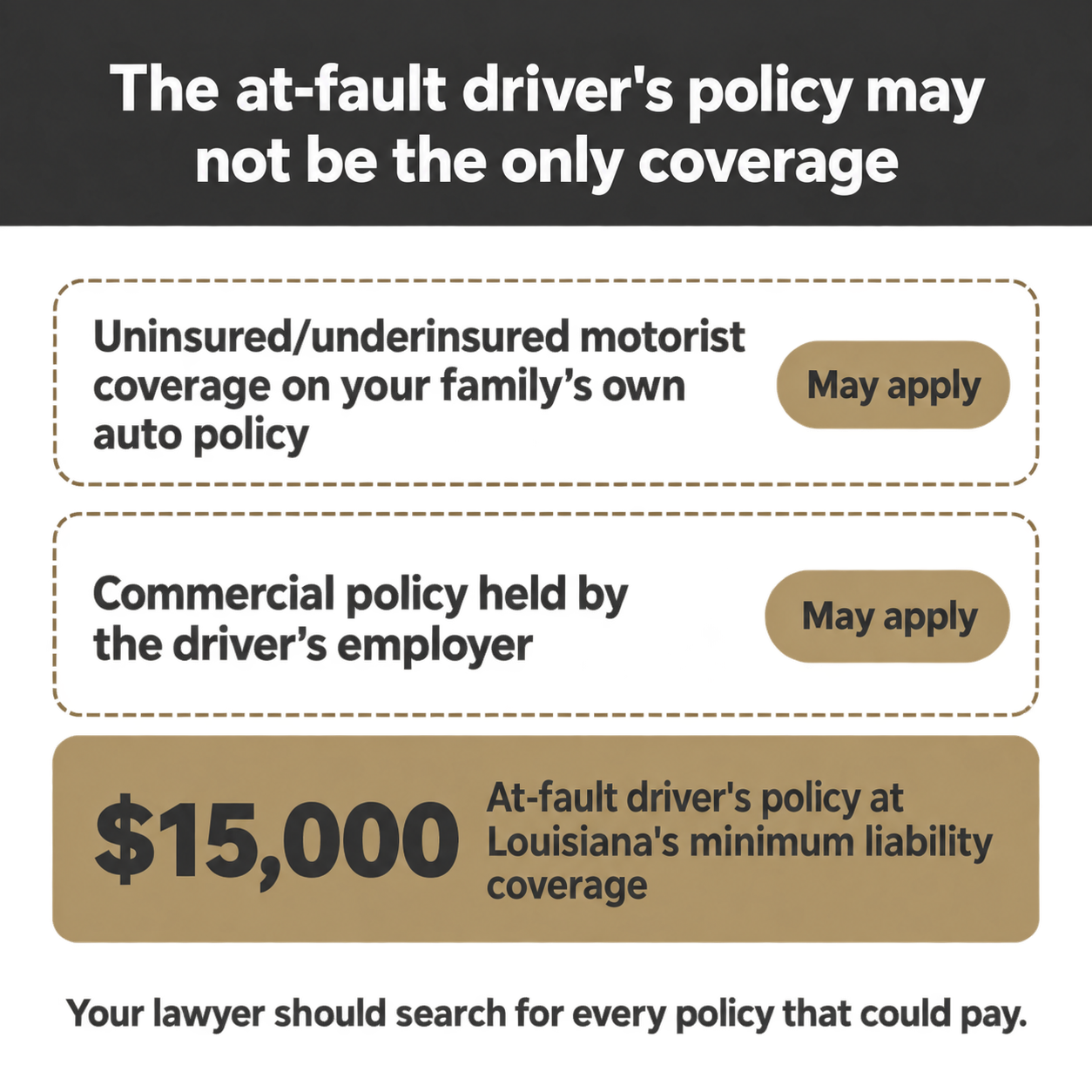
The firm should also search for every insurance policy that could pay the claim. When the at-fault driver carries only Louisiana’s minimum liability coverage of $15,000, a family’s recovery can depend on finding other coverage. Other sources can include a commercial policy held by the driver’s employer or the uninsured and underinsured motorist coverage on the family’s own auto policy.
How Much Does a Wrongful Death Lawyer Cost in Louisiana?
Wrongful death lawyers in Louisiana usually work on a contingency fee, which means the lawyer takes a percentage of the money recovered and charges no fee if there is no recovery. Our fee is one-third of the recovery if the case resolves without a lawsuit and 40% if we file suit. The first consultation is free, and our general practice is to make sure our clients receive more money than our firm does.
Why the Lowest Fee Percentage Shouldn’t Decide Your Choice
What matters most is how much your family receives after fees and costs are paid. A lawyer who charges a lower percentage but accepts an early, low offer can leave a family with less money than a lawyer who charges more and builds the case for a larger recovery. Compare lawyers first on who will handle the case, their trial record, and how they plan to build it, and then look at the fee.
Also ask how costs are handled. If costs come out of the recovery before the fee is calculated, the percentage applies to a smaller amount, and the family keeps more.
Can the Attorney Handle a Wrongful Death Case in Federal Court?
A wrongful death case can end up in federal court when the company responsible is based in another state, such as an out-of-state trucking company or manufacturer. Federal courts can hear cases between citizens of different states when more than $75,000 is at stake, under 28 U.S.C. § 1332. If the family files in state court, an out-of-state defendant can often move the case to federal court within 30 days of being served. Cases between Louisiana residents usually stay in a parish district court, such as the 19th Judicial District Court in East Baton Rouge Parish or the 21st Judicial District Court in Livingston Parish.
Federal court has its own procedural rules, tighter discovery schedules, and often closer scrutiny of expert testimony. A Louisiana law license alone does not let a lawyer appear in federal court, because each federal court requires its own admission. The federal trial court for the Baton Rouge area is the U.S. District Court for the Middle District of Louisiana, which sits in Baton Rouge.
All three of our partners are admitted to practice in the U.S. District Courts for the Middle, Eastern, and Western Districts of Louisiana. Jason Melancon and Lee Daquanno are also admitted to the U.S. Fifth Circuit Court of Appeals, and Jason Melancon is admitted to the U.S. Supreme Court. Our attorneys have worked federal cases in Louisiana, Georgia, Texas, California, and New York, though we are licensed to practice law only in Louisiana.
One of our federal court results was a $3.5 million settlement in a fatal car accident case. When a verdict is appealed, our appellate practice handles appeals in state and federal courts.
How Will You Communicate With Your Attorney?
Ask how often you’ll get updates and how you can reach your attorney directly. A family with a pending wrongful death case needs answers from the lawyer making decisions about it. A good answer tells you who will call you, how often, and how quickly your calls will be returned.
Our partners give clients direct cell phone and email access. Our office is open Monday through Thursday from 8:30 a.m. to 4:30 p.m. and Friday from 8:30 a.m. to 3:30 p.m. If you contact us after hours, we’ll call you back the next business day.
How to Check a Wrongful Death Lawyer’s Track Record
Look for results in cases like yours, note whether each result was a verdict or a settlement, and confirm the lawyer’s license and disciplinary history with the state.
A verdict means a judge or jury decided the case, and a settlement means the parties agreed on an amount. Both kinds of results are meaningful, and jury verdicts also show that the lawyer is willing to go to trial. Pay the most attention to results in fatal crashes, trucking cases, and other cases like your family’s. For each one, ask whether the lawyer you’re meeting handled it personally.
A result can be strong even when no dollar amount is listed. Many settlements include confidentiality terms that keep the amount private. Other cases end with the insurer paying the full limits of its policy, which is the most the policy will pay. Our dump truck case ended that way, and the dollar amount is not disclosed.
Before you hire anyone, check the lawyer’s record with the state. The Louisiana Attorney Disciplinary Board website lets you search a lawyer’s name and see any public discipline. If you have questions about what you find, you can call the Board’s Office of Disciplinary Counsel at (225) 293-3900. If a lawyer says they are certified in wrongful death or personal injury law, ask which organization certified them. Louisiana’s Board of Legal Specialization does not certify lawyers in either area.
Red Flags When Hiring a Lawyer After a Death
Be cautious about any lawyer who promises a specific result or dollar amount, because no lawyer can honestly guarantee how a case will turn out. Keep looking, too, if a lawyer gives vague answers about who will handle your case or can’t clearly describe their trial experience.
Pressure to sign a contract at the first meeting is a red flag. You should have time to read the agreement and talk it over with your family before you commit. A fee agreement that isn’t in writing, or that doesn’t explain how case costs are handled, is a red flag as well.
Treat it as a serious red flag if a lawyer, or someone working for one, contacted your family before you reached out. That includes a phone call, a visit at the hospital, or a visit to your home. Louisiana’s professional conduct rules prohibit lawyers from soliciting accident victims and their families in person or by phone. Letters and other written solicitations have to wait at least 30 days after the incident. Paying someone (sometimes called a “runner”) to steer injury cases to a lawyer is a crime under Louisiana law.
Questions to Ask at a Free Wrongful Death Consultation
Bring these questions to each consultation and write down what each lawyer says, so you can compare the firms afterward:
- Who will handle my case day to day, and who will try it if it goes to court?
- How many cases have you tried to get a verdict in the past five years, and in which courts?
- What will you do in the first few days to preserve evidence?
- Who in my family has the right to bring the claim?
- Which filing deadline applies to my family’s claim, and what is the exact date?
- How might the other side try to blame the person who died, and how would you respond?
- Are you admitted to practice in the U.S. District Court for the Middle District of Louisiana?
- Who pays for experts, and would I owe those costs if we lose?
- Is your fee calculated before or after case costs are taken out?
- How will you keep me updated, and how can I reach you directly?
What to Avoid Before You Hire a Lawyer
Until you have a lawyer, don’t give a recorded statement to the other side’s insurance company, and don’t sign any release or settlement paperwork it sends you. An adjuster may call within days of the death. Anything the family says or signs in those first weeks can limit the claim. Hiring a lawyer early means your lawyer takes those calls for you.
Talk With a Baton Rouge Wrongful Death Attorney
If someone else’s negligence took your family member’s life, we would be glad to sit down with you, answer your questions, and explain your family’s options. The consultation is free, and you’ll meet directly with one of our partners. Call Melancon, Rimes & Daquanno at (225) 303-0455, visit our office at 6700 Jefferson Hwy (Building 6) in Baton Rouge, or start with our wrongful death attorney page to request a consultation.
Past results do not guarantee a similar outcome. Every case depends on its own facts.