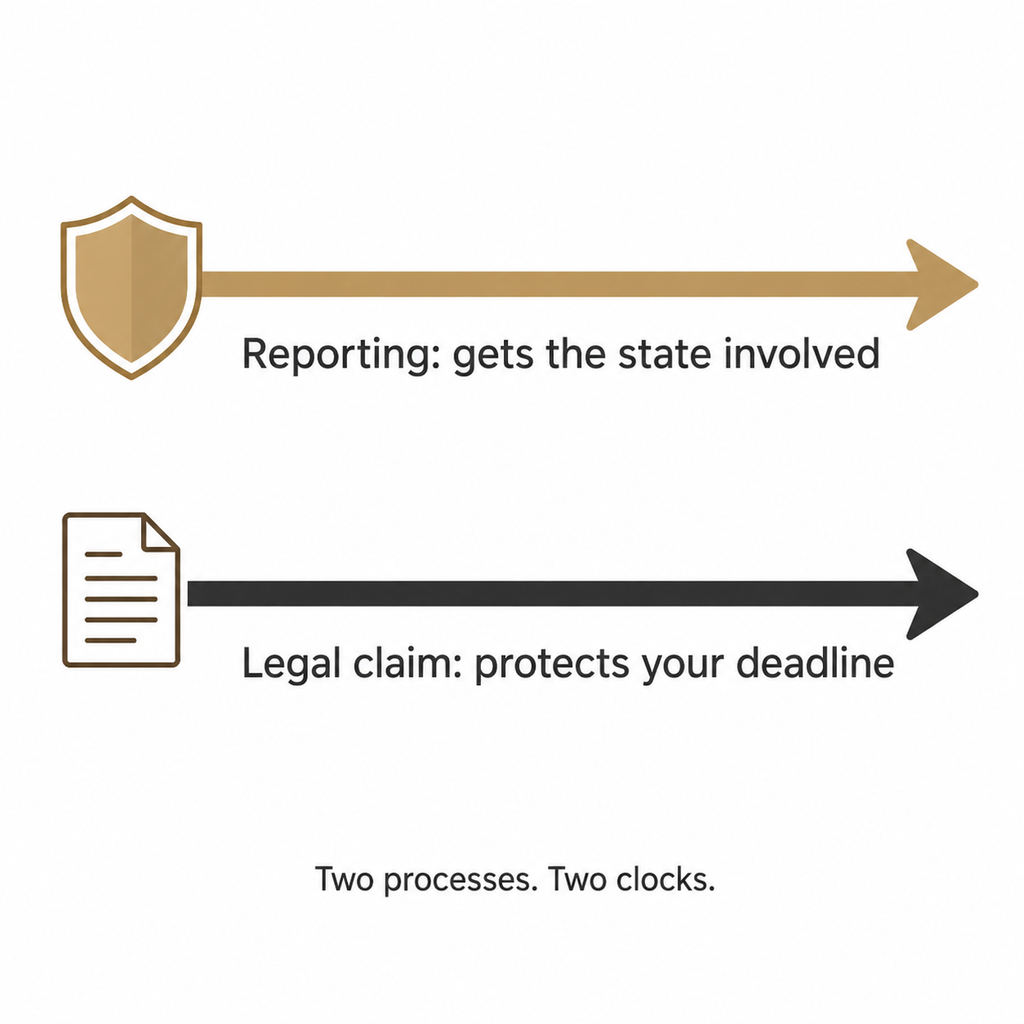
If you believe a family member is being neglected or abused in a Louisiana nursing home, you are dealing with two separate processes that run on two separate clocks. Reporting is how you get the state involved and your family member safe. For a licensed nursing facility, that means calling the Louisiana Department of Health’s Health Standards Section at 1-888-810-1819. A legal claim for compensation is the second process, and reporting does not start it. A complaint filed with the state does nothing to protect your filing deadline, and in Louisiana that deadline is often one year rather than the two years most people expect.
At Melancon, Rimes & Daquanno, we have handled personal injury and medical malpractice claims for Baton Rouge area families since 2005, and we have lost one trial in that time. The mistake we see most often in facility cases is the assumption that the state investigation is the case. It is not. Both tracks are laid out below, reporting first, because getting your family member safe comes before everything else.
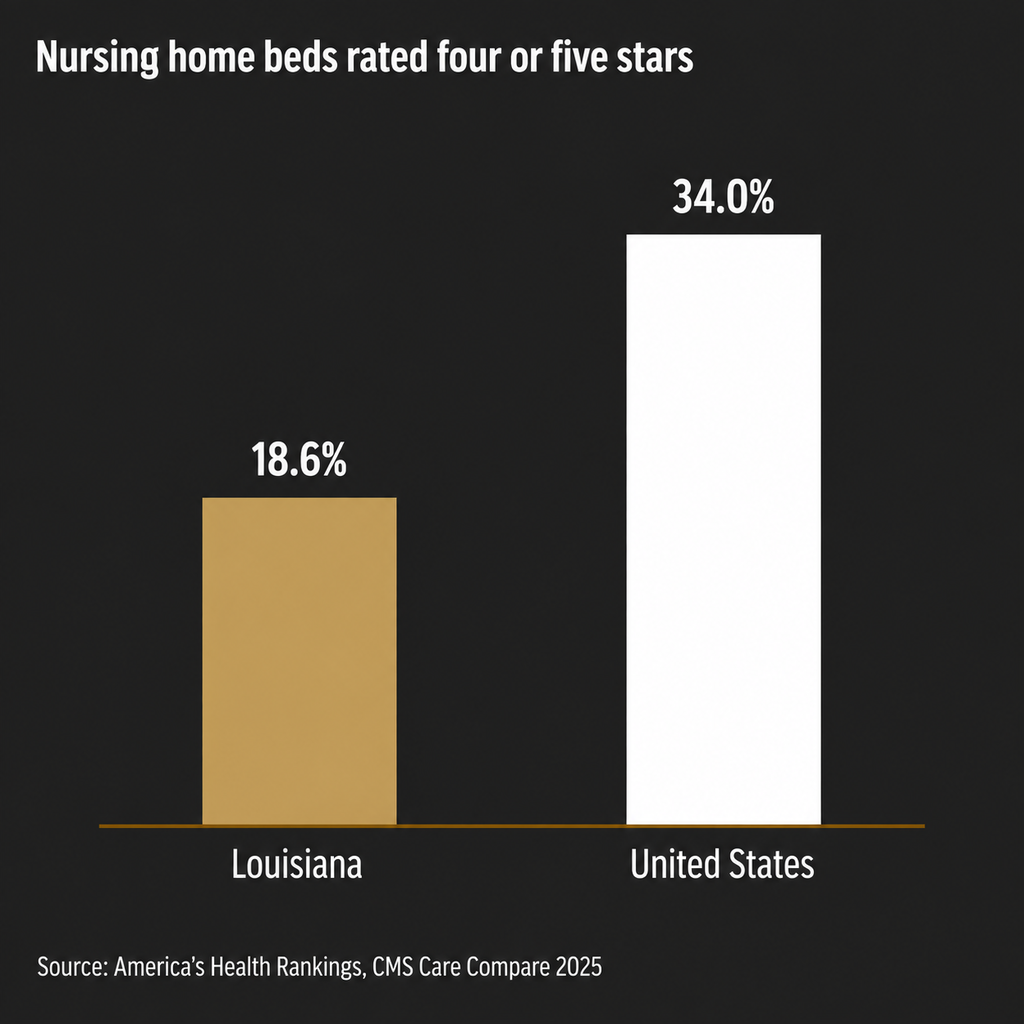
Some context before you start. Louisiana ranks last among the 50 states for nursing home quality. Only 18.6% of the state’s certified nursing home beds are rated four or five stars, compared with 34.0% nationally, according to America’s Health Rankings’ analysis of CMS Care Compare five-star data from late 2025. What you are seeing is common here, and you are not imagining it.
Signs of nursing home neglect and abuse
Neglect and abuse look different from each other. Neglect shows up as care that was not delivered. Abuse shows up as harm that was inflicted. Both can be present at once.
Two things families often dismiss and should not. The first is a resident who suddenly stops talking or goes quiet around certain shifts. The second is a facility that starts making it hard to visit, or moves your family member to a different room or unit right after you raise a concern.
|
For a licensed facility, LDH is the office with regulatory authority. You can call the complaint line above, or download the complaint form and return it by mail, fax, or email, and LDH will inspect the facility and investigate. Reports can be made anonymously, though an anonymous report limits the agency’s ability to follow up with you.
The Elderly Protective Services program investigates abuse, neglect, exploitation, and extortion involving adults 60 and older, but its jurisdiction is domestic settings. If your family member lives in a nursing home, EPS is not your agency.
The Long-Term Care Ombudsman sits in a different category again. Ombudsmen are advocates for residents. They investigate concerns and work to resolve them, but they have no regulatory authority over the facility the way LDH does. They are free, confidential, and often the fastest way to get a facility to actually respond to a concern, particularly around visitation, room changes, care plans, and discharge notices. Calling the ombudsman does not replace filing with LDH, and calling LDH does not replace the ombudsman. Many families use both.
Louisiana law requires you to report, and it protects you when you do
Under La. R.S. 15:1504, any person who has cause to believe an adult’s health or welfare has been adversely affected by abuse, neglect, or exploitation is required to report it. Reporting is not optional here. Good faith reporters have immunity from civil and criminal liability, and under La. R.S. 14:403.2, retaliating against someone who reports adult abuse is a misdemeanor.
We raise this because families hesitate. The usual reason is fear that the facility will take it out on the resident, or that there will be nowhere else to place them. Those concerns are real, and the ombudsman is the right person to raise them with. They are not a reason to stay silent.
What to document before you do anything else

Facility records get thin and memories get vague. What you gather in the first two weeks tends to carry the case, whether that case ends up in front of a state surveyor or a jury.
- Dated photographs. Wounds, bedsores, bruising, soiled linens, an empty water pitcher, a call button out of reach. Photograph the same thing again a few days later so there is a progression.
- A written log. Date, time, what you saw, who was on shift, what you were told and by whom. Contemporaneous notes carry far more weight than a recollection assembled months later.
- Names. Aides, nurses, the director of nursing, the administrator. Titles change and staff turn over.
- Written communication. Put concerns in an email or a certified letter rather than raising them verbally at the desk. You want a date stamp.
- The medical and care records. Care plans, nurse’s notes, medication administration records, incident reports, wound care documentation, weight logs.
On records, you have more leverage than facilities sometimes let on. Under 42 CFR 483.10, a resident, or a representative to whom the resident has delegated the right, has the right to access personal and medical records pertaining to the resident within 24 hours of an oral or written request, excluding weekends and holidays. Copies must be provided with two working days’ notice, and the facility may charge only a reasonable, cost-based fee limited to copying labor, supplies, and postage. If a facility stalls, cite the regulation in writing.

Why classification decides everything about your legal claim
Here is where Louisiana differs from most states, and where families get hurt.
A nursing home claim in Louisiana is handled either as ordinary negligence or as medical malpractice under the Louisiana Medical Malpractice Act. That single classification determines your filing deadline, whether you have to go through a medical review panel before you can file suit, and whether a cap limits what you can recover. Everything else in the case is downstream of it.
Is it malpractice or ordinary negligence?
Louisiana courts apply a six factor test from the Louisiana Supreme Court’s decision in Coleman v. Deno to decide which category a claim falls into. In practical terms, the questions are whether the injury arose from treatment or from a failure to exercise professional skill, whether proving the breach requires expert medical testimony, whether the act involved assessing the resident’s condition, whether it occurred within a physician and patient relationship or within the scope of activities the facility is licensed to perform, whether the injury would have occurred if the resident had not been seeking care, and whether the act was intentional.
Two developments have pushed the line hard toward malpractice for nursing home claims.
Effective August 1, 2025, the Legislature amended the Medical Malpractice Act’s definitions of “health care,” “health care provider,” and “malpractice” to expressly cover services related to policies and procedures, staffing, and custodial care, including acts performed in an administrative or managerial capacity. That change came through Senate Bill 134, enacted as Act 342, and the stated purpose was to bring nursing home management companies inside the Act.
Then, in Broden v. Priority Management Group, LLC, 25-1651 (La. 2/12/26), 427 So. 3d 726, the Louisiana Supreme Court held that allegations of inadequate care, understaffing, and underfunding of a nursing home were medical malpractice claims rather than general negligence.
The upshot for families: if the harm involves care that was supposed to be delivered and was not, assume you are in the malpractice track until an attorney confirms otherwise. Bedsores, falls tied to inadequate supervision, medication errors, untreated infections, dehydration, and malnutrition all sit squarely there. A genuinely non-medical incident, such as a visitor injured by a hazard on the property, is more likely to be ordinary negligence and would be handled the way any other premises liability claim is.
| Type of claim | Deadline | Authority |
|---|---|---|
| Ordinary negligence, cause of action arising on or after July 1, 2024 | 2 years from the injury | La. C.C. art. 3493.1 |
| Medical malpractice | 1 year from the act or omission, or 1 year from discovery, and in no event more than 3 years from the act | La. R.S. 9:5628 |
| Wrongful death where the underlying claim is malpractice | 1 year from the date of death | La. C.C. art. 2315.2(F) |
This is the trap. Louisiana moved the general personal injury prescriptive period from one year to two for causes of action arising on or after July 1, 2024. Medical malpractice did not move with it. La. R.S. 9:5628 still requires suit within one year of the act, omission, or neglect, or within one year of discovery, with an outside limit of three years from the act no matter when discovery occurred.
A family that reads about the two year change, assumes it applies, and waits fourteen months can lose a valid claim outright. The same is true after a death. When the underlying claim is malpractice, the wrongful death deadline is one year from the date of death, without the alternative period that applies to other fatal injury claims.
The medical review panel comes before the lawsuit
If the claim is malpractice against a qualified health care provider, you cannot file suit first. Louisiana requires the claim to go to a medical review panel, made up of three health care providers and an attorney chairman who serves in an advisory capacity and does not vote. The panel issues an opinion on whether the standard of care was breached, and that opinion is admissible later but not binding.
A properly filed panel request suspends prescription until 90 days after you are notified by certified mail that the panel has issued its opinion. Two points matter here:
- The request has to go to the state panel process, filed with the division of administration. Filing a complaint with the Louisiana Department of Health does not suspend prescription. Neither does complaining to the facility, or negotiating with its insurer.
- Whether the facility is a qualified health care provider is a question with an answer. Providers enroll with the state Patient’s Compensation Fund oversight board, and a certificate of enrollment can be verified rather than guessed at.
The $500,000 damages cap
Under La. R.S. 40:1231.2, total recovery for all malpractice claims for injuries to or death of one patient cannot exceed $500,000, plus interest and costs. A single qualified provider is not liable for more than $100,000 of that, with the balance paid from the Patient’s Compensation Fund.
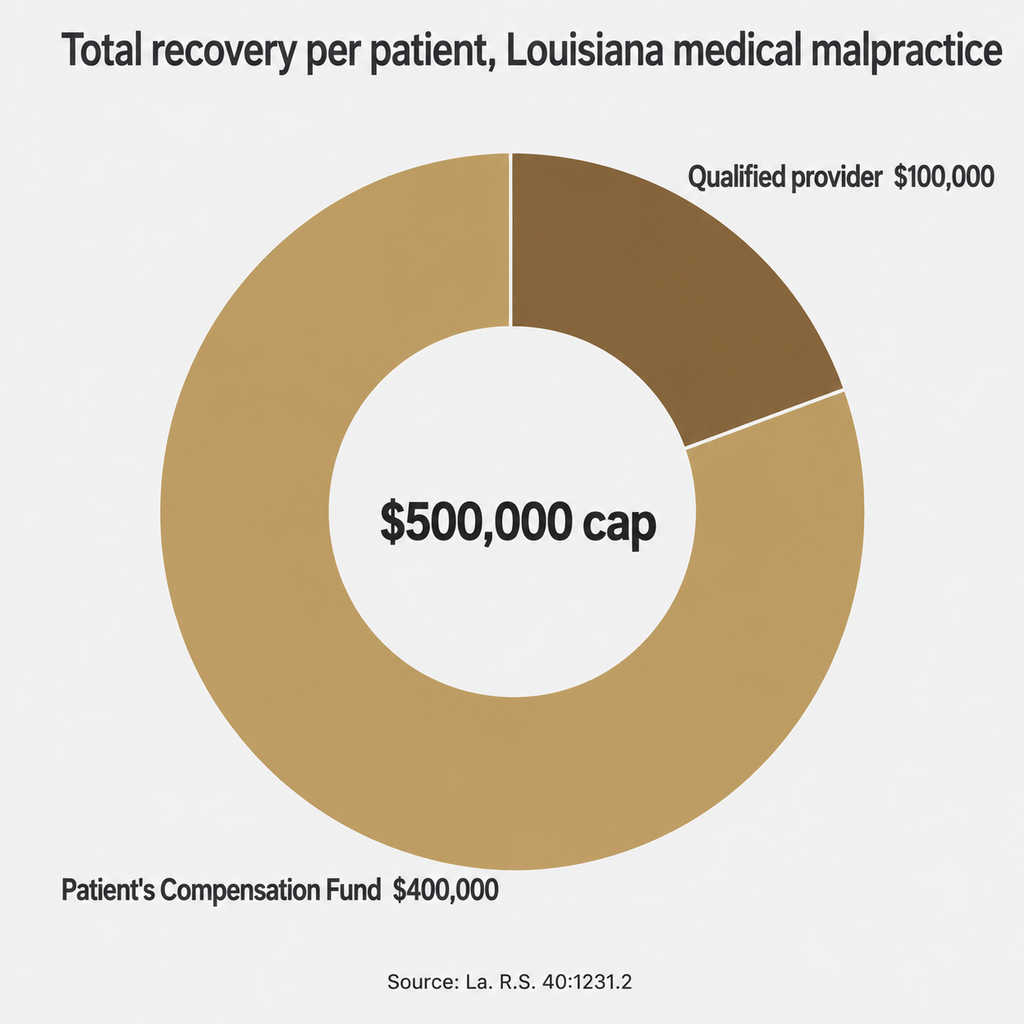
The cap excludes future medical care and related benefits, which the Fund pays separately as those costs are incurred. That exclusion matters more than families expect in cases where a resident survives with injuries requiring long term care. No comparable cap applies to ordinary negligence claims.
What the Nursing Home Residents’ Bill of Rights actually gets you
Louisiana’s Nursing Home Residents’ Bill of Rights, at La. R.S. 40:2010.8, gives residents a detailed set of enforceable rights, including:
- Dignity, privacy, and freedom from abuse and unreasonable restraint
- Participation in care planning
- Private and uncensored communication
- Immediate access to family, regulators, and ombudsmen
- The ability to present grievances without reprisal
- Protection during transfer or discharge
Facilities have to post the statement and give a copy to every resident and sponsor on admission.
What it does not give you is money. Under La. R.S. 40:2010.9, the private right of action is for injunctive relief: a court order making the facility stop a violation or comply with the law. A prevailing plaintiff can recover reasonable attorney fees and costs. There is no damages remedy under the statute itself, and the same statute puts a clock on these claims, one year from the act or from discovery, with a three year outside limit.
The Bill of Rights is still a fast tool when a facility is blocking visitation, refusing records, or pushing a discharge that should not be happening. Compensation comes through a medical malpractice or negligence claim, and the Bill of Rights expressly does not restrict those other remedies.
Common questions from Louisiana families
Does filing a complaint with the Louisiana Department of Health start my lawsuit?
No. An LDH complaint triggers a regulatory investigation of the facility. It does not file a claim, does not suspend your prescriptive period, and does not produce compensation for your family. The legal track has to be started separately.
How long do I have to sue a Louisiana nursing home for neglect?
Assume one year until an attorney tells you otherwise. Most nursing home care failures now fall under the Medical Malpractice Act, which requires the claim to be brought within one year of the act or of discovery, with a three year outside limit. Only claims that fall outside the Act get the two year period.
Can I bring a claim for a bedsore?
Yes, and bedsores are among the most provable neglect claims because they are staged, photographed, and documented in the chart over time. A stage three or four pressure ulcer that developed in a facility is difficult to explain away as unavoidable.
My parent died in the facility. What is the deadline?
If the underlying claim is malpractice, one year from the date of death. This is shorter than the deadline for most other fatal injury claims in Louisiana, and it does not wait for you to finish grieving or settle the estate.
How do I check a facility’s inspection history?
Use the federal Care Compare tool, which publishes each facility’s overall star rating along with separate ratings for health inspections, staffing, and quality measures, plus the deficiencies cited at recent surveys. Look at the staffing rating on its own rather than stopping at the overall score, because a facility can carry a middling overall rating while its staffing number tells a harder story.
Do I need a lawyer to file a report?
No. Anyone can report, and you should not wait on counsel to do it. Reporting protects your family member now. Talking to an attorney protects the claim, and those are two different jobs.
How we handle nursing home neglect cases
Nursing home defenses tend to run on two arguments. The first is that the resident was already declining, so the harm would have happened anyway. The second is that the injury is not as serious as the family says. We have fought both.
In a spinal injury case, the defense argued our client’s low back pain predated the accident. We pulled and rebuilt the medical record to show the herniation and the fusion surgery that followed were caused by the collision, and the case settled for $1.25 million. The causation fight in a facility case is the same argument in a harder form, because most residents genuinely do have underlying conditions. Winning it means getting the full chart, mapping the timeline, and working with the treating providers.
On the second argument, we tried a case for a child who was attacked by a neighbor’s dog and suffered facial injuries. The insurance company refused to offer more than $100,000 and minimized the injuries. We turned the offer down and tried the case, and the jury returned $360,000, more than three and a half times the maximum offer. Insurers undervalue claims involving people they assume a jury will not connect with, and elderly residents get the same treatment. We prepare every case for trial rather than building it to settle.
We are also candid about which cases we take. We evaluate malpractice claims carefully and focus on files where the breach can be clearly demonstrated. The consultation costs nothing and the evaluation is real. If we do not think we can prove it, we will tell you that instead of taking your case and letting it drift.
Each of our partners manages their cases directly rather than handing them to a junior associate, which matters in a case built on records, timelines, and expert testimony.
Talk to a Baton Rouge attorney before your deadline passes
If you think a family member has been neglected or hurt in a Louisiana nursing home, report it today and then call us. We handle personal injury and medical malpractice claims for families across East Baton Rouge, West Baton Rouge, Livingston, Ascension, Iberville, Pointe Coupee, East Feliciana, West Feliciana, and St. Helena parishes, including catastrophic injury cases that require long term care planning.
The consultation is free, we advance case expenses, and you owe us nothing unless we recover for you. Call (225) 303-0455. If the deadline on your claim is one year, the time to find that out is now.