After a rear-end collision in Louisiana, call 911 so the crash is documented in a police report, photograph both vehicles and the scene before anything is moved, exchange information with the other driver, and get contact information for any witnesses. Then see a doctor the same day or the next, even if nothing hurts yet. Report the crash to your own insurance company, and be careful about giving the other driver’s insurer a recorded statement before you know how badly you are hurt or who they plan to blame.
Motor vehicle accidents make up roughly 85% of the personal injury cases we handle at Melancon, Rimes & Daquanno, and rear-end collisions are a regular part of that work on the highways and surface streets around Baton Rouge.
Those steps have always been good advice, and they carry more weight now. Louisiana changed three rules between 2024 and 2026 that decide these claims: how long you have to file, how you prove the crash caused your injury, and how much fault it takes to lose your case entirely. Which version of each rule applies to you depends on the date of your crash, so that date is the first thing to pin down.
What to Do at the Scene of a Rear-End Crash
Your job at the scene is to stay safe and to leave behind a record someone else can verify months later. That second part matters because the other driver’s account of the crash often changes once an insurance adjuster is involved.
- Check for injuries and get out of traffic if you can do it safely. If anyone is hurt or a vehicle cannot be moved, leave everything where it is and wait for help. If EMS offers to check you out, let them.
- Call 911. Louisiana law requires drivers to report any crash that injures someone or causes more than $500 in property damage, under La. R.S. 32:398. Bumper and sensor repairs pass $500 easily on most modern cars, so even a fender bender usually qualifies.
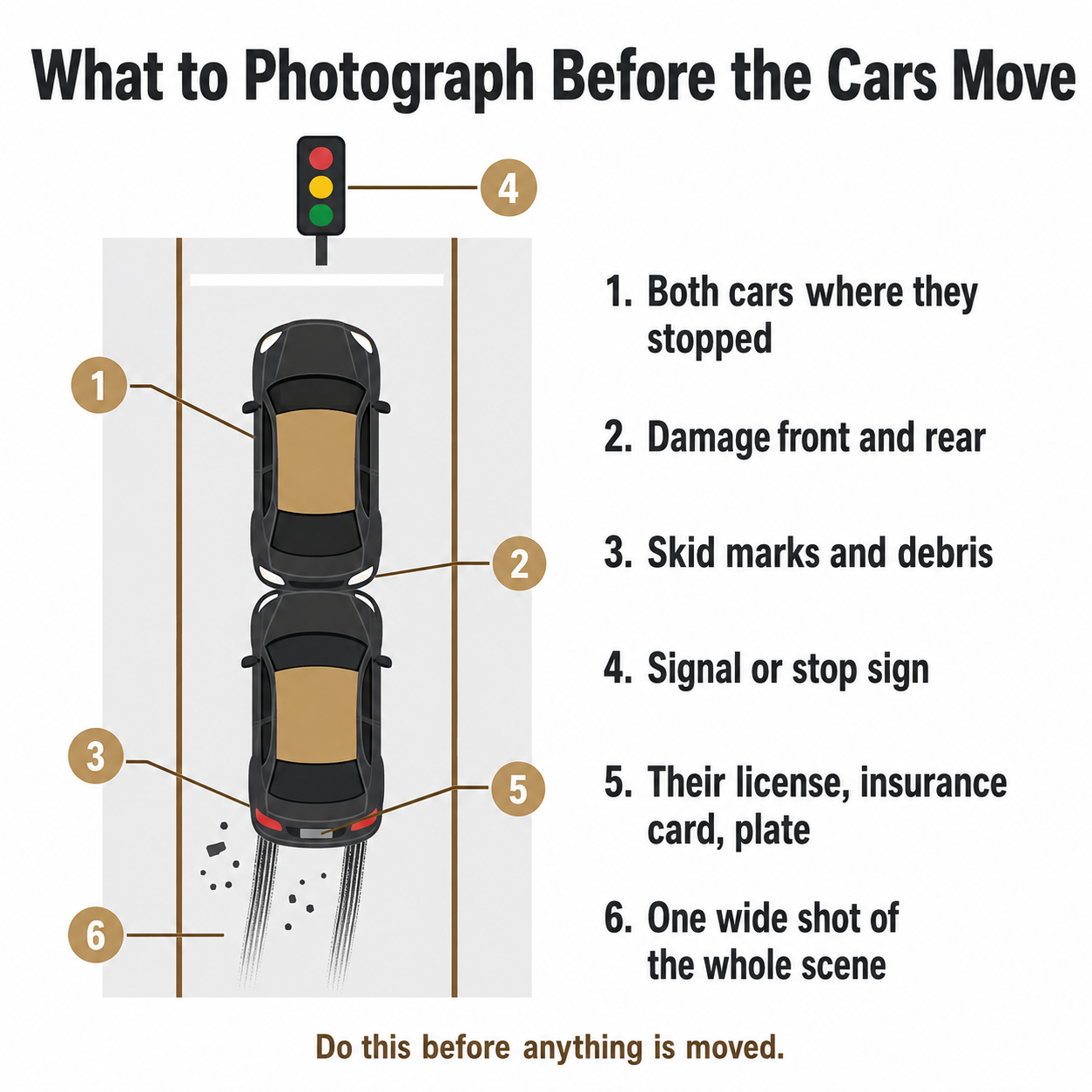
- Take photos before the cars are moved. Get the position of both vehicles, the damage to your car and to the front of theirs, skid marks, debris, the traffic signal or stop sign, and the road surface. Photograph the other driver’s license, insurance card, and license plate instead of writing the numbers down.
- Exchange information. Name, phone number, address, insurance company, and policy number. If the other driver was working at the time, write down the employer’s name and whatever is printed on the side of the vehicle.
- Get contact information for witnesses. Independent witnesses matter more in rear-end cases than most people expect. Following drivers often describe the stop in front of them very differently once an adjuster starts asking questions.
- Be careful what you say about fault. Saying “I’m sorry” is a reflex for most of us around here, and an adjuster can write it up as an admission. Tell the officer what happened and answer questions honestly. Deciding who caused the crash is not your job at the scene.
The investigating agency files the crash report with the Louisiana Department of Transportation and Development within 48 hours of completing its investigation. Once the investigation is finished, you, your attorney, and your insurer can request a copy, generally within seven working days. It is one of the first documents we ask for in a rear-end case.
Get Checked by a Doctor, Even If You Feel Fine
See a doctor within a day or two of the crash even if you feel fine, because Louisiana no longer presumes that a crash caused an injury just because you were healthy before it. Your medical record now has to do that work for you.
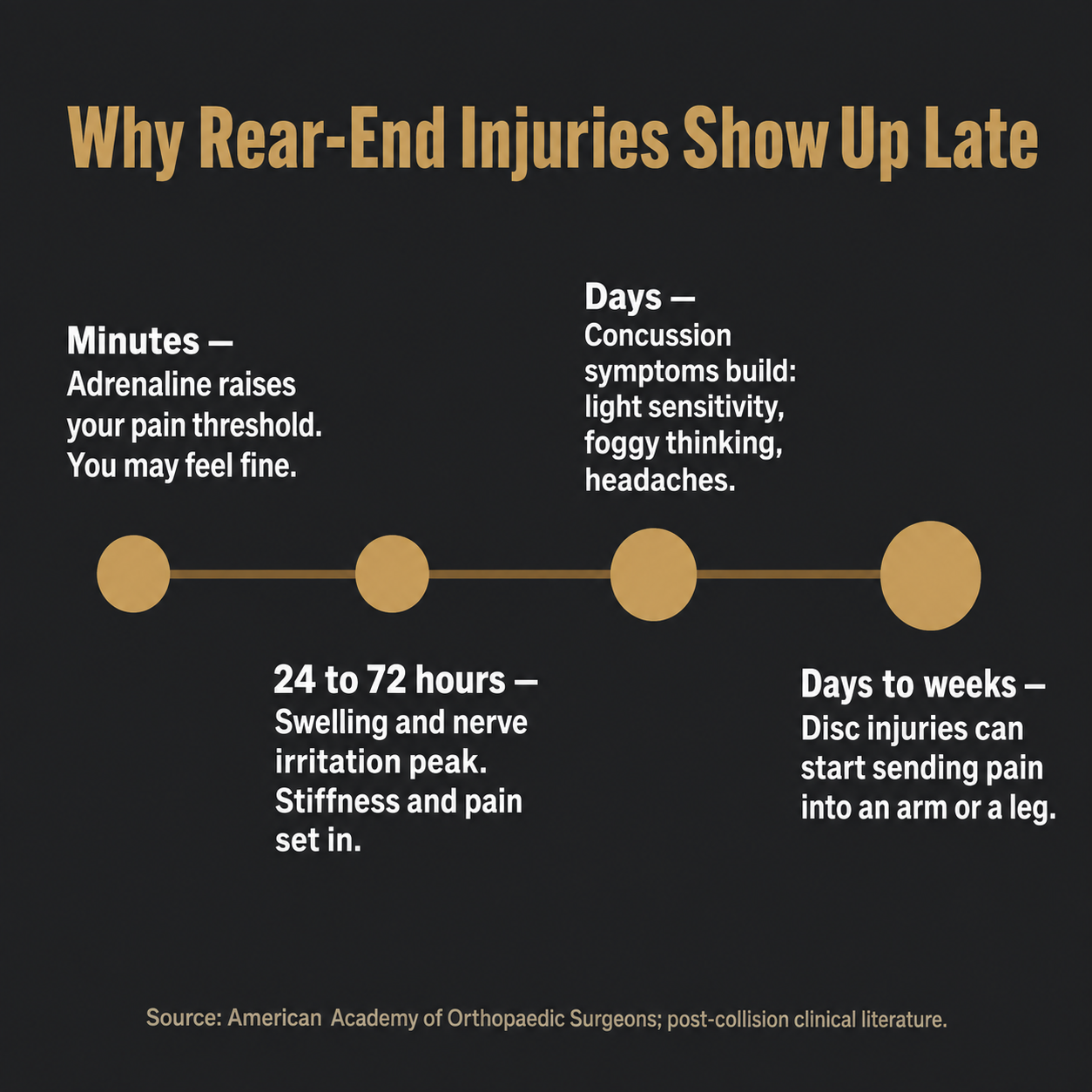
Rear-end impacts are known for delayed symptoms. The moment of impact floods your body with adrenaline, which raises your pain threshold and can hide a torn muscle, a strained ligament, or a spinal injury for hours. Pain from a neck sprain often does not appear until hours after the injury, or even the next day, which is why the American Academy of Orthopaedic Surgeons tells people to get evaluated after a neck injury even when they feel fine. Disc injuries can take longer than that, and pain that shoots into an arm or a leg sometimes does not start until days or weeks after the crash. Concussion symptoms build the same way, with light sensitivity, foggy thinking, and headaches that get worse over several days.
That delay used to be easier to explain. Until 2025, Louisiana courts applied what lawyers call the Housley presumption. If you were in good health before the crash, your symptoms started with it and continued afterward, and a doctor said the crash could reasonably have caused them, the law presumed it did, and the defense had the job of proving otherwise. Act 18 of the 2025 session ended that for crashes on or after May 28, 2025. Under Louisiana Code of Evidence Article 306.1, having no prior history of the injury creates no presumption at all. You now have to prove the crash caused your injury with medical records, imaging, and testimony from the doctors treating you.
That puts a lot of weight on the first few weeks after the crash:
- Get evaluated promptly, and go to the emergency room or an urgent care the same day if you have head, neck, or back pain.
- Describe every symptom to the provider, including the ones that feel too minor to mention. If it is not in the chart, an adjuster will argue it did not exist.
- Keep your follow-up appointments. A three-week gap in treatment turns into an argument that you were hurt somewhere else.
- Follow through on imaging and referrals when a doctor orders them. An MRI confirming a herniated disc is the kind of objective evidence Article 306.1 now requires you to have.
We handled a case that is the exact scenario this change makes harder. Our client was rear-ended and later developed severe low-back pain, numbness, and tingling in the legs. An MRI confirmed a herniated disc that eventually required low-back fusion surgery. The insurance company’s defense attorneys claimed the pain was pre-existing and had nothing to do with the accident. We ran an exhaustive search of the medical records, proved the crash caused the injury, and settled the case for $1.25 million after three years of litigation. We won that argument while the Housley presumption was still in place. Without it, the same argument takes more medical proof to answer, so expect insurers to raise it more often. If you are dealing with a back or neck injury, our spinal injury attorneys can walk you through what your records need to show.
How Louisiana Decides Fault in a Rear-End Collision
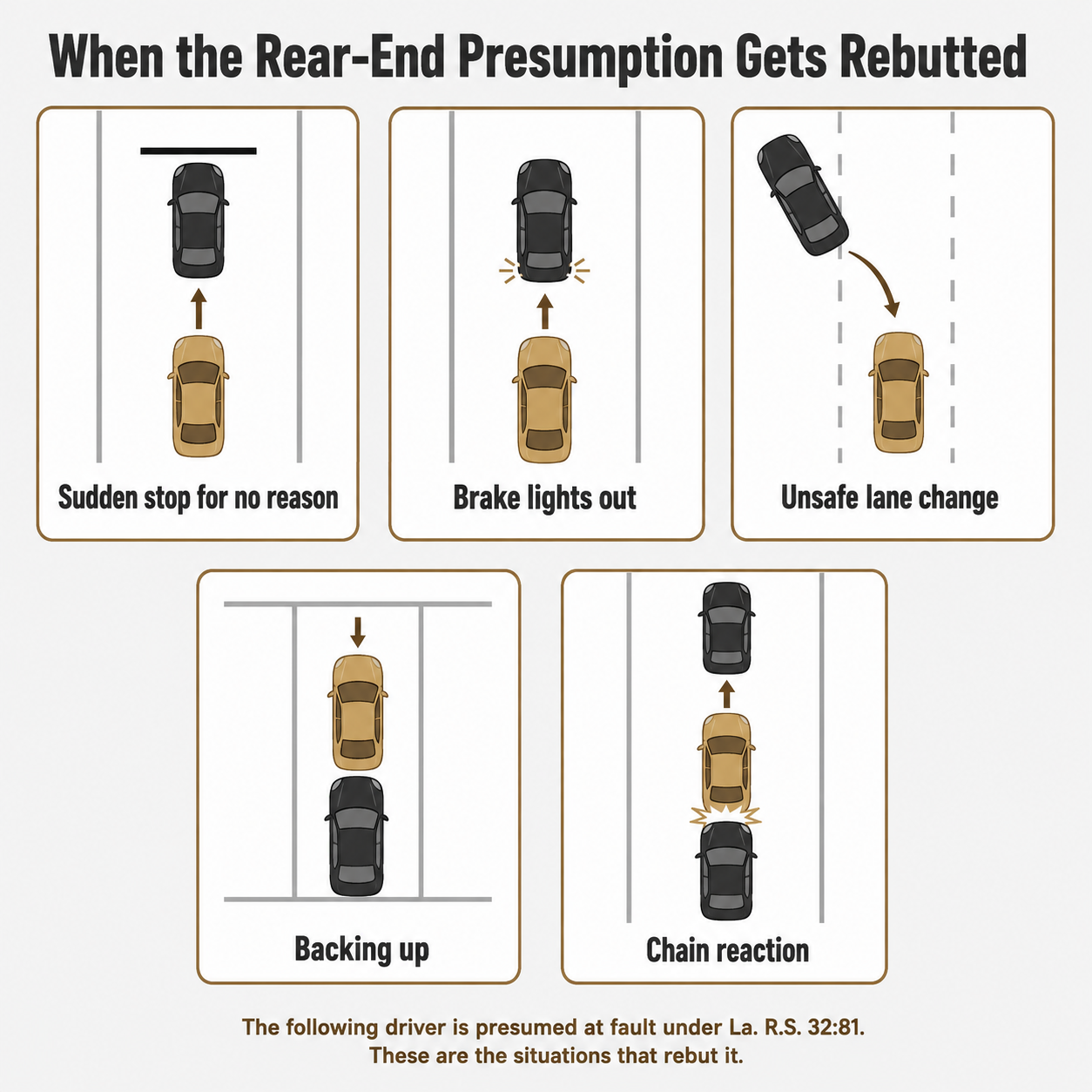
The driver who hits you from behind starts out presumed at fault. Louisiana Revised Statute 32:81 says a driver may not follow another vehicle more closely than is reasonable and prudent, and Louisiana courts read that to mean a following driver who rear-ends someone is presumed negligent. Once you show that you were struck from behind, the burden shifts to the other driver to prove they were not at fault.
That presumption can be rebutted, which is why these cases are less automatic than most people assume. These are the situations where a following driver can defeat it, or push part of the fault back onto the driver in front:
- The lead driver stopped suddenly for no reason. Stopping short in a live lane of travel with no traffic or hazard to justify it can shift fault. Following drivers are still expected to anticipate ordinary stops at intersections and in backed-up traffic, so this argument works less often than insurers suggest.
- The lead car’s brake lights were out. If they were completely out, especially at night or in the rain, the following driver never got the warning the car in front is required to give.
- A car changed lanes unsafely. When a car cuts in front of another and gets hit, Louisiana courts treat it as a lane-change case rather than a rear-end case, and most or all of the fault lands on the driver who changed lanes.
- A driver backed into the car behind them. In a parking lot or a stopped line of traffic, the damage can look like a rear-end crash from the outside, and the driver who reversed is responsible.
- A third vehicle started a chain reaction. A middle driver who was stopped and then shoved into the car ahead is not presumed at fault, but that driver does have to prove the push. Photos of the damage at both ends of the car, witness accounts, and the order of the impacts are what prove it.
If you were the driver who did the rear-ending, the presumption starts against you. It does not decide the case by itself, and what you can prove about the few seconds before impact determines whether it holds.
What the 51% Fault Rule Means for Your Claim
For crashes on or after January 1, 2026, a driver found 51% or more at fault recovers nothing. Louisiana spent decades under pure comparative fault, where your damages were reduced by your share of the blame and nothing worse than that happened to your claim. A driver who was 90% at fault could still collect 10% of their damages. Act 15 of the 2025 session amended Civil Code Article 2323 and replaced that with a modified system carrying a 51% bar. Below 51%, your damages are still reduced in proportion to your fault. At 51% or above, the claim is worth zero, and juries are told about that cutoff before they assign a percentage.
Here is what the change looks like in dollars, if your damages come to $100,000:
| Your share of fault | Crash on or before Dec 31, 2025 | Crash on or after Jan 1, 2026 |
|---|---|---|
| 0% | $100,000 | $100,000 |
| 20% | $80,000 | $80,000 |
| 51% | $49,000 | $0 |
| 75% | $25,000 | $0 |
The result is that the other driver’s insurance company now has a reason to build a fault argument against you even though you were the one who got hit. Adjusters look for anything they can use: that you stopped short, that you were slow off the light, that you could have pulled onto the shoulder, that a brake light was out. Getting you to 51% erases the entire claim, so there is far more incentive to try than there used to be. That is why what you say at the scene, in a recorded statement, and in a casual phone call with an adjuster matters more than it did two years ago.
Those arguments can be beaten. We represented a husband and wife who were hit when a driver pulled out of a private driveway into their right of way, and both suffered serious neck and back injuries. The insurance company’s defense attorneys argued our clients were speeding and partly to blame for their own injuries. We tried the case in the 19th Judicial District Court for East Baton Rouge Parish, where the judge granted our motion for a directed verdict and dismissed the comparative fault claim for lack of evidence. After a five-day trial, the jury awarded over $1 million to the two of them.
What to Say to the Insurance Companies
Report the crash to your own insurance company promptly. Your policy requires it, and your own coverage may end up paying some of your medical bills. Give them the basic facts of what happened.
Talking to the other driver’s insurer works differently. An adjuster will usually call within a few days and ask for a recorded statement, and you are not required to give one. What the adjuster is collecting is your description of the crash while you are still sore and unsure of the details, and your description of your injuries before anyone has run an MRI. Those answers come back later, quoted to you when the company decides what your claim is worth.
Be just as careful with an early settlement offer. The first offer almost always arrives before the full injury picture exists, sometimes within a week or two of the crash, and it is calculated from the medical bills that have come in so far. If your neck pain turns into a disc injury that needs surgery six months later, the release you signed to get that check has already ended the claim. A settlement cannot be reopened because the injury turned out to be worse than anyone thought.
If you have already given a statement or signed something you are unsure about, that is worth a phone call before your next conversation with the adjuster.
If the Other Driver Has Little or No Insurance
Louisiana requires every registered vehicle to carry liability coverage, and the required minimums are low: $15,000 for injury to one person, $30,000 total for injuries in one crash, and $25,000 for property damage. A single ambulance ride, an ER visit, and an MRI can use up the $15,000 before anyone talks about lost wages or surgery. That is why the at-fault driver’s policy is often only part of the answer.
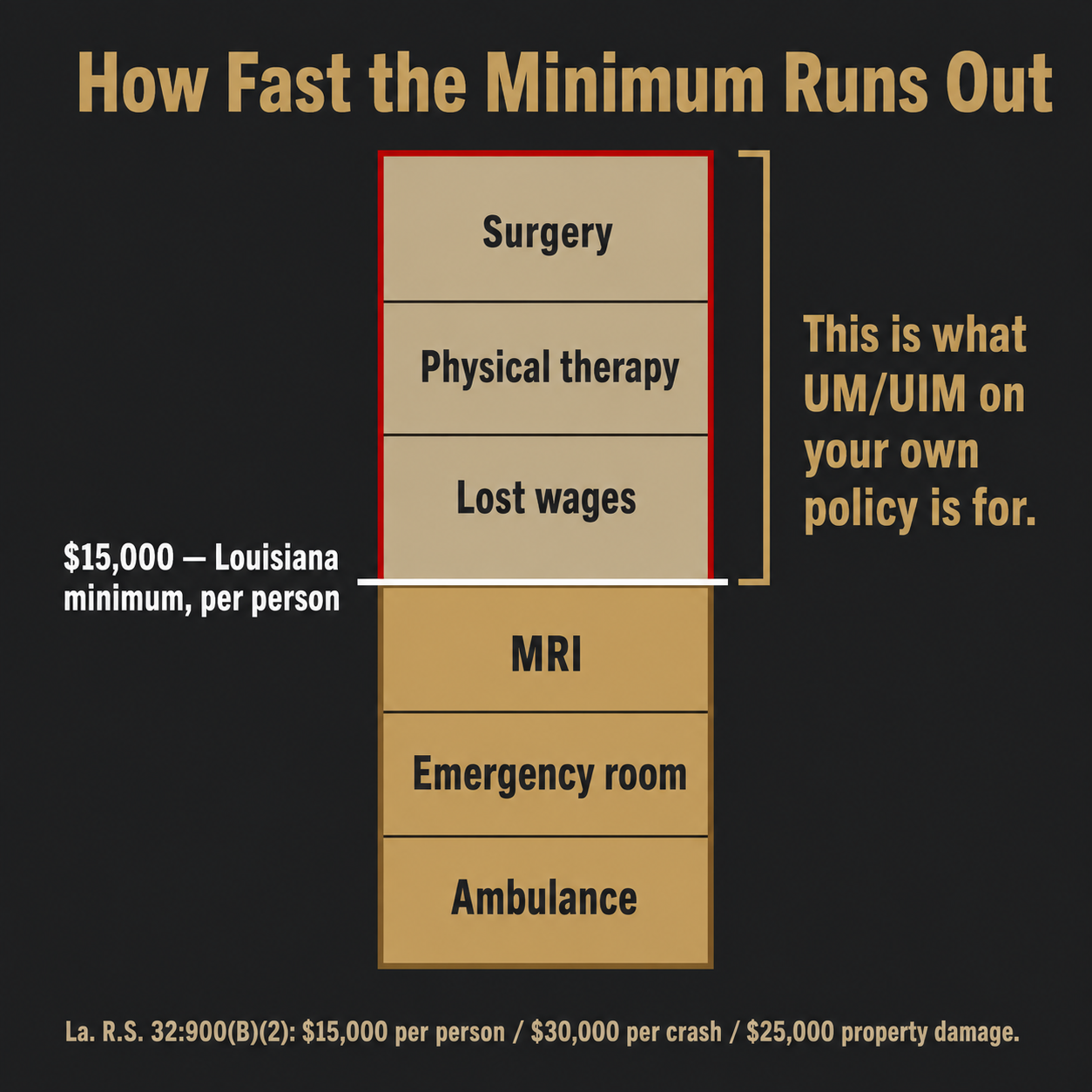
Three coverages on your own policy can cover the rest:
- Uninsured and underinsured motorist coverage (UM/UIM). This is your policy paying when the at-fault driver has no insurance or not enough of it. Louisiana law puts UM coverage into every auto policy at the same limit as your bodily injury liability coverage, unless you signed the state’s rejection form to waive it or lower it. Check your declarations page. If you are told you rejected UM, ask your agent for a copy of the signed form, because the form has to be filled out and signed correctly, and a defective rejection means the coverage applies anyway.
- Medical payments coverage (Med Pay). Optional coverage that pays medical bills after a crash no matter who was at fault. It helps early, when you need imaging and treatment before anyone has accepted liability.
- Collision coverage. This repairs your vehicle regardless of fault, which matters when the other driver’s property damage limit will not cover your car.
Louisiana also penalizes uninsured drivers who get hit, and the penalty got much steeper. Under the state’s “No Pay, No Play” law, an uninsured driver cannot recover a set amount of their damages even when the crash was entirely someone else’s fault. Act 16 of the 2025 session raised that amount from $15,000 to $100,000 for bodily injury and from $25,000 to $100,000 for property damage, effective August 1, 2025. In practice, an uninsured driver rear-ended after that date with a $60,000 neck injury and $15,000 in damage to the car recovers nothing. If that driver files suit and is awarded $100,000 or less in bodily injury damages, the court also assesses every party’s court costs against them. The bar does have exceptions: under La. R.S. 32:866, it does not apply when the other driver is convicted of DWI for the crash, flees the scene, causes the crash intentionally, or is committing a felony at the time, and it does not block the claim of a passenger who does not own the uninsured vehicle.
How Long You Have to File a Claim in Louisiana
For crashes on or after July 1, 2024, you have two years from the date of the crash to file suit. Act 423 of the 2024 session enacted Civil Code Article 3493.11 and replaced Louisiana’s old one-year deadline for personal injury claims. Crashes on or before June 30, 2024 kept the one-year deadline, and those windows have all closed by now.
Two years sounds like plenty of time, and waiting costs you evidence. Vehicles get repaired or sold for scrap. Gas station and business cameras record over their footage within days or weeks. Witnesses move and stop answering the phone. And because you now have to prove the crash caused your injury, a long gap before your first medical visit hands the insurer an argument that later treatment cannot take away.
Some claims run on different deadlines. If a government vehicle or a parish or state agency is involved, there are separate notice requirements to meet, and they come up quickly. Medical malpractice arising out of your crash treatment has its own deadlines as well.
Which Louisiana Rules Apply to Your Crash Date
Every one of these changes applies going forward only, so the date of your crash decides which rules govern your claim.
| Crash date | Deadline to file | Proving the crash caused the injury | Comparative fault | Bar on uninsured drivers |
|---|---|---|---|---|
| On or before June 30, 2024 | 1 year (expired) | Housley presumption applies | Pure comparative fault | $15,000 injury / $25,000 property |
| July 1, 2024 to May 27, 2025 | 2 years | Housley presumption applies | Pure comparative fault | $15,000 injury / $25,000 property |
| May 28, 2025 to July 31, 2025 | 2 years | No presumption (Art. 306.1) | Pure comparative fault | $15,000 injury / $25,000 property |
| Aug 1, 2025 to Dec 31, 2025 | 2 years | No presumption (Art. 306.1) | Pure comparative fault | $100,000 injury / $100,000 property |
| On or after Jan 1, 2026 | 2 years | No presumption (Art. 306.1) | 51% bar to recovery | $100,000 injury / $100,000 property |
If your crash happened close to one of these dates, have the specific date checked against the effective date of each act before you rely on any general guidance, including ours. Anything written about Louisiana injury claims before mid-2025 is likely wrong on causation, on fault, and on what an uninsured driver can recover.
Common Questions About Rear-End Collisions in Louisiana
Can you be at fault if you were rear-ended in Louisiana?
Yes. The following driver is presumed at fault, and that presumption can be rebutted with evidence that you stopped suddenly for no reason, that your brake lights were out, that you changed lanes unsafely, or that you were backing up. For crashes on or after January 1, 2026, being assigned 51% or more of the fault bars you from recovering anything.
Do you have to call the police after a minor rear-end accident?
Louisiana requires drivers to report a crash that injures anyone or causes more than $500 in property damage. Most rear-end damage clears that threshold, so the safe answer is to call. A police report also gives you an independent record of the crash before the other driver’s story changes.
How long after a rear-end collision do you have to see a doctor?
No statute sets a deadline, but the sooner the better, and the same day or the next day is a reasonable target. Since Louisiana repealed the presumption that linked a crash to an injury, the medical record is what proves causation, and every day between the crash and your first visit is a day an adjuster will point to.
Do you have to give the other driver’s insurance company a recorded statement?
No. Your own policy requires you to cooperate with your insurer, and that obligation does not extend to the other driver’s company. It is reasonable to tell the adjuster you are not giving a recorded statement until you have spoken with an attorney.
What happens in a three-car chain-reaction crash?
The middle driver is not automatically responsible for hitting the car in front. A driver who was stopped and then pushed forward by the impact from behind can rebut the presumption of fault by proving that sequence, usually through the damage patterns at both ends of the vehicle, witness accounts, and the statements each driver gave at the scene.
What should you do if a commercial truck rear-ends you?
Take the same steps you would after any rear-end crash, then move quickly to preserve the truck’s electronic data. Commercial vehicles record speed, braking, and throttle input, and trucking companies often have an investigator at the scene the same day. In a wrongful death case we handled, the driver of a dump truck claimed he could not stop in time. We retained experts immediately to secure and analyze the onboard electronic data recorder, which showed the truck accelerating rather than braking, and the insurer tendered its full policy limits. Our truck accident attorneys can send a preservation letter before that data is overwritten or the truck is repaired.
Talk to a Baton Rouge Car Accident Attorney
If you were rear-ended anywhere in the greater Baton Rouge area, we will look at your case for free and tell you honestly what we think it is worth and what it will take to get there. One of our partners handles your case from start to finish, so the attorney doing the work on it is the attorney you talk to, and you will have a cell number for calls and texts. We also prepare every case for trial instead of assuming it will settle. You can read more about our attorneys and how we work.
There is no cost to get started. We take rear-end collision cases on a contingency fee, we advance the case expenses, and you owe us nothing unless we recover for you. Call us at (225) 303-0455 or send us a message through our car accident page. If you reach us after hours, we will call you back the next business day to set up your free consultation.