Firm size tells you less about how an injury case will turn out than two other things: who personally handles your file, and whether the firm is prepared to try the case to a jury. Large firms and small firms both come in versions that do those things well and versions that do not, so the comparison worth making is between how two firms actually operate, measured against the case you have. A minor collision with clear fault and a small policy limit needs something different from a disputed-fault crash that ends in fusion surgery.
At Melancon, Rimes & Daquanno, one of our three partners manages every file from the first consultation through resolution. Personal injury is about 85% of our practice, roughly 85% of those cases are motor vehicle accidents, and we have lost one trial since we opened in 2005.
Most people weighing this question are doing it while they are still hurt and already getting calls from an adjuster. If you are working out how to evaluate a lawyer at all, our guide to choosing a personal injury lawyer in Baton Rouge covers credentials, red flags, and the full consultation checklist. What follows is the size question specifically, including the cases where a large firm is the better answer.
How high-volume personal injury firms operate
High-volume injury firms run on advertising and throughput. Stanford law professor Nora Freeman Engstrom spent years studying these practices, and her research in the Georgetown Journal of Legal Ethics describes a consistent pattern. Heavy advertising brings in a large number of claims. Those claims move through a standardized administrative process. Much of the substantive work sits with paralegals and case managers, direct attorney contact is limited, and the firm rarely files suit or takes a case to trial.
That produces a specific negotiating position. A firm that does not file lawsuits negotiates against a history of past settlements rather than against the risk of a verdict, and over time both sides settle into standard going rates. Engstrom found the arrangement works reasonably well for minor injuries with clear liability, which resolve quickly and cheaply. It works poorly for severe injuries and large economic damages, because carriers know the firm will not litigate and can close a catastrophic claim well below what a jury would likely award.
None of this is hidden. It is a business model, and for some claims it is the right one.
When a large, high-volume firm is the better choice
There are cases where a firm built for speed and volume serves the client better, and we will say so in a consultation.
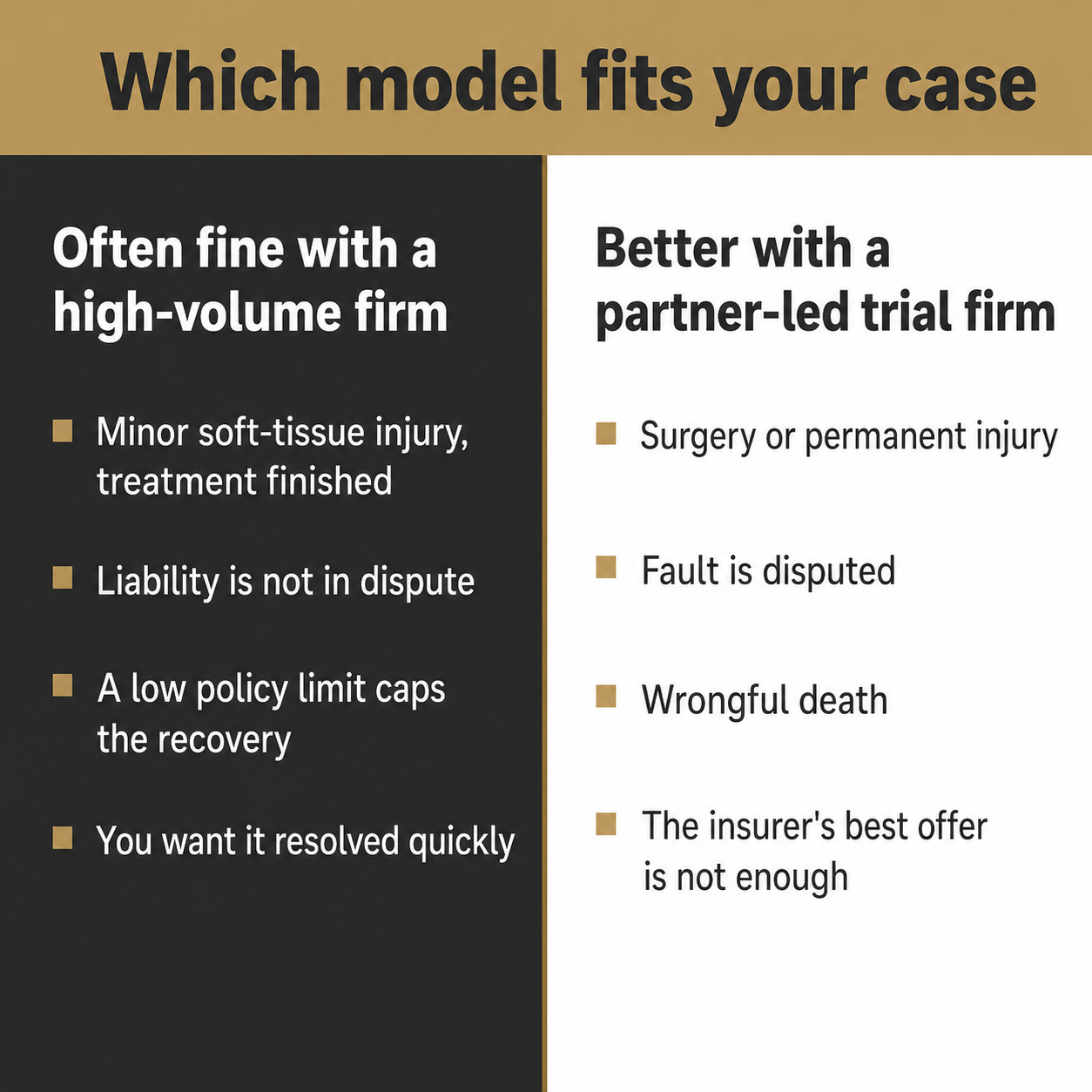
- Soft tissue injuries that resolve after a few months of treatment, where the medical picture is not in dispute.
- Clear liability. You were rear-ended at a red light, the police report is clean, and nobody is arguing about who caused the crash.
- A policy limit low enough to cap the recovery no matter who handles the file. If the at-fault driver carries $25,000 in coverage and your damages run past it, litigation cannot create money that does not exist.
- You want the case over. Some people, for good reasons, would rather have a check in three months than a larger check in two years.
There is also an access argument, and it is a fair one. A firm that prepares every case for trial cannot carry an unlimited number of files, so our intake is selective and we do turn cases down. The scholarship makes that point directly: economies of scale let high-volume firms take on smaller claims that litigation-focused firms decline. Large regional firms also hold deeper reserves for mass tort and multi-party corporate litigation, where expenses can run into six figures before anyone sees a settlement.
When a smaller, partner-led firm is the better choice
The case for a smaller firm rests on two things you can verify: who does the work, and what the firm does when an insurer’s best offer is not enough. Both matter most where the most money is at stake, which means catastrophic injuries, disputed-fault crashes, and wrongful death claims.
At our firm, the partner you meet in the consultation is the attorney who works the file, appears in court, and takes your calls. We prepare every case for trial from the day we open it, and that preparation sets the value of the case long before anyone talks about settling.
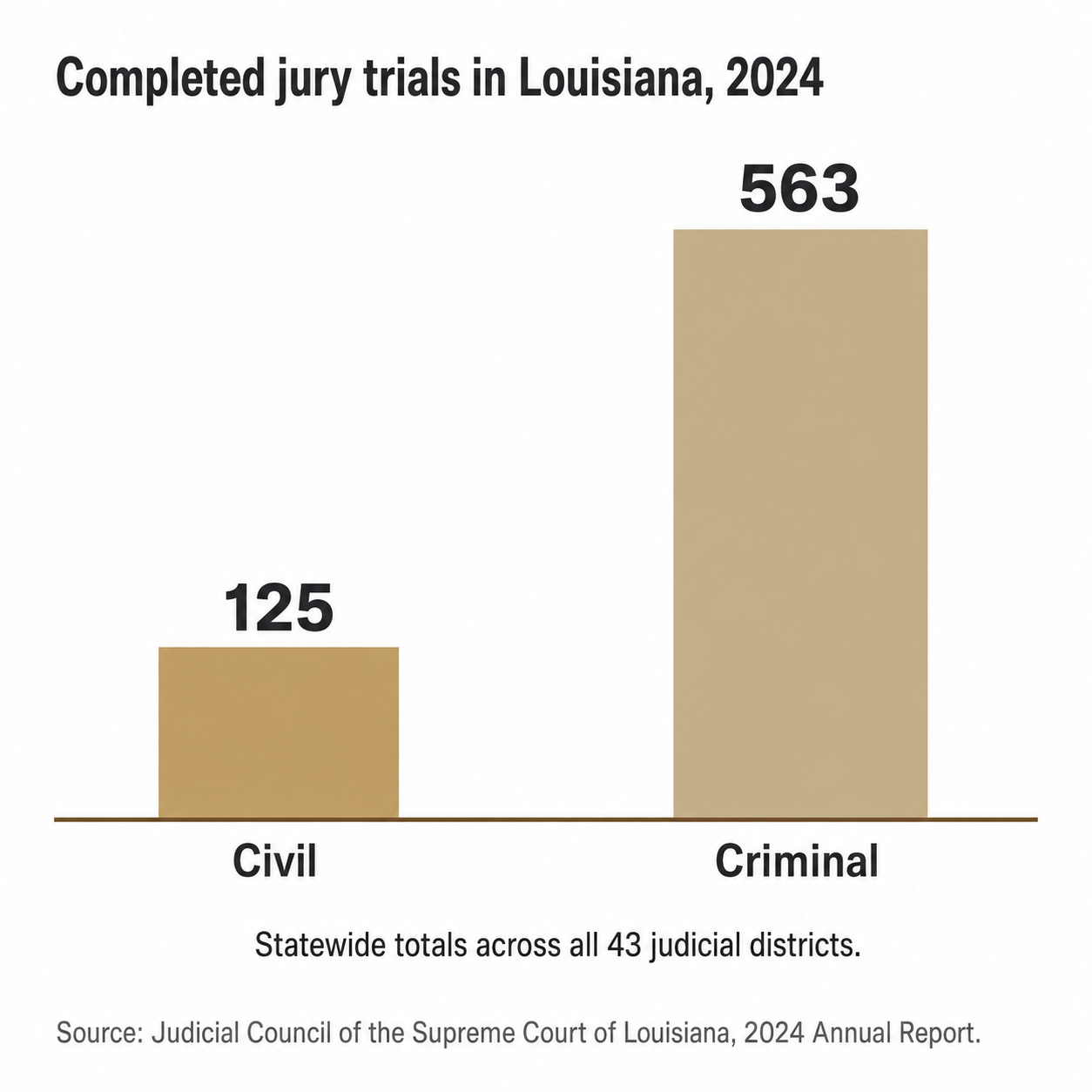
Trial experience is rarer than the advertising suggests. The Judicial Council of the Supreme Court of Louisiana counted 125 completed civil jury trials statewide in 2024, down from 131 in 2023 and 160 in 2022. Spread across Louisiana’s judicial districts, that averages fewer than three civil jury trials per district in a year. Criminal jury trials outnumbered civil ones by more than four to one.
Insurers price claims against what they expect the firm on the other side to do. A 2024 RAND Corporation study built on Verisk insurance claims data found that trial awards in personal injury and wrongful death cases grew faster than inflation from 2010 through 2019, and that the severity of bodily injury claims followed the same pattern. What juries award sets the ceiling on what adjusters offer. In our experience, the file that is visibly ready for trial is the file that draws a serious number.
A $360,000 dog bite verdict after a $100,000 offer
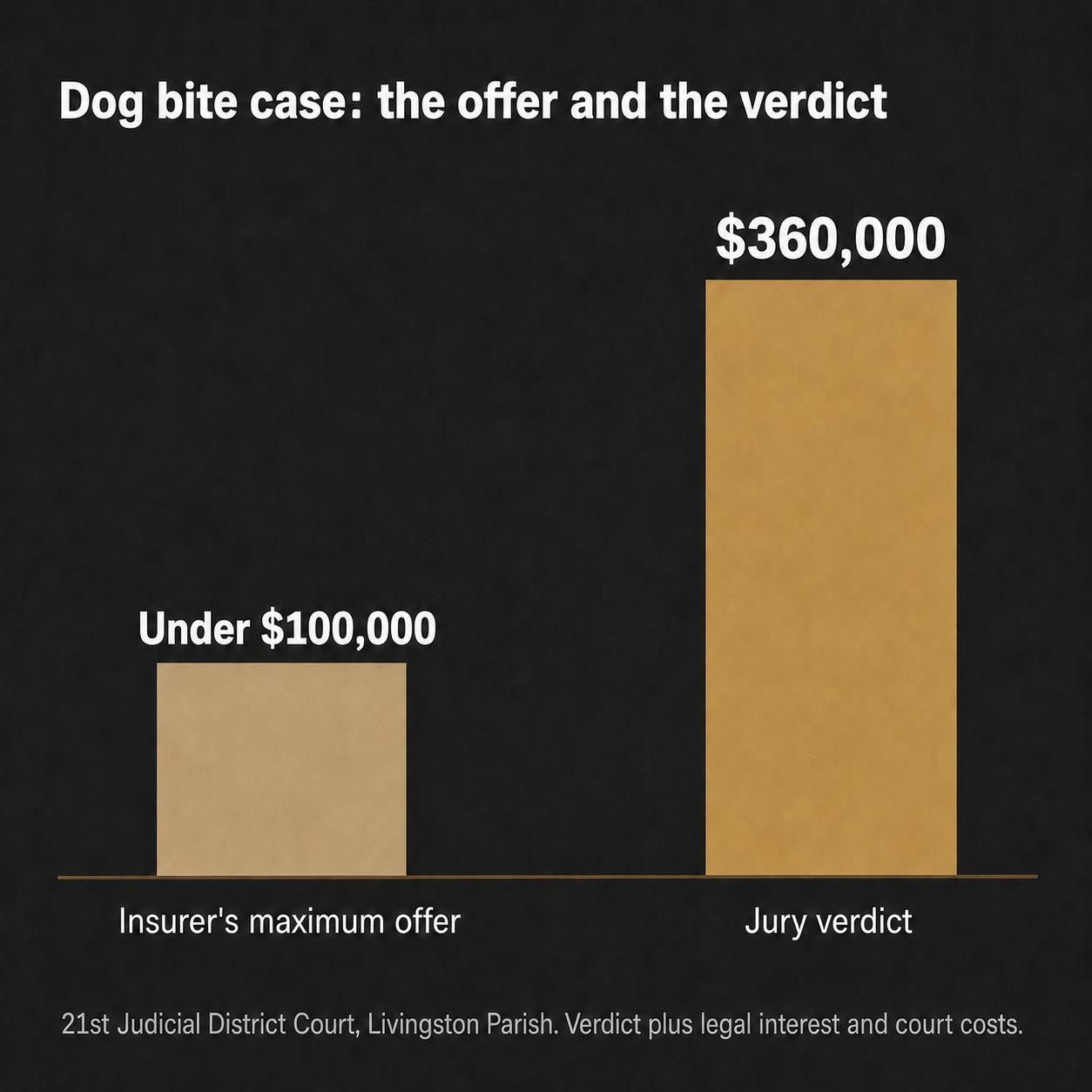
The clearest example in our own results involves a child rather than a car. A neighbor’s dog attacked a child on the face and shoulder during a playdate, after the supervising adult had agreed to keep the dog kenneled. The dog had a known history of aggression toward children in the neighborhood. The insurer’s position was that the dog had been protective and the injuries were overstated, and it would not offer more than $100,000.
We gathered accounts from neighbors about the dog’s history, worked with the child’s plastic surgeons and social workers to document the physical and emotional injuries, refused the offer, and tried the case for a week in the 21st Judicial District Court in Livingston Parish. The jury returned $360,000, more than three and a half times the insurer’s maximum offer, plus legal interest and court costs. That gap came from being willing to put the case in front of a jury.
Does a small firm have the resources to fund a serious injury case?
Yes, if the firm advances case costs and retains experts early. That is the part to ask about. Contingency representation means the firm fronts filing fees, expert fees, medical records, and depositions. We advance all case costs, we charge no interest on the money we advance, and if the case is unsuccessful you owe us nothing.
Here is what that money paid for in three of our cases:
- A truck accident on Airline Highway killed the driver of the car a dump truck struck, and the defense argued the crash was unavoidable given the truck’s weight. We retained experts immediately to secure and analyze the truck’s on-board electronic data collection device, and the data showed the driver had accelerated instead of braking. The insurer tendered its full policy limits and the wrongful death case resolved in two years.
- An air conditioning repairman suffered a permanent eye injury when a pump sprayer hose dislodged and shot pressurized sodium hydroxide into his eye. The manufacturer blamed him for not wearing goggles. We hired product design experts to show the hose connection was defective and separate warnings experts to show the labeling was unreadable, refused the pre-trial offers, and settled for $750,000 on the second day of a scheduled jury trial.
- A rear-end collision client needed low-back fusion surgery, and the insurer’s defense was that the disc problem predated the crash. Building the causation case meant an exhaustive search through years of medical records, which is slow and expensive work. It produced a $1.25 million settlement.
Ask any firm you are considering, ours included, who pays the expert if the case does not settle, and whether that money comes back with interest attached.
Can a small firm handle a large or complex case?
Complexity and duration test a firm’s experience and staying power more than its headcount. Between them, our partners are admitted in all Louisiana state courts, the U.S. District Courts for the Middle, Eastern, and Western Districts of Louisiana, the U.S. Fifth Circuit Court of Appeals, and the U.S. Supreme Court.
Two matters show the range. We filed a class action against a Louisiana homeowner’s insurance company that had charged customers a service fee prohibited by state law, won class certification, and the litigation prompted the Louisiana Commissioner of Insurance to order the fees reimbursed. The $16 million judgment covered roughly 67,000 Louisiana citizens and the case concluded in two years. In a separate commercial matter, we represented the developer of a wireless video surveillance system whose technical designs were taken by public officials working with private competitors. That case ran 13 years, required review of tens of thousands of pages of documents and expert testimony on the value of the stolen technology, and produced millions of dollars in settlements.
Contingency fees at a small firm vs. a large firm
The percentage rarely separates two firms. Contingency rates in Louisiana injury cases sit in a narrow band, and the numbers of a small firm and a large firm quote will usually look similar. The terms around that percentage decide how much you keep:
- Whether case costs come out of the recovery before or after the fee is calculated. On the same gross settlement, deducting costs first leaves the client with more money, so ask the firm to run the math on a sample number.
- Whether the firm charges interest on the costs it advances. Some practices finance case expenses through credit lines and pass those charges along to the client.
- What you owe if the case is lost. Owing no attorney fee is standard. Whether out-of-pocket expenses are also forgiven is a contract term, so read it before you sign.
Our structure is one-third of the recovery if no lawsuit is filed and 40% if a lawsuit is filed, with all case costs advanced by us, no interest on those costs, and nothing owed if we do not win. Our general practice is that the client takes home more than the firm does.
Louisiana’s 51% comparative fault rule and your choice of lawyer
Louisiana changed how shared fault works on January 1, 2026. Under Act 15 of the 2025 regular session, which amended La. Civ. Code art. 2323, an injured person found 51% or more at fault recovers nothing. Below that line, the recovery is reduced by the percentage of fault assigned. The rule applies based on the date of the incident rather than the date you file, and courts must now instruct juries on what crossing the 51% threshold does to a claim.
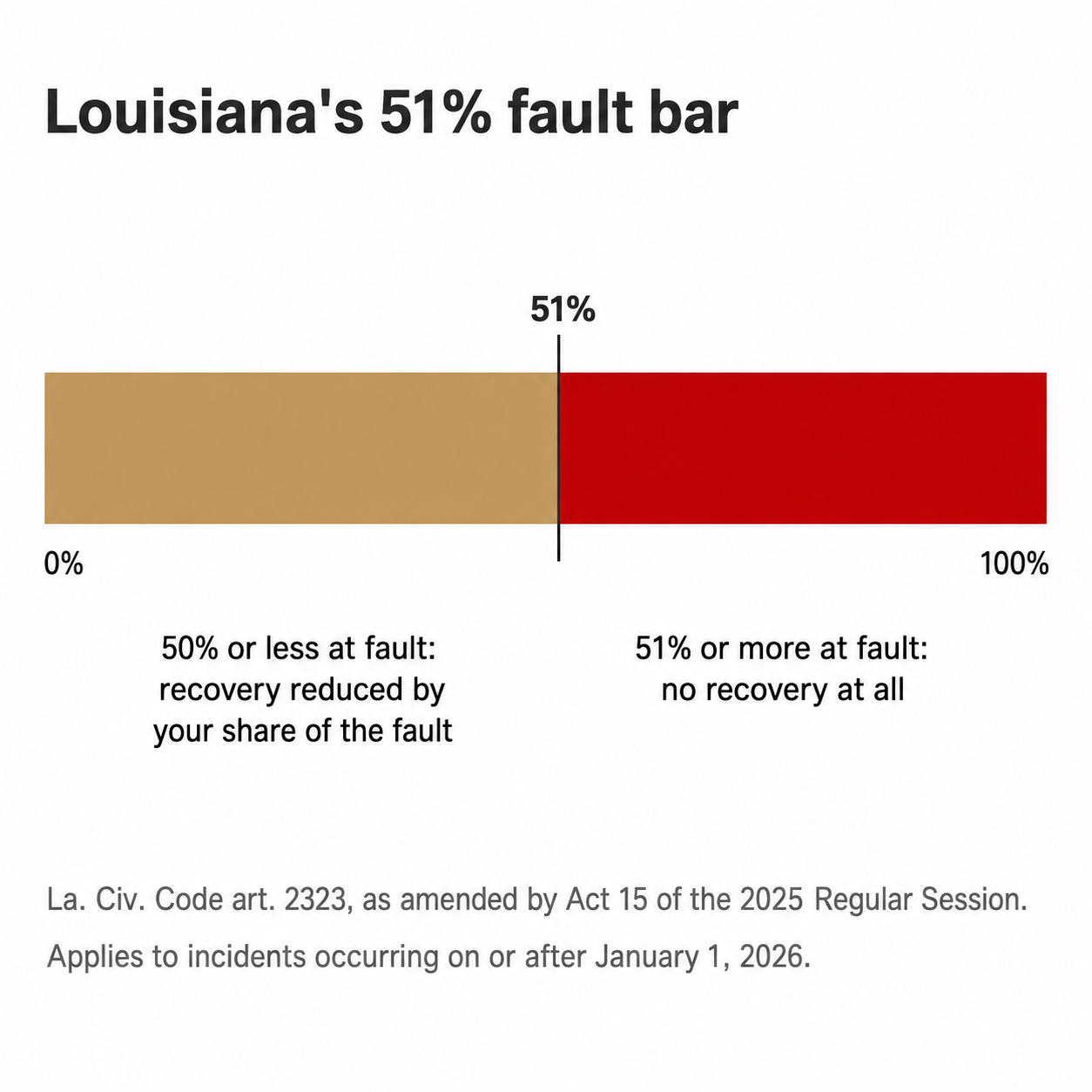
That gives insurance carriers a reason to fight about fault instead of arguing about medical bills. Under the old rule, blaming you reduced what a carrier had to pay. Under the new one, pushing you past 51% can end the claim entirely. So ask any firm you talk to how it handles a comparative fault defense, and whether it has taken one to a jury.
We have. In a car accident case in the 19th Judicial District Court for East Baton Rouge Parish, a driver pulled out of a private driveway into our clients’ right of way and injured a husband and wife. The insurer’s defense attorneys argued our clients had been speeding. We prepared the case for trial from the filing, and the judge granted our motion for a directed verdict dismissing the comparative fault claim for lack of evidence. The five-day jury trial ended in a verdict of more than $1 million for the couple.
One more deadline worth knowing: Louisiana gives you two years to file for injuries on or after July 1, 2024 under La. Civ. Code art. 3493.1, and one year for injuries before that date. Wrongful death claims run on a separate clock, one year from the death or two years from the injury, whichever is longer. Our overview of Louisiana personal injury laws covers the general rules and how they apply.
Five questions to ask before you sign
These are specific to the size question. Ask them in every consultation, ours included, and compare the answers side by side.
| Ask this | What a clear answer sounds like |
| Who personally handles my file, and who signs my fee agreement? | One named attorney, and the same name in both answers. |
| Who appears in court for me if we file suit? | A specific name, and ideally that attorney is sitting with you during the consultation. |
| When did this firm last try an injury case to a jury verdict, and in which court? | A case, a year, and a courthouse. “We settle nearly everything” is also an answer, and a useful one. |
| Do you advance case costs, and do you charge interest on them? | Yes to advancing, no to interest, and both terms written into the agreement. |
| Are case costs deducted before or after your fee is calculated? | A direct answer, with the math shown on a sample settlement figure. |
If a firm cannot answer the trial question with a case and a court, you have learned something useful about how your case is likely to be valued.
Talk with one of our partners
If you are comparing firms after a crash, a fall, or the death of someone in your family, we will give you a straight read on what your case needs, including whether it needs a firm like ours. The consultation is free, we advance the costs, and you owe us nothing unless we win. Call us at (225) 303-0455 or send us your information through our consultation form, and one of the three partners will talk with you directly. We handle cases throughout the greater Baton Rouge area, including St. George, Port Allen, Zachary, and Denham Springs.